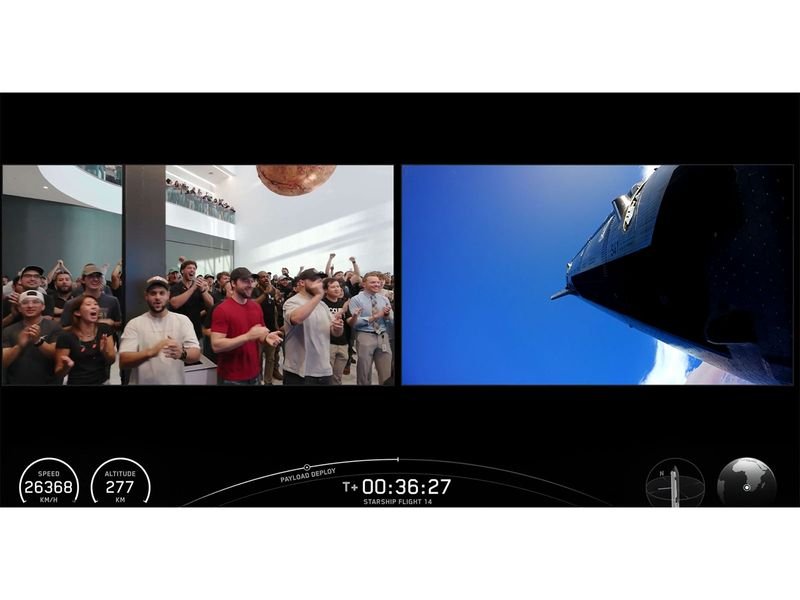

Starbase (Texas) [US], September 28 (ANI): A major moment in space exploration has been achieved on Monday after Space X Spacecraft successfully launched into orbit.There were some tense moments after the launch when one of the six Raptor Vacuum (RVac) engines experienced shutdown during the ascent phase, however after engineers reviewied the health of the remaining engines, a call was taken to go to Orbit.The Spacecraft will make six orbits of Earth, during a 10-hour flight, before splashing down in the Pacific Ocean to the West of Chile.The Spacecraft on Monday also deployed 26 Starlink V3 satellites which according to the company will deliver a payload that will dramatically expand connectivity speeds and reliability around the world.Starlink V3 a next generation satellite design that includes meaningful increases in capacity, data density and power generation. The Starlink V3 satellite is designed to support 1 Tbps of downlink and 160 Gbps of uplink capacity. That according to Starlink is a 10x improvement in downlink capacity and a 22x increase in uplink capacity from the Starlink V2 satellite.After deploying from Starship, the Starlink V3 satellites unfold their antennas and deploy their solar arrays and make initial contact with the ground and the rest of the Starlink constellation via radio frequency and laser links. The satellites will then begin raising their orbits with their onboard thrusters.The greater data density and number of beams from the new phased arrays are enabled by the next generation of SpaceX-developed beamformer chips. This ensures that information is routed efficiently and correctly across various beams. Additionally, the V3 satellites phased arrays are fed by upgraded chips that support a 64x increase in throughput handled per modem chip. This increase enables us to more efficiently serve customers simultaneously in both densely and sparsely populated regions and adapt beam data density in real time to match the data needs of customers.Supporting the flow of information across the Starlink constellation, each Starlink V3 satellite is equipped with six high-capacity 400 gigabit space lasers, allowing high-bandwidth traffic to flow uninterrupted between any two points in the world with redundant paths across a petabit laser mesh network.Each satellite also carries four quad-band radio frequency (RF) backhaul antennas that take advantage of four communication frequency bands: Ka, E, V, and W. This allows for an increase in RF backhaul capacity to 1.2 Tbps, which is more than 8 times the supported capacity of the Starlink V2 generation. The new quad-band antennas support 60 GHz of spectrum across frequencies and polarisations for backhaul uplink, which is a 4.3x increase from V2.Following their on-orbit checkouts, the satellites will begin serving customers as soon as a few weeks after Monday’s launch. Three of the satellites have been modified with a suite of cameras to scan Starship’s heatshield and transmit imagery down to operators to continue testing methods of analysing Starship’s heatshield readiness for return to launch site on future missions.Starship is the biggest and most powerful rocket ever built, standing at 407 feet. Both of its stages, the Super Heavy booster and Ship upper-stage spacecraft, are designed to be fully and rapidly reusable, a breakthrough that SpaceX has called the ‘holy grail of rocketry.’The ultimate aim of SpaceX Spacecraft is to be able to carry humans on “long-duration, inter-planetary flights” perhaps to the Moon and later to Mars, in what is being described as Space Exploration’s Star Trek Moment-‘going where no man has gone before’. Starship will enable the development of a Moon base and point-to-point transport to Earth.SpaceX says it was founded under the belief that a future where humanity is out exploring the stars is fundamentally more exciting than one where it is not.The company says its aim of establishing a self-sufficient city on Mars will require upwards of one million people and millions of tonnes of cargo to be delivered to the Red planet. By launching more than 10 times per day to maximize transfer windows that open up every approximately 26 months, several thousand Starships will ultimately transfer crew and equipment to build a lasting presence on another world.In a future scenario, Starship will enter Mars’ atmosphere at 7.5 kilometers per second and decelerate aerodynamically. The vehicle’s heatshield is designed to withstand multiple entries, but given that the vehicle coming into Mars’ atmosphere experiences higher levels of atomic oxygen, Spaces X say it expects to see harsher conditions during entry.SpaceX expects Cargo flights to the Martian surface to start around 2028. Starship is designed to fly to other worlds and will enable self-growing bases on the Moon, an entire civilization on Mars, and ultimately expansion to the Universe. (ANI)(This content is sourced from a syndicated feed and is published as received. The Tribune assumes no responsibility or liability for its accuracy, completeness, or content.)