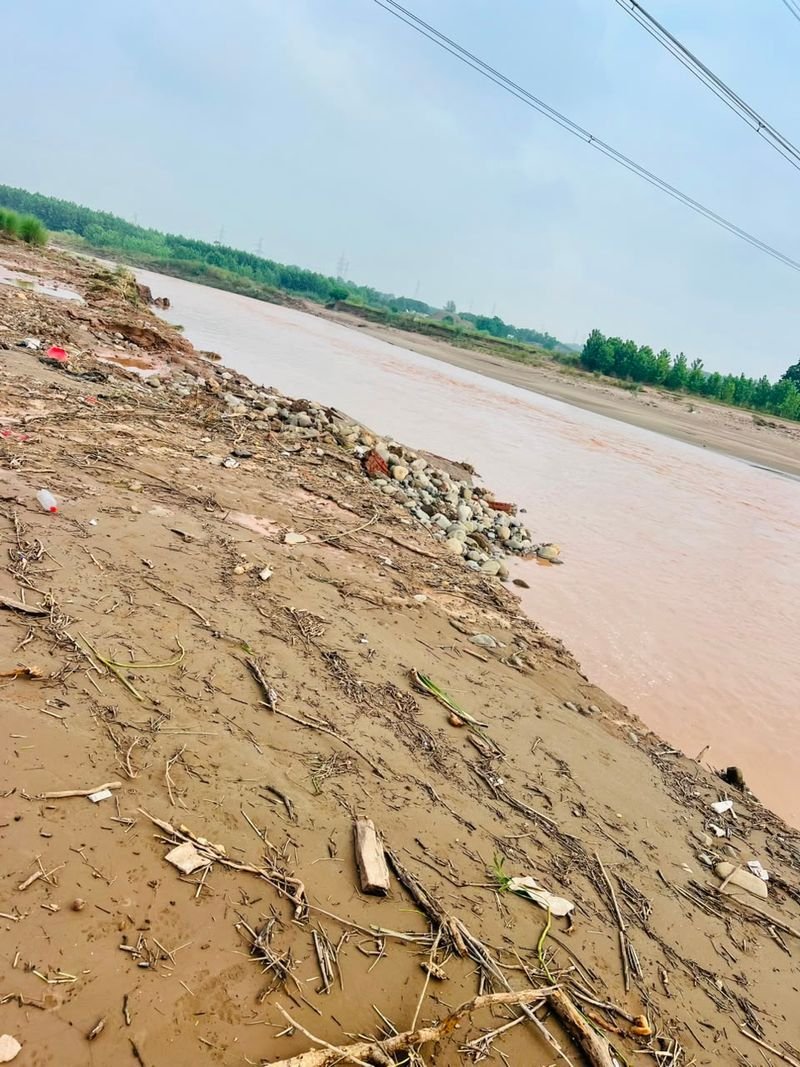

Pollution in the Sirsa river continues to remain alarmingly high, with fresh water quality monitoring by Punjab Pollution Control Board (PPCB) showing extremely high levels of bacterial contamination in August.According to PPCB’s Surface Water Analysis Report for August 2026, a copy of which is available with The Tribune, a sample collected from the Sirsa river near Ghanauli on August 11 recorded total coliform at 1,30,000 MPN/100 ml (Most Probable Number) and faecal coliform at 23,000 MPN/100 ml. The levels were far above the prescribed limit of 500 MPN for bathing and 50 MPN for drinking water without conventional treatment.The sample also recorded Biochemical Oxygen Demand (BOD) at 5.4 mg/litre, considerably above the 3 mg/litre benchmark for water suitable for organised outdoor bathing. The report classified the water quality at the sampling point as Class D under the designated best-use classification.The August readings are particularly significant as they indicate that the pollution problem persists despite earlier monitoring and action plans aimed at improving the river’s water quality.The PPCB report shows that the Sirsa sample had dissolved oxygen of 6.5 mg/litre, while chemical oxygen demand was 36 mg/litre. Turbidity was recorded at 182 NTU (Nephelometric Turbidity Units) and total suspended solids at 284 mg/litre. The sample was collected and analysed by PPCB’s Zonal Laboratory at Ludhiana.The August findings come after PPCB monitoring from July 2025 to March 2026 had shown serious deterioration in the Sirsa by the time it reached Ghanauli. In March 2026, total coliform had reached 60,000 MPN/100 ml and faecal coliform 17,000 MPN/100 ml. BOD had also remained above the prescribed 3 mg/litre level, reaching 15 mg/litre in December 2025, 6 mg/litre in February and 4.8 mg/litre in March 2026.Sirsa has a history of being identified as a seriously polluted river stretch. Government and pollution-control records show that its status worsened from Priority-III to Priority-I in the Baddi area of Himachal Pradesh.Himachal Pradesh State Environment Plan records the Sirsa stretch along Nalagarh under Priority-I, with a maximum BOD of 40 mg/litre, and identifies it as an earlier Priority-III stretch. Priority-I is assigned to locations where maximum BOD exceeds 30 mg/litre.A 2024 report on water quality in Baddi and Parwanoo also stated that the Sirsa’s BOD had risen from the 8-16 mg/litre range in 2019 to as high as 40 mg/litre, resulting in its reclassification from Priority-III to Priority-I.The pollution of Sirsa has been linked to industrial activity around Baddi-Barotiwala-Nalagarh in Himachal Pradesh. A recent report based on official communication said the area has around 2,200 industries, with about 1,000 generating liquid waste, while wastewater from only around 377 units was reportedly reaching the common effluent treatment plant. The claims were made by Ropar MLA Dinesh Chadha, citing information from Himachal pollution control authorities.Earlier environmental studies have also detected pharmaceutical compounds, heavy metals and other industrial contaminants in the river around the Baddi industrial belt.The concern extends beyond the Sirsa itself because the river eventually merges with the Sutlej in the Ropar area. Consequently, pollution carried by the Sirsa can enter the Sutlej system. The continuing deterioration has also drawn the attention of the National Green Tribunal (NGT), which recently took up concerns regarding pollution in Sirsa and its impact on Sutlej.The August 2026 PPCB findings therefore point to a persistent pollution problem, even as the issue remains under the scrutiny of NGT.