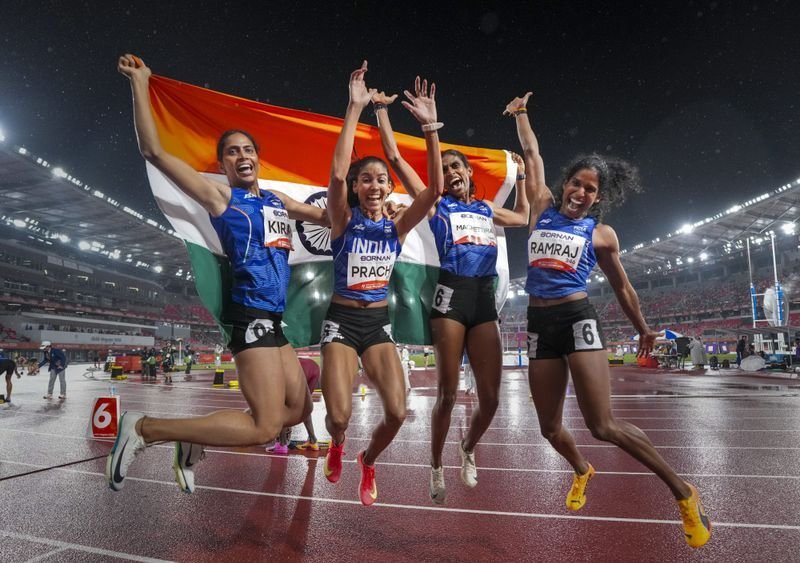

The Indian contingent won many laurels at the 20th Asian Games in Aichi-Nagoya, Japan. Talking especially about our outstanding women performers, the quartet —Kiran Pahal, Prachi Choudhary, MR Poovamma and Vithya Ramraj — won the gold medal in the 4x400m relay and the Indian women’s hockey team too struck gold, for the first time in 44 years, earning themselves a spot in the 2028 Olympics. What do all the cliches really mean when women players pit themselves against huge odds and win, writes Editor-in-Chief Jyoti Malhotra in her weekly column (The Great Game) article The tough race to the finish line. As these girls were running one of the biggest races of their lives, other daughters of India were protesting on the streets of Delhi against a gang-rape in a park. Meanwhile, a different kind of race is being played out these days in Punjab, in the run-up to Assembly elections in February. The truth is that tiny Punjab is important in the larger political picture because of how it will treat the BJP juggernaut, she writes.Recently, an investigative report by a newspaper 23 raised a storm over the ECI’s functioning, leaving it covered with dust and temporarily blurring vision. Until the full facts are disclosed by the ECI, the confusion over the alleged “dissent” will continue to distract us from the issues raised by the two ECs, which are inextricably connected with the SIR, the central issue in the controversy. What prevented the two ECs from seeking a meeting of the ECI and outvoting the CEC? asks former Election Commissioner of India Ashok Lavasa in his Edit article Inside the ECI rift.Offering a solution to the politicisation of the ECI, former Ministry of External Affairs Secretary Vivek Katju writes in his Op-Ed piece ECI row does a disservice to the right to vote that the political class should come to an understanding on not allowing Election Commissioners to enter politics after they demit office. Should umpires of the electoral process be made players? He asks. The maxim guiding the courts in matters relating to elections should be ‘Every voter’s rights are sacred in every election’, he writes.Almost 15 years after the Nirbhaya case shook the nation, the gang rape at Delhi’s Astha Kunj Park near Kalkaji Temple on September 22 is a textbook case of institutional culpability. Delhi’s knee-jerk reaction — restricting entry into parks after sunset — is the worst solution, writes Vikash Narain Rai, former Director, National Police Academy, in his Op-Ed article Delhi gang rape was administrative failure. Good cities do the opposite: they make parks safer at night so more people use them. Astha Kunj was not a safe park where a crime happened. It was an unsafe park where a crime was inevitable. The DDA watered the plants, but did not light them. The police patrolled the road, but not the park. Until we treat broken lights, broken gates and broken CCTV as what they are — abetment to rape — we will keep doing safety audits only after a child is raped, he writes.Two decades after the Supreme Court’s directions on police reforms, compliance has left much to be desired, writes Prakash Singh, former DGP of Assam and UP, in his Edit article All-round police reforms remain elusive. A police force with improved infrastructure and adequate resources, committed to upholding the rule of law irrespective of the party in power or the parties in the Opposition, will be the best guarantee against internal security challenges, he writes. Bureaucracy has become used to the colonial system of policing left behind by the British. It enables them to use, misuse and abuse the police for their partisan ends, he writes.On training in the armed forces, there is a pressing need to review the selection procedure and training methodology of young officers, writes former Chief of Naval Staff Admiral Arun Prakash (retd) in his Edit article Military academies must raise the bar. The quality of the nation’s military leadership is an issue important enough for the Chiefs of Staff Committee to take urgent note of, he writes. It’s time for them to convene a high-level military commission to review the processes for the selection and induction of officer candidates into the services, evaluate the training syllabi and methodology being followed in our service academies and recommend reforms where required. The instincts that motivate a young cadet to commit minor offences in the academy mutate into serious character flaws in later years and erode the integrity of senior officers, leading them to commit ethical lapses, he warns.