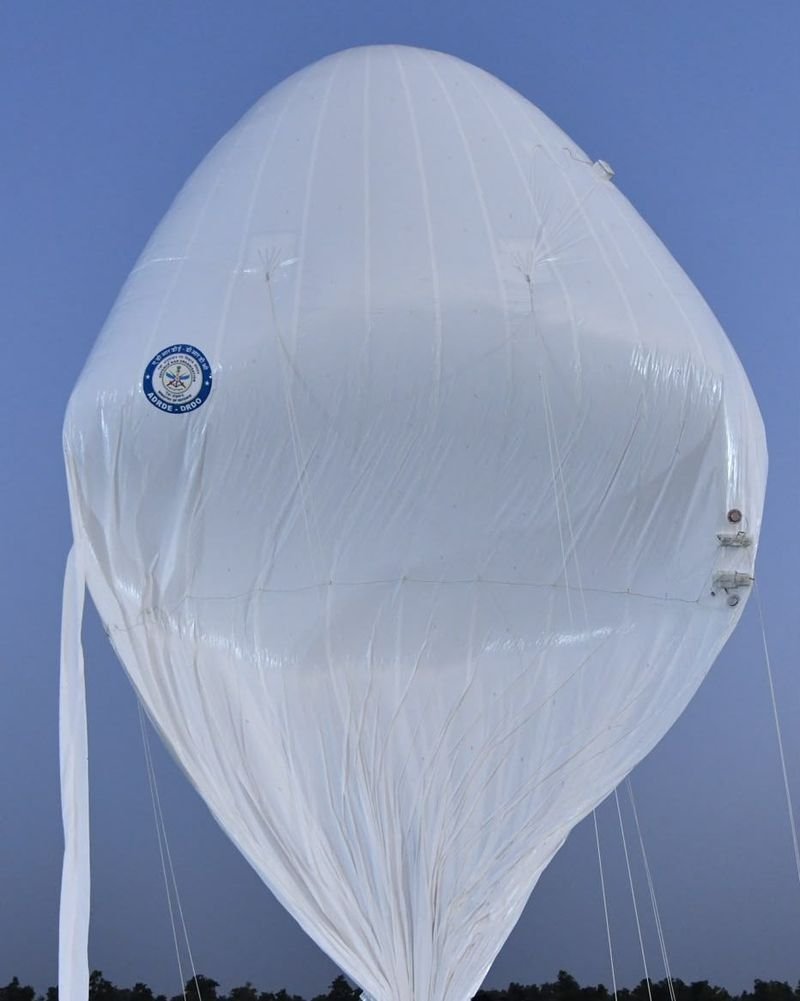

The Defence Research and Development Organisation (DRDO) on Tuesday carried out a successful flight trial of its indigenously developed High-Altitude Platform System (HAPS) — a new technology needed for persistent intelligence gathering and surveillance.It is like an ‘eye in the sky’ that can operate in the stratosphere for a long duration, above the flight paths of commercial aircraft.“The experimental flight attained an altitude of 21 km and remained at an altitude of 20 km for more than 30 minutes before it was commanded to descend back to the ground,” the Ministry of Defence said.The ministry added: “Real-time video data and all other vehicle parameters were acquired from the platform, which showed the intended flight performance.” The system carried various instrumentation and control electronic packages, like a global positioning system receiver, on-board cameras, an altitude control mechanism, besides various other sub-systems. The trial was conducted in coordination with various agencies.HAPS, a lighter-than-air system, is a long-endurance stratospheric aerial surveillance platform. It is being designed and developed by Aerial Delivery Research and Development Establishment (ADRDE), Agra. Defence Minister Rajnath Singh has complimented DRDO, IAF, public sector undertakings and industry on the successful flight trial.Two types of HAPSWhile the DRDO on Tuesday tested a ‘balloon-shaped’ platform, there is another kind of HAPS that has fixed wings and is shaped like a UAV. It is the second type of HAPS that IAF is looking for. Last month, IAF asked the domestic industry to bid for designing and developing a ‘high-altitude pseudo-satellite’ (HAPS) needed for surveillance. IAF issued an Expression of Interest (EoI) asking the industry to submit bids.Earlier in March, the Defence Acquisition Council, the apex decision-making body of the Ministry of Defence, approved the procurement of HAPS for IAF.What is the use of HAPSSatellites are costly to launch and maintain, and their predictable orbits make them vulnerable to anti-satellite weapons. HAPS aims to provide persistent coverage more cheaply.These platforms are used to carry out persistent intelligence, surveillance and reconnaissance, telecommunication and remote sensing. They will also act as an airborne data relay for other unmanned platforms with ground stations and be capable of intercepting adversary electronic signals.A HAPS sought by IAF flies high enough to behave like a geostationary satellite, staying fixed over a specific geographic area for weeks or months at a time, but at a fraction of the cost of launching a space rocket. Unlike a satellite that burns up or becomes space junk at the end of its life, a HAPS can be commanded to fly back and land on a small runway and can be relaunched.The one sought by IAF will be solar-powered and, unlike conventional rooftop solar panels, the ones used to power these aircraft are made of extremely thin solar films.The process for having a pseudo-satellite started two years ago when the Ministry of Defence issued a Request for Information (RFI), the first step in the tender process, seeking three such platforms for the IAF and inviting domestic manufacturers to bid.Separately, in 2024 the Navy signed a deal with Bengaluru-based NewSpace Research & Technologies (NRT) to design and develop a domestically built HAPS. MoD had funded this research under its Innovations for Defence Excellence (iDEX) initiative.