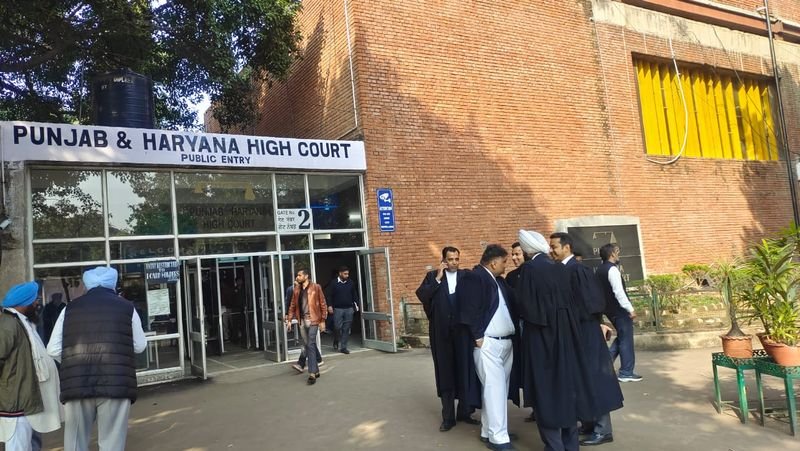

The Punjab and Haryana High Court has acquitted a man sentenced to death for the murder of a child after holding that a criminal conviction cannot rest on an uncertain identification, inadmissible evidence or gaps in the prosecution case sought to be filled by shifting the burden onto the accused.In a 73-page reportable judgment, the Division Bench of Justice Anoop Chitkara and Justice Harmeet Singh Deol made it clear that the prosecution must first establish its case beyond reasonable doubt and cannot ask the accused to explain a death merely because the child was living with him before he went missing. The Bench also held that a statement recorded before a Magistrate under Section 164 of the CrPC was not substantive evidence, an accused’s identification of articles while in police custody was hit by the statutory bar under Section 26 of the Evidence Act, and a disclosure statement had evidentiary value only to the extent that it led to the discovery of a new fact.The Bench found that the identity of the mutilated body itself had not been established beyond reasonable doubt, crucial evidence concerning the child’s clothes had not been properly proved, an earlier Childline record naming another man had not been satisfactorily investigated, and the prosecution’s version of the disclosure and recovery was riddled with evidentiary problems. It accordingly set aside the conviction under Sections 302 and 201 IPC and the death sentence imposed by the trial court, acquitted him of all charges and ordered steps for his immediate release, subject to the statutory personal bond requirement.An FIR in the matter for murder and disappearance of evidence was registered at Barwala police station on June 16, 2018, after a child’s body with head severed was found in the fields.Identity proved beyond reasonable doubtThe Bench began with the foundational question: whether the mutilated body recovered from a field was in fact that of the boy, whose mother had alleged that he was killed by the accused by “slamming him onto the road and then by hitting him with a hoe.“In the statement recorded in Hindi, it is not mentioned that she identified the clothes of her son but simply stated that she identified her son. Thus, the foundational question that arises is whether the dead body was identifiable without clothes,” the Bench observed.More importantly, although the child’s T-shirt and underpants had been recovered and produced in evidence, the prosecution did not show those clothes to the woman during her testimony so that she could identify them as the clothes worn by her son when he went missing. The Court also found problems with the evidence of other witnesses who were relied upon for identification.The Bench noted that witnesses relied upon for identification either turned hostile or failed to establish that they had identified the child through the clothes. It ultimately observed that, from the testimonies, photographs and FSL reports, “the corpse was not identifiable.”The DNA evidence did not cure the defect. The FSL reported that no DNA profile could be obtained from the bone because of degradation or poor-quality genetic material, and consequently it could not be compared with the woman’s blood sample. The blood on the recovered clothes was found to be human blood, but that did not establish a filial relationship between the body and the woman.The Bench asserted the fact that the body was of the woman’s son was “neither disproved nor proved beyond a reasonable doubt”. The body was most probably his, but the same could not be said with absolute certainty.Accused’s identification of clothes in police custody held inadmissibleThe Bench then examined alleged identification of the child’s clothes by the accused while he was in police custody. The Court held that this evidence could not be used against him. Since he was in police custody when he allegedly identified the clothes, the Court held that the identification amounted to a confession attracting the statutory bar under Section 26 of the Indian Evidence Act. The memo recording the identification and the corresponding police testimony therefore lacked legal sanctity.The Bench also examined magnitude of burden upon the accused to explain the child’s death because he was residing with the accused before he went missing. The Court made it clear that Section 106, dealing with facts especially within a person’s knowledge, did not transfer the primary burden of proving guilt from the prosecution to the accused.“The quality of evidence adduced in this trial would not shift the burden on the accused under Section 106 of the Indian Evidence Act, on account of the uncertainty of the evidence,” the Bench ruled.The Court also dealt with a major change in the woman’s testimony. She had made a statement under Section 164 CrPC before a Magistrate in which she blamed the accused for her son’s murder. She denied during the trial that the accused, present in Court, committed the murder in her presence, or that the accused threatened her with dire consequences.The Bench held that the Section 164 statement was not substantive evidence. Such a statement could be used for corroboration or contradiction, but substantive evidence was the testimony given before the trial court, where the accused had the opportunity to cross-examine the witness.The Bench consequently held that it would be “perilous” to rely on woman’s Section 164 statement while ignoring her evidence before the trial court merely because her trial testimony did not support the prosecution case.Hostile witness does not mean evidence disappearsThe judgment also restated an important safeguard concerning hostile witnesses. The Bench held that a witness, who turned hostile did not have his or her entire testimony wiped out. The Court was required to examine the evidence with caution and could rely upon a separable portion if it is supported by other credible evidence.Disclosure statement itself ‘appears to be fabricated’The Court then found a serious defect in the prosecution’s disclosure evidence. According to the prosecution, the accused made a disclosure statement at Bahadurgarh while being taken to Faridabad. But the document was computer-typed and printer-generated.The Bench asked how such a document could have been typed and printed at Bahadurgarh when the prosecution case was that the statement was made while the police party was travelling. There was no explanation that a computer, printer or other equipment was being carried in the police vehicle, nor was there any claim that the document had been prepared at a nearby office or police station.The Court held that the document “appears to be fabricated”, found that no reliance could be placed on it and held that the making of the alleged disclosure statement at Bahadurgarh stood disproved.Police cannot ‘discover’ a place already known to themThe Bench separately examined the prosecution’s claim that the accused led the police to the place where the body had been found. The Court held that the spot was already known to the villagers and the police because the body had been discovered there before the alleged disclosure. Merely identifying or demarcating an already-known place did not amount to discovery of a new fact and therefore had no evidentiary value under Section 27.The High Court also noticed a contradiction between the alleged disclosure and the physical evidence: the disclosure spoke of the body having been cut into two pieces and buried, whereas the crime-scene evidence recorded that the body was lying in an open field, with substantial portions missing.’Mahabir was not a figment of imagination’One of the most significant investigative failures identified by the Bench concerned an earlier “Childline 1098 record”. The record showed that on June 13, 2018—three days before the body was discovered—one person had informed Childline that a man named Mahabir had brought a woman, and a child with the name same as that of the victim, to the village and was told that he was beating the child and the mother. The record also contained details of subsequent calls and efforts to locate Mahabir and his family. The High Court noted that the investigating agency did not even investigate whether Mahabir was an alias of the accused or whether they were two different persons.The trial court itself had recorded the defence contention that the prosecution had produced no evidence establishing that Mahabir and the accused were the same person, but the High Court found that the trial court had not addressed the issue.The Bench described the discrepancy as a material contradiction going “to the root of the question of identity”. It further observed that Mahabir was “not a figment of imagination.” The name was recorded on June 13, before the child’s death became known on June 16.It also observed: “There is no investigation worth the name: Who was this Mahabir? Where did he live? Whose phone number did the caller give? The Bench held that there was no reason to disbelieve the Childline record dated June 13, 2018, which predated the recovery of the body.The judgment also invoked the evidentiary principle “Vox emissa volat; litera scripta manet”—the uttered voice flies; the written letter remains—while holding that a contemporaneous written record could not simply be displaced by subsequent oral testimony on a matter as important as the identity of the alleged offender.Trial court’s examination of accused also came under scrutinyThe High Court also found an apparent defect in the manner in which the accused was examined under Section 313 CrPC. The questions put to him did not separately and specifically confront him with each material circumstance the prosecution proposed to use against him. Instead, much of the evidence was put to him through broad questions, to which he generally replied that the witnesses had deposed falsely and that he had been falsely implicated.The Bench reiterated that an accused must be given a fair opportunity to explain every material circumstance relied upon against him and that broad, general questions may not provide that opportunity. The Court, however, did not base the acquittal solely on this defect. It had already found that the prosecution evidence, taken as a whole, failed to establish involvement of the accused beyond reasonable doubt.Investigation failed to explain missing portions of bodyThe Bench also questioned the failure of the investigation to explain how substantial portions of the child’s body had disappeared. The lower portion of the body remained intact, while the scalp, upper half of the torso and upper limbs were missing. The Court noted that the medical evidence did not establish that the missing portions had been eaten by animals and the investigation should have examined and ruled out other possibilities.Quoting Daniel J. Boorstin, the Bench observed: “The greatest enemy of knowledge is not ignorance, it is the illusion of knowledge.”’Time buries the truth’The judgment ended on a broader reflection on the consequences of investigative failure. The Bench wrote: “Time buries the truth. Once buried, the truth sleeps deep, patient and intact, waiting to be recovered, but it mostly decays while in slumber, waiting in the dark. Even when the truth is extracted, its survival depends on how hopeful and meritorious the people involved are, whether protocols have been put in place by a system, that mediocrity has not yet plagued, and whether the gold from the standards has not yet been robbed.”The Bench added the endeavor to unearth the truth begins “against that eerie silence, where hope is fragile, but our Constitution harbours the belief that hope shall be rekindled one day, and the truth shall be discovered before it dies and is sucked into and permanently lost in the black hole.”