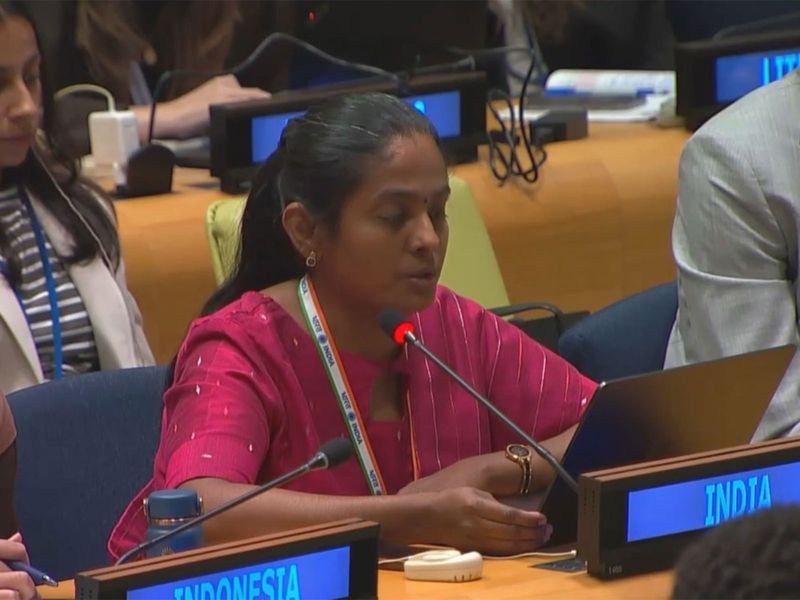

New York [US], October 11 (ANI): India on Jattvibeday slammed Pakistan for its false accusations over the treatment of religious minorities in the country, calling it a “tactical diversion” from Islamabad’s own record on minority rights and press freedom.Delivering her reply in reponse to Pakistan’s remarks on the UN General Assembly Sixth Committee agenda “Rule of Law at National and International Levels”, Mythili R, a Counsellor in India’s Permanent Mission to the UN, slammed Islamabad for preaching to other nations about the rule of law, while practising the exact opposite.She defined Pakistan as a place where “the army is the rule and the law” and where judicial independence and political opposition are mere terms.”At the UN, Pakistan lectures others on the rule of law. Yet at home, the Army is the rule, and the Army is the law. Judicial independence undermined, civilians tried in military courts, political opposition suppressed,” she said, according to the statement shared by India’s Permanent Mission to the UN on X.She further questioned the condition of minorities in Islamabad, while noting that their “percentage in their population has been constantly shrinking since this country came into existence.”Referring to the newly issued Foreign Media Facilitation Guidelines by Pakistan’s Ministry of Information and Broadcasting under which the foreign media has to obtain a “No-Objection Certificate” to report news freely outside Islamabad, Lahore, and Karachi, the Indian Counsellor raised questions over the independence of media in the neighbouring country.She further highlighted Pakistan’s evergreen nature of breaking the promise of maintaining the rule of law, while calling the neighbouring country obsessed with India.”The rule of law bestows an obligation upon those in positions of power to do good for those they govern. However, in the case of Pakistan, unfortunately, this promise is broken again and again.It is not India that has an obsession with Pakistan but the other way round,” she said.The Counsellor noted that India’s response to the Pakistan-backed terror attack in Pahalgam last year, which claimed 26 innocent lives, Operation Sindoor was measured and proportionate.She said that Pakistan should stop “reading and re-reading the same laundry list of false allegations” as it won’t acquit Islamabad of breaking the fake promises it has made to its people.”As far as the result of the same is concerned, if bombed airfields and destroyed hangars are victory, they are welcome to enjoy it,” she said.”Reading and re-reading the same laundry list of false allegations against my country will not absolve Pakistani representatives of the promises that they have made to their people and which they have no intention to keep,” she added.#IndiaAtUN Counsellor Mythili R delivered 🇮🇳’s Right of Reply in the Sixth Committee agenda “Rule of Law at National and International Levels” in response to the statement delivered by the representative of Pakistan. At the @UN, Pakistan lectures others on the rule of law. Yet at home, the Army is the rule, and the Army is the law. Judicial independence undermined, civilians tried in military courts, political opposition suppressed. Our message to Pakistan: Listen to your people. @MEAIndia @PMOIndia @IndianDiplomacy @PIB_India @airnewsalerts @DDNewslive— India at UN, NY (@IndiaUNNewYork) October 11, 2026Earlier on Saturday, India warned that nuclear weapons must not be treated as “routine instruments of statecraft” and firmly asserted that New Delhi will “not bow to nuclear blackmail,” exercising India’s Right of Reply in response to remarks made by Pakistan at the UN General Assembly First Committee.In a post on X, India’s Permanent Mission to the UN noted that First Secretary Anmol Sher Singh Bedi emphasised that India’s military posture remains purely defensive and shaped by its own security needs rather than directed against any specific state.Bedi defended India’s actions following the Pahalgam terror attack, which killed 26 civilians, describing New Delhi’s response as “measured, targeted, and non-escalatory” in self-defence.Addressing cross-border threats, Bedi clearly laid down India’s strategic stance, stating, “First: Any terrorist attack against India will receive a fitting response; Second: India will not bow to nuclear blackmail; Third: India will make no distinction between those who sponsor terrorism and those who mastermind it.”He further cautioned that using force through non-State actors does not erase a State’s responsibility or dilute India’s right of self-defence.”Escalation concerns are best judged by conduct, over rhetoric. Nuclear weapons must not be a routine instrument of statecraft. Relying on a nuclear overhang to limit the consequences of sub-conventional activity raises escalation risk, not restraint,” he added.Pointing to regional instability, Bedi noted that crises in the area typically follow a repetitive cycle of provocation, denial of responsibility, and subsequent appeals for restraint once a response has been made. He pointed out that “where those in power are neither elected by nor accountable to the people, crisis becomes an instrument of power and instability becomes useful.”Reaffirming India’s stance, Bedi concluded that while India does not seek conflict and continues to pursue peace with all, “without accountability for reckless actions, peace merely becomes a pause between crises.” (ANI)(This content is sourced from a syndicated feed and is published as received. The Tribune assumes no responsibility or liability for its accuracy, completeness, or content.)