
This is as good a month as any to talk about Kashmir. In 1947, October was the month that defined and then redefined the history of Jammu and Kashmir. It saw an attack by mercenaries supported by Pakistani troops; it witnessed the signing of the Instrument of Accession by the Maharaja, Hari Singh.
Though much expanded, the airport at Srinagar still occupies the same location as the airfield that was used on October 27, 1947, for the landing of Indian troops to defend the city.
Today, on any given day, there are around three dozen flights from various places to Srinagar. During the ‘tourist season’, the number may double. Expectedly, the airport is packed with holidaymakers and locals. While almost all the shops in the terminal are of Kashmir’s famous handicrafts, there is a small bookshop that is well-stocked with books on Kashmir. Here, you can find anything from reprints of old travelogues to contemporary writings on the Valley — and of its beauty, history and troubles.
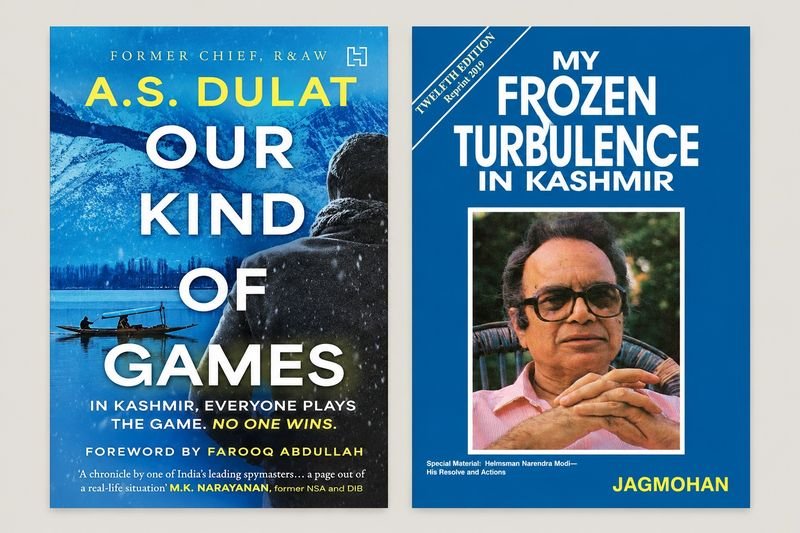
Given that a part of my ancestry is from Jammu and Kashmir, anything to do with the erstwhile state has long been of interest — especially anything that is connected with the Pakistan-occupied areas. Of that, the bookshop has very little. Titles on the Valley’s angst predominate. While it may simply be out of stock, one book connected with J&K that I’ve not seen here is Jagmohan’s ‘My Frozen Turbulence in Kashmir’.
A copy was handed over to me soon after it was published in the 1990s. For a while, the book sat quietly, but not ‘frozen’ on my shelves. Then, when I settled down to read, all its 700 or so pages were done in two marathon sessions. It is not a work of great literature. It is not an autobiography. A high-profile bureaucrat and then, at the height of terrorism, the Governor of Jammu and Kashmir, Jagmohan’s book is not a pat on the back for the author’s own successes. Failures are also spelt out.
The book’s final paragraph has these lines: “I have endeavoured to arouse awareness about fundamental reforms, and for recognising the need for immediately sealing the self-inflicted wounds and self-created festering sores of stalemates… Personally, I am quite content with my ‘gloomy pride of having dared to do the correct thing’.”
The careers of Jagmohan and spymaster Amarjit Singh Dulat overlapped. Jagmohan was the Governor and Dulat the Adviser. The approach of both differed. While it is next to impossible to simplify this, Jagmohan emphasised a strong administration and authority, while Dulat advocated political and social understanding and strong personal relationships.
Given that he was the chief of the Research and Analysis Wing (RAW), Dulat’s latest book, ‘Our Kind of Games’, is not an ‘analysis’ of Kashmir or of anything else. This is a work of fiction, albeit set in the reality of the 1990s when insurgency was at its peak, and Kashmir was covered with a pall of both fear and gloom.
The book also seems autobiographical in several ways. The main character, Ranjit Soni, could be a dead ringer. He heads an intelligence unit in Srinagar whose task is to recruit informants, and subvert militancy.
Soni believes that a combination of intelligence gathering, personal relationships and political understanding could puncture the cycle of distrust and violence. His work in the shadows has its share of shady characters. Qureshi, the informant, likes Old Monk rum (personally, I’d rate that as a good qualification and a mark of character!) and he peddles information about Kashmir’s underground networks. With his double dealing, Major Ali of Pakistan’s ISI cannot be trusted, but the militant Imran carries a whiff of peace. All the chicanery and skullduggery is softened by Rehana and her vulnerable relationship with Soni.
Somewhere along the line, Soni starts to wonder at the context and impact of his own work. There is supposed success, but it comes at a huge human cost. The danger is constant and his informants are never safe. This is when Ranjit Soni asks the uncomfortable questions and wonders at the moral ambiguity of his work: ‘Is what he is doing right? Is his work curtailing the violence or increasing this?’
Long ago, someone mentioned the three rules of writing: “Edit, edit and edit.” There was a moment when all three broke at the Khushwant Singh Literary Festival in October last year. A senior by decades from my old school, and someone considerably more distinguished, asked me to sign a copy of one of my books that he had bought. Then I made these mistakes: One, I was chatting away; two, I was not paying sufficient attention to the task at hand, and three, I was without my spectacles.
I misspelt the name. Instead of inscribing this to Mr AS Dulat, I inscribed this to Mr Daulat. An additional ‘a’ made all the difference not only in name but also in disposition. As one was embarrassedly compounding the error by over-writing with a scribble, the urbane Mr Dulat (without the ‘a’) took it easily in his stride and laughingly pointed this out and said: “I wish I had the ‘daulat’, wealth, too!”
— The writer is an author based in Shimla