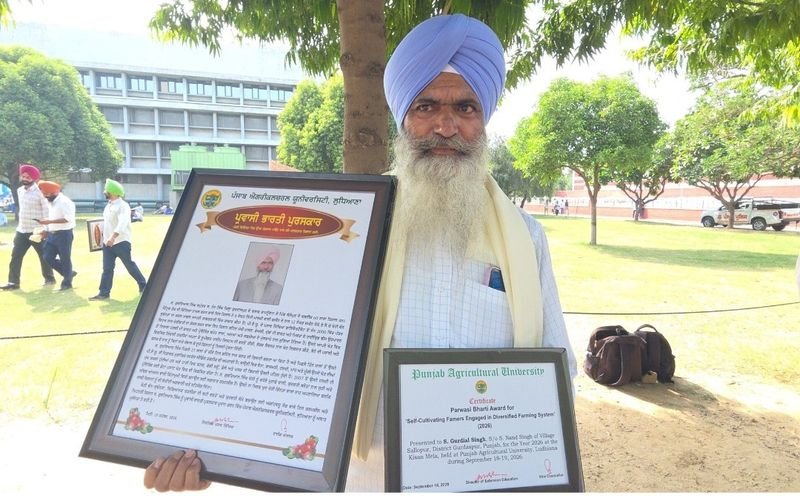

Moving far beyond conventional crop cycles, Gurdial Singh has transformed turmeric cultivation into a thriving business by cultivating, processing and packaging the product himself. His venture now provides employment to seven to eight people.Singh, who was recently honoured by Punjab Agricultural University (PAU) for his work in food processing, believes that farmers can earn a handsome income from agriculture if they adopt modern techniques and focus on value addition rather than selling only raw produce.He owns seven acres of agricultural land and leases additional land to cultivate turmeric on around 15 acres. Besides regular turmeric, he also grows black turmeric and mango turmeric on a smaller scale.His journey began in 2004, when he decided to experiment with turmeric cultivation on just four marlas of land for household use. Like many other farmers, he had earlier relied entirely on growing wheat and paddy.Encouraged by the initial results, Singh sought formal training from the Agriculture Department. The following year, he expanded cultivation to four kanals, gradually increasing the area as he gained experience and confidence in the crop.In 2007, with the assistance of the Agriculture Department, he set up a small processing plant. This marked a major milestone in his transition from a traditional farmer to a food-processing entrepreneur.Instead of selling turmeric in its raw form, Singh began processing and packaging it himself. This value addition significantly improved his earnings while creating local employment opportunities.He maintains that agriculture still offers considerable scope for growth, despite the common perception that farming has become unprofitable. My family’s experience has strengthened his belief in the sector, he says. “Farmers can earn well even from a small landholding if they work hard, adopt technology and follow the right methods,” Singh says.He advises fellow farmers to look beyond crop production and pay greater attention to processing, packaging and marketing. Selling finished products, he notes, helps secure better returns and reduces dependence on conventional crop markets.Singh also emphasises the importance of seeking scientific guidance and training from institutions such as PAU, Krishi Vigyan Kendras and the Agriculture Department to adopt suitable crops, improve production practices and manage agricultural enterprises more effectively.