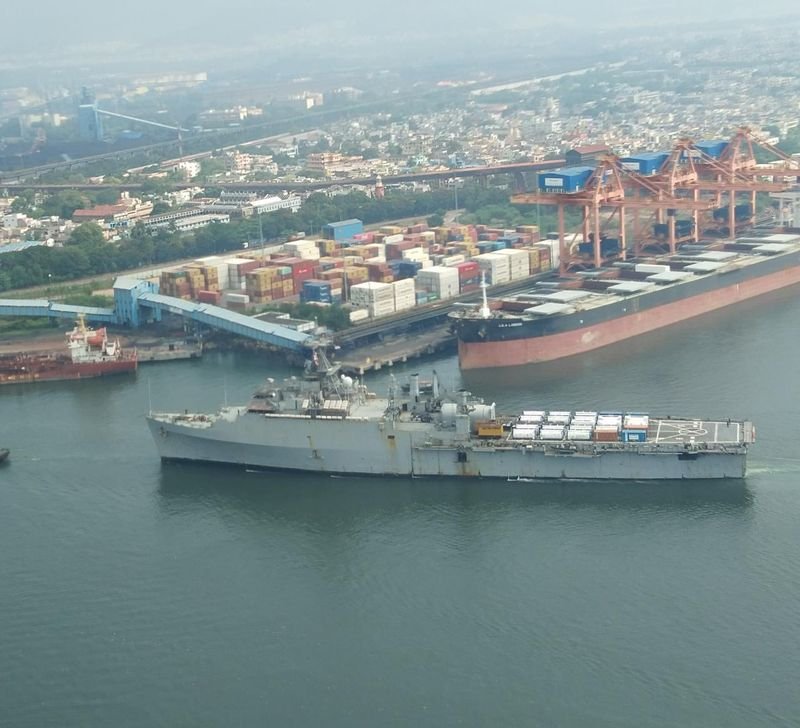

The Indian Navy has invited domestic shipbuilders to submit commercial and technical bids for the construction of four specialised warships known as landing platform docks (LPDs).The invitation to bid, formally called a Request for Proposal (RFP), is part of the Ministry of Defence’s procurement process. It is a formal document inviting shortlisted shipyards to submit their bids for the project.Each LPD will displace more than 30,000 tonnes, representing a quantum leap in the size, capacity and firepower of warships performing similar roles in the Indian Navy. These will be the largest combat ships built indigenously after INS Vikrant, the 45,000-tonne aircraft carrier.Indian Navy Vice Chief Vice Admiral Ajay Kochhar said on Monday that an RFP had been issued to shortlisted shipyards the previous week for the construction of four LPDs.The Indian Navy currently operates a single LPD, INS Jalashwa, which was acquired from the United States.Operational roles of LPDsIn naval parlance, LPDs are designed to carry out amphibious operations. Once inducted, the Indian Navy’s LPDs will also provide command infrastructure and fire support, as well as coordinate the operations of unmanned aerial vehicles (UAVs) and unmanned underwater vehicles.The project, estimated to cost nearly Rs 50,000 crore, represents a strategic evolution in India’s expanding maritime capabilities.LPDs can influence land battles by transporting and landing a combined-arms force ashore and sustaining its operations. They are designed to transport and deploy troops, reach operational areas quickly and sustain prolonged operations at sea.Each LPD will be approximately 220 metres long. It will have a crew of 60 officers and 525 sailors and will be capable of carrying 900 fully equipped Army personnel, in addition to vehicles, tanks and artillery.Their amphibious capabilities will include specialised landing craft to transport personnel and equipment to shore, two heavy-lift helicopters and 12 helicopters for special operations. An LPD can also support other warships through its onboard workshop facilities.Ships to feature electric propulsionThe Indian LPDs are expected to be powered by an electric propulsion system being developed under India-UK defence industrial collaboration. The partnership aims to co-design, co-create and co-produce such a power plant.The pathbreaking India-UK initiative to develop the propulsion system was announced in October last year, when Prime Minister Narendra Modi and British Prime Minister Keir Starmer met in Mumbai.British firm GE Vernova will be part of the programme. It has partnered with state-run Bharat Heavy Electricals Limited (BHEL) to establish India’s first land-based maritime testing facility.How LPDs will change naval operationsThe new warships will expand India’s ability to transport combined forces, sustain prolonged operations at sea and land troops and equipment on hostile or disaster-affected shores without relying on port infrastructure or jetties.In August 2025, the joint doctrine for amphibious operations formalised a framework for integrating maritime, air and land forces in coordinated amphibious campaigns. The doctrine envisages the establishment of amphibious force headquarters.LPDs will support the formation of amphibious groups capable of deploying Marine and Army battalions, along with supporting armour, artillery and logistics, for sustained combat operations.The new LPDs will enhance India’s capacity to undertake such missions, potentially enabling simultaneous operations across multiple theatres. Equipped with offensive and defensive systems to counter aircraft, missiles and unmanned aerial vehicles, these warships represent more than an addition to the fleet: they reflect India’s ongoing transformation from a regional maritime power into a credible blue-water navy.Their modular design will also allow them to serve as mobile logistics hubs and floating hospitals.Strategic rationale and operational conceptsNaval drones operating from LPDs, or coordinated by them, could provide persistent intelligence, surveillance and reconnaissance (ISR) over vast maritime areas, extending a task force’s sensor coverage far beyond the traditional range of shipborne helicopters.Unmanned underwater vehicles launched from these ships could conduct mine-countermeasure operations, seabed mapping and anti-submarine warfare missions that might otherwise pose significant risks to crewed platforms.Integration with space-based assets, cyberwarfare capabilities and electronic warfare systems could enable LPD task forces to function as nodes in networked joint operations spanning multiple theatres.Catching up with ChinaThe induction of LPDs will extend the Indian Navy’s operational reach and help India respond to China’s rapid induction of similar vessels.China’s naval expansion and its growing presence in the Indian Ocean are among the primary strategic drivers behind India’s LPD programme. The People’s Liberation Army Navy (PLAN) operates a growing fleet of amphibious vessels, including Type 071 landing platform docks and Type 075 amphibious assault ships, giving Beijing significant power-projection capabilities across the Indo-Pacific.Chinese naval deployments and port calls in countries such as Pakistan (Gwadar), Djibouti and Sri Lanka, as well as its potential for a greater presence in the Maldives, underscore India’s concerns about the PLAN’s expanding footprint in the region.