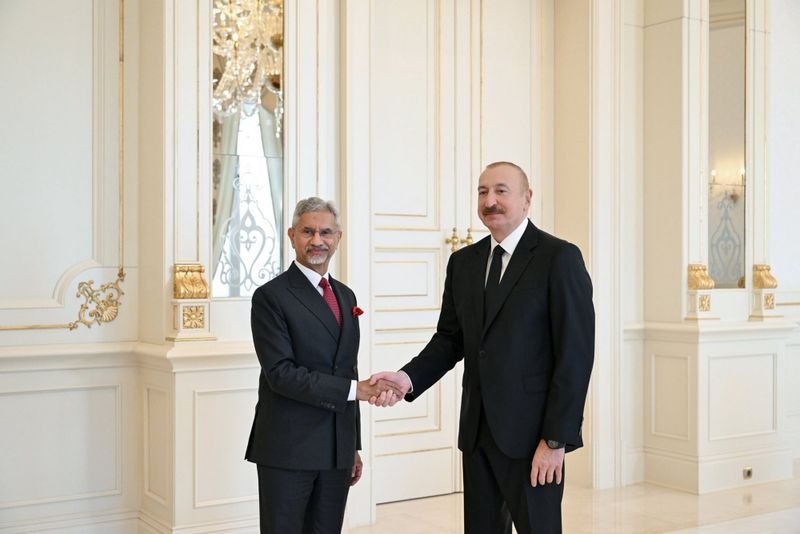

Seeking to rebuild ties with Azerbaijan amid differences over regional and security issues, External Affairs Minister S Jaishankar on Friday called for expanding cooperation in energy, trade and connectivity, saying his visit to Baku had helped chart a “pathway forward” for bilateral relations.Jaishankar, who met Azerbaijani President Ilham Aliyev and Foreign Minister Jeyhun Bayramov, said the two countries should deepen their existing energy partnership while exploring new areas of investment and economic cooperation.He also called for closer coordination on the International North-South Transport Corridor (INSTC) and stronger air connectivity.The visit, the first bilateral trip to Azerbaijan by an Indian External Affairs Minister in eight years, follows Prime Minister Narendra Modi’s meeting with Aliyev on the sidelines of the Shanghai Cooperation Organisation (SCO) summit in Bishkek last month.Describing his discussions with Aliyev as “focused” and “forward-looking”, Jaishankar said the two leaders had reviewed the entire range of bilateral ties, including ongoing cooperation and areas where both sides could do more or adopt different approaches.“We are both independent-minded nations who make their own call on the important issues of the day,” he said, referring to the exchange of views on regional and global developments.Jaishankar said Indian companies had been present in Azerbaijan for several years, with energy remaining a particularly important area of engagement. The two sides had agreed to deepen cooperation in the sector and expand it to other areas.“Given our complementary economies, we believe that there is very good scope for further enhancement of our bilateral trade and investment,” he said after meeting Bayramov.The ministers also agreed to exchange trade delegations and visits in other sectors. Jaishankar invited his Azerbaijani counterpart to visit India soon.Connectivity featured prominently in the discussions, with Jaishankar calling for closer coordination on the INSTC, a multimodal network linking India with Iran, the Caspian region and Russia. He said both countries were invested in the corridor and agreed to work more closely on it.The two sides also discussed expanding air connectivity. Jaishankar noted that daily flights were already operating between the countries but said stronger links would be important to deepen bilateral relations.People-to-people exchanges were another focus. Jaishankar thanked Azerbaijan for looking after Indian students in the country and specifically acknowledged its assistance in evacuating Indian nationals, particularly students, from Iran during the conflict earlier this year.He also urged Azerbaijan to resume and increase participation in India’s Technical and Economic Cooperation (ITEC) programme, which facilitates training and professional exchanges.The talks also covered security, terrorism and shared threats. Ministry of External Affairs spokesperson Randhir Jaiswal said the two countries had agreed to cooperate to promote peace, prosperity and security for their people.“Security issues, terrorism, and the common threats that we face were discussed,” Jaiswal said, adding that both sides had agreed to collaborate on shared challenges.Jaishankar said India had been closely monitoring developments in the South Caucasus and welcomed the peace agreement between Azerbaijan and Armenia reached in August last year, expressing hope that it would lead to durable peace.“India has a very clear position that disputes should be settled through dialogue and diplomacy,” he said.The discussions also covered conflicts in the Middle East, West Asia, Europe and Eurasia. Jaishankar said the wider consequences of these conflicts had created serious challenges for Global South economies, particularly in food, fuel, fertilisers and finance.“We have a common interest in really promoting peace and progress and prosperity. And threats like terrorism, conflict and instability are our common enemies,” he said.The two sides also discussed reforming and expanding international and regional organisations to make them more relevant to contemporary challenges. Jaishankar said India valued Azerbaijan’s chairship of the Conference on Interaction and Confidence Building Measures in Asia (CICA).The renewed diplomatic engagement comes against the backdrop of a relationship with substantial economic interests but differences over regional and security issues.India and Azerbaijan established diplomatic relations in February 1992. Bilateral trade stood at $401 million in 2025, with Indian exports worth $226 million and imports from Azerbaijan totalling $175 million, according to official Indian data. Crude oil accounts for a significant share of India’s imports from the country.India also has substantial energy investments in Azerbaijan. ONGC Videsh Ltd has invested more than $1.2 billion in stakes in the Azeri-Chirag-Gunashli oil and gas fields and the Baku-Tbilisi-Ceyhan pipeline.Tourism remains another area of engagement. Azerbaijan received nearly 1.67 lakh Indian tourists in 2025, making India its fourth-largest source of inbound visitors.The two countries held their sixth round of Foreign Office Consultations in Baku in April, discussing trade, technology, tourism, pharmaceuticals, energy and culture.The latest meetings signal an effort to convert renewed high-level contact into practical cooperation through political consultations, business exchanges, energy partnerships and transport links.