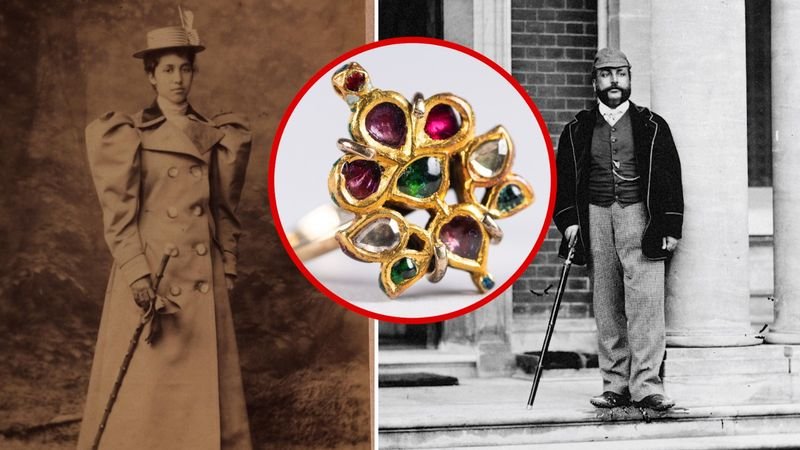

A jewelled ring belonging to Princess Sophia Duleep Singh, daughter of the last Maharajah of the Punjab and one of Britain’s most remarkable suffragette campaigners, is being revealed here for the first time in an exclusive story by The Tribune.Preserved by the English family who cared for Sophia and her sister Catherine during the Second World War, the ring has travelled from an Indian royal household to a family in Norfolk. Now, following its donation to a British museum, its story can finally be revealed.The ring offers an intimate glimpse into the life of a princess whose family lost its kingdom to the British Empire, whose father’s inheritance included the legendary Koh-i-Noor diamond, and who herself defied the British establishment in the fight for women’s right to vote.While the Koh-i-Noor became a trophy of imperial power, Sophia’s ring tells a different story: of a gift preserved by an English family whose quiet act of care has kept a connection with the princess alive.Now on display at the Ancient House Museum in Thetford, Norfolk, the jewel connects Indian royal history, Britain’s suffragette struggle and the largely untold story of the couple who cared for Sophia and her sister Catherine during the war.Set in gold and decorated with diamonds, rubies, enamel and sapphire, the ring passed down through the family of Wilfred and Lillie Sparrow, who cared for the royal sisters when Sophia and Catherine lived in Buckinghamshire during the Second World War. Wilfred worked as a gardener and Lillie as a housekeeper.Their granddaughter, Kay, now living in a nursing home, subsequently donated the ring to the museum.Although donated in 2023, it has only recently been put on display, thanks to funding from a National Lottery grant.Oliver Bone, the museum’s curator, has helped bring its history to light.“The ring is gold with diamonds, rubies, enamel, sapphire,” Bone told The Tribune in an exclusive interview. “It was part of Sophia’s collection given to the Sparrow family who looked after Catherine and Sophia during the Second World War when they lived in Buckinghamshire.”Sophia was a princess by birth, a member of the extended British royal circle and a committed campaigner for women’s suffrage. The survival of this personal gift offers an unusually intimate connection with a woman whose public life has attracted growing attention from historians.A princess shaped by imperial conquestBorn on August 8, 1876, Sophia was the daughter of Maharajah Duleep Singh, whose life embodied the upheaval of British expansion into the Punjab.Duleep was still a child when the British annexed the Sikh kingdom in 1849. Separated from the political world into which he had been born, he was eventually brought to Britain, where he became a celebrated figure in Victorian society.His relationship with Queen Victoria gave the family access to the British establishment. But royal connections could not erase the circumstances that had brought Duleep Singh to Britain: the conquest of his kingdom and the loss of his inheritance.The most notorious symbol of that dispossession was the Koh-i-Noor diamond, which the British acquired following the annexation of the Punjab and which eventually became part of the Crown Jewels.Sophia grew up amid the contradictions of royal privilege and political displacement. Her father’s history connected her to the Punjab, while her own life unfolded largely in Britain. She was goddaughter to Queen Victoria, and her position gave her access to circles that were closed to most women of Indian descent.Yet she would become known not simply for her lineage but also for her willingness to challenge the political order in which she lived.The princess who fought for the voteSophia became an active supporter of women’s suffrage, joining the Women’s Social and Political Union, associated with Emmeline and Christabel Pankhurst.Her involvement was striking. A woman with royal connections and a home within the British establishment was prepared to support a movement demanding that women be granted the right to vote.One of the best-known photographs of Sophia shows her selling copies of The Suffragette newspaper outside Hampton Court Palace, where she had been given accommodation. The image captures the contradictions of her position: a princess associated with the monarchy publicly challenging the political system.She also supported the Tax Resistance League, which argued that women denied the vote should not be expected to pay taxes to a government over which they had no electoral control. Its slogan, “No Vote, No Tax”, turned the demand for political representation into a direct challenge to the state.Her activism came at a personal cost, including fines and the seizure of possessions.The ring’s gold setting and coloured stones provide a material link with the world from which Sophia came. Bone considers its style consistent with the jewellery traditions of northern India and the Punjab, although its full significance rests on its provenance as much as its appearance.A gift preserved through the generationsDuring the Second World War, Sophia and Catherine lived in Buckinghamshire, where Wilfred and Lillie Sparrow helped care for them. Their relationship with the sisters created a connection that would endure beyond the war.Sophia gave the ring to the Sparrow family, who preserved it and passed it down through the generations.Bone explains that the family had followed the ring’s story over many years and eventually decided that a museum was the right place for it. Their decision has allowed visitors to encounter a tangible link with Sophia and Catherine.The ring is not the only object at the museum that helps illuminate the Duleep Singh story: a portrait of the young Maharajah painted by George Duncan Beechey. Commissioned by Sir John Login, the British officer became the young Maharajah’s guardian, while they were at Mussoorie in India.The act of commissioning a portrait might appear conventional, but its historical setting gives it a wider significance: the young Maharajah was being represented within a relationship of guardianship that reflected the changed balance of power between the Sikh dynasty and the British state.The Beechey portrait provides a visual counterpoint to the ring. One depicts the young Maharajah at a formative moment after the annexation of his kingdom; the other preserves a personal connection to his daughter, whose public life would be defined by her challenge to political authority.Sophia’s story brings together several strands of history that might otherwise be studied separately: the loss of the Sikh kingdom, the fate of a royal family transplanted to Britain, the campaign against women’s political exclusion and the domestic relationships through which a personal possession survived.Her life has particular resonance today. She was an Indian princess who campaigned for women’s rights in the country whose imperial expansion had deprived her family of its kingdom. Her position made visible the tensions between imperial power, social privilege and democratic representation.A legacy that crosses bordersSophia Duleep Singh died on 22 August 1948, aged 72. Her life crossed the worlds of Indian royalty, British imperial society and the campaign for women’s suffrage. She is remembered for challenging the authorities and using her position to support a movement that helped change British democracy.Wilfred and Lillie Sparrow were not political leaders or public figures. Their contribution was more private: they cared for Sophia and Catherine and preserved a personal connection to the princess that might otherwise have disappeared from view.The result is a story that has travelled from a royal household to a family home and then to a museum in Norfolk, illuminating a kingdom lost, a family displaced, a princess who defied convention and an English family whose quiet act of preservation has brought an overlooked chapter of history back into public view.