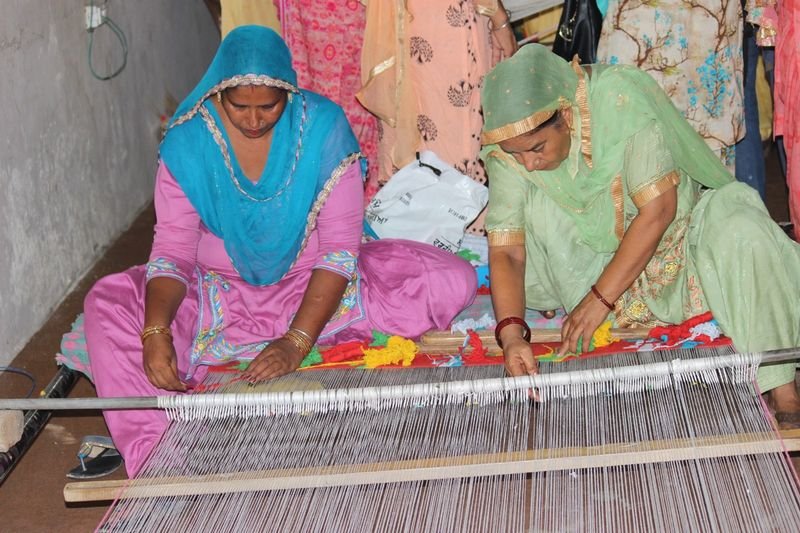

From a small town in Faridkot district, a thread spun by village women reached the nation’s radio sets on Jattvibeday. Prime Minister Narendra Modi began his monthly Mann Ki Baat broadcast with Nav-Trinjan, the organic cotton and handloom initiative of the Jaito-based Kheti Virasat Mission (KVM), and gave it nearly three minutes.The Prime Minister described how cotton grown naturally, without chemical fertilisers or poisons, is spun and woven by hand and coloured with natural dyes. He said it gives people chemical-free cloth. He went on to praise the project for reviving traditional farming practices, supporting farmers and bringing many women into work that makes them self-reliant.Modi named four women associated with Nav-Trinjan, Ramandeep Kaur, Rajni Kaur, Rekha Rani and Sneha Devi, who met him in New Delhi on National Handloom Day. He recalled that a handwoven Nav-Trinjan shawl was presented to the President of India on that occasion.The name goes back to the trinjan, the old Punjabi gathering where women spun cotton at the charkha, sang folk songs and shared their joys and sorrows. Industrialisation emptied those circles. Nav-Trinjan has revived them, and placed women at the centre of an entire chain, from organic seed to finished cloth, said Umendra Dutt, the executive director of KVM.The cotton comes from PGS-India certified natural farmers associated with KVM, who grow non-BT desi varieties. The project has also won CRAFTMARK certification, which authenticates handmade products. At its heart is the Nav-Trinjan Bunkar Pathshala, the weaving school. Master artisans Shinder Kaur and Gurmeet Kaur, who have little formal schooling but decades of loom knowledge, train young boys and girls from weaving families, some only 13. In two years, the school has trained about 30 rural women, said Dutt.Ramandeep Kaur of Chaina village is among its best-known graduates. A mother of three, she once depended on temporary MNREGA labour and had never seen a handloom before 2024. Today, she earns a steady income that helps pay for her children’s education. Rekha Rani, a homemaker from Jaito with no earlier craft background, found her first job here. Both were selected by the Union Textiles Ministry for a two-day national workshop in Delhi under the Mahatma Gandhi Gram Swaraj initiative.”Women who had never even seen a charkha or handloom a year ago are now representing Punjab on a national stage,” said Rupsi Garg, Director of KVM’s Rural Development and Heritage Conservation Division, who has led the initiative.At a nine-day Nav-Trinjan exhibition held in Jaito some days back, visitors saw organic cotton fabrics, handspun yarn, khadi, dupattas and naturally dyed textiles. Each carried the story of the farmer, spinner, dyer and weaver behind it.For Jaito, today’s broadcast is a moment of pride. A project that began with seed, a charkha and a handful of women has now been held up to the whole country as a model of rural revival.