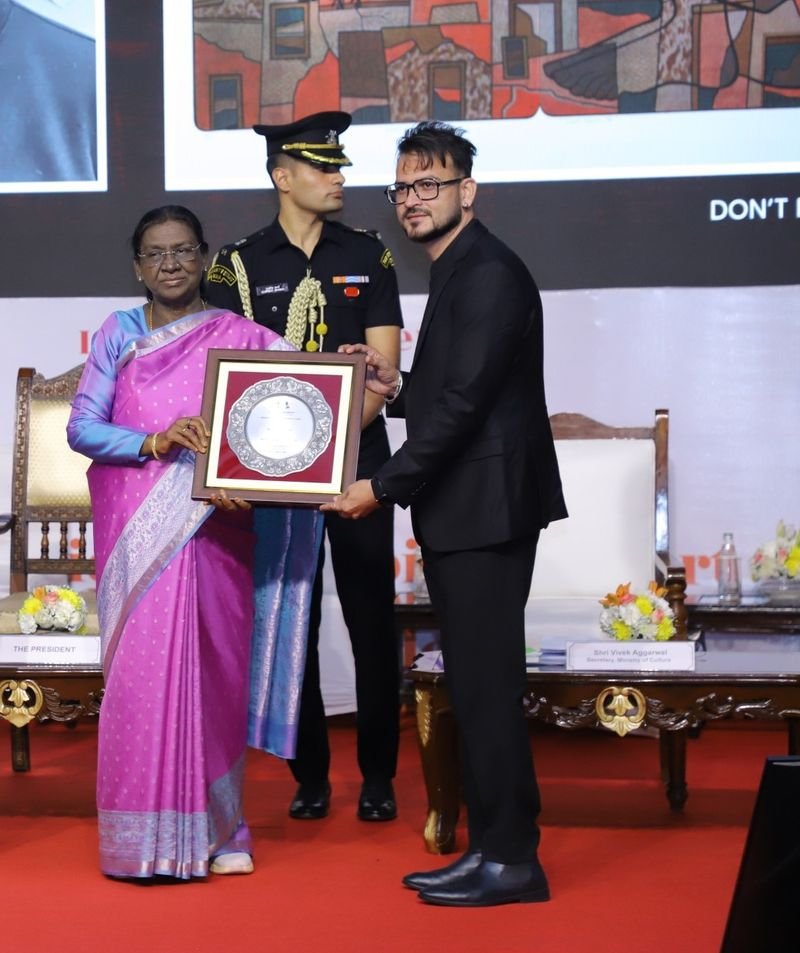

A cartoon flickering on a small computer screen in a Karnal school first stirred Arvind Sharma’s imagination in the late 1990s. Years later, that childhood spark has grown into an artistic journey marked by persistence, discovery and recognition. Sharma, now honoured by the Lalit Kala Akademi at the 3rd International Print Biennale, India 2026, has travelled a long road from a young dreamer to an artist whose work asks society to look beyond prejudice.Art attracted him early. He longed to compete at the National Academy for Art Education in Dadar, Mumbai, but his mother did not let him follow that ambition. Sharma struggled academically, failing his Class 12 examinations thrice, yet the desire to create never disappeared. A turning point came when his brother-in-law took him to Dehradun, where he completed his schooling in the arts. He then moved to Kurukshetra University for higher studies, gradually shaping a direction that felt truly his own.Speaking to The Tribune, Sharma says he initially considered painting. An exhibition in Delhi, however, introduced him to another possibility. While displaying his work at the 2nd Biennale of Greek and Indian Students on Engraving, EX-LIBRIS (Miniprints), he drew the attention of Prof Lakshman Prasad, a visual arts professor at IGNOU. Impressed by the young artist’s work, Prasad encouraged him to explore printmaking. The medium demanded specialised techniques and careful precision, but it also offered Sharma a fresh way to translate ideas into images. That conversation became a defining moment in his career.Growing up amid Karnal’s varied social landscape had nurtured Sharma’s interest in human behaviour and relationships. He observes that people respond differently according to their surroundings, circumstances and company. A choice considered acceptable in one setting may be condemned in another. Such contradictions, he feels, reveal how complicated social life can be, leaving individuals caught between personal convictions and collective expectations. His work has been exhibited in several national and international art exhibitions.These questions now lie at the heart of his practice. Through printmaking, Sharma examines emotions, everyday encounters and the choices that shape our place in the world. The act of making art often brings fresh questions about existence, responsibility and belonging. Rather than offering easy answers, his images invite viewers to pause and consider the tensions that influence how people treat one another.His award-winning series, Don’t Ignore Me, focuses on the prejudices directed at women and crows. Drawing on personal experience and close observation, Sharma explores why both are frequently misunderstood, labelled or pushed to society’s edges. In his work, the woman and the crow represent lives judged through inherited beliefs instead of encountered with openness. Their connection challenges viewers to reconsider familiar assumptions and recognise the worth of those too readily dismissed.For Sharma, neither women nor crows should be reduced to stereotypes or overlooked in the shared world they inhabit. His series asks audience to question their own biases and approach difference with greater sensitivity. The message is quietly powerful: understanding begins when judgement gives way to attention.From a cartoon on a classroom computer to recognition on an international art platform, Sharma’s journey reflects the endurance of a dream once repeatedly deferred. His work now turns that persistence outward, urging society to see more generously and to ignore no one with genuine empathy.