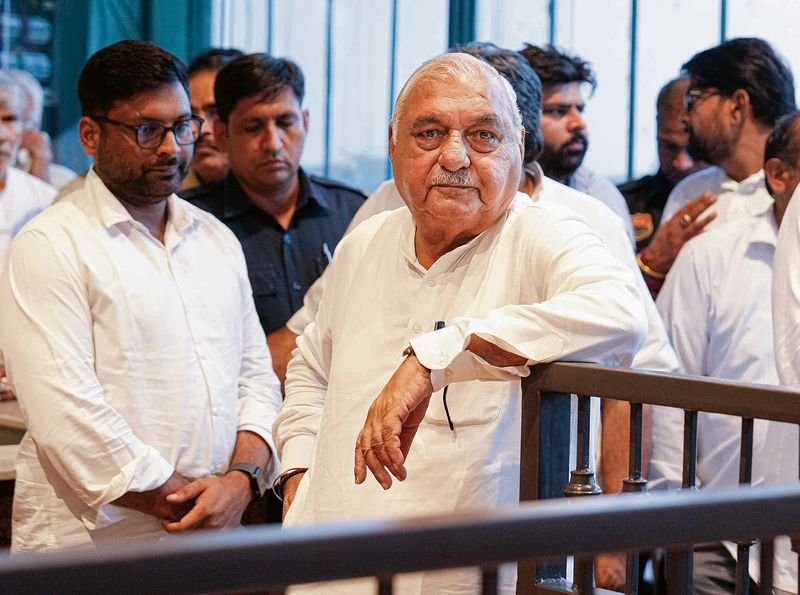

A Special CBI Court has accepted the CBI’s closure report in the Raxil fungicide case, giving a clean chit to former Haryana Chief Minister Bhupender Singh Hooda, who approved the 2010 decision to make the fungicide mandatory for treating certified wheat seed, and to the state officials involved.The case ends without a trial, 11 years after the FIR.Special Judge (CBI) Vijayant Sehgal ruled that the investigation “has not yielded material sufficient” to substantiate the alleged conspiracy, cheating, dishonest decision-making, wrongful loss to the government or unlawful pecuniary advantage. On independent consideration, he said, he found no ground to differ from the investigating officer. The case originated in a complaint by the Haryana Government, which asked the Centre for a CBI probe. It was former IAS officer Ashok Khemka who brought it out.The agency registered the FIR on August 21, 2015, against unknown persons in the State Agriculture Department and others. It invoked Section 120-B (criminal conspiracy) read with Section 420 (cheating) of the IPC, and Section 13(2) read with 13(1)(d) of the Prevention of Corruption Act, 1988.The CBI examined six sets of allegations:Raxil 2% DS, made by Bayer Crop Science India, was made compulsory in October 2010 for seed dealers and growers without certification by the Haryana State Seed Certification Agency, risking loss of crores in government funds and possible harm to ecology and health. It was alleged that the decision relied on a questionable recommendation by a few state agricultural university scientists, and on an October 6, 2010, meeting held without a formal agenda note.It was added that all supplies came from one source, Vishal Trading Company of Hisar/Karnal, at inflated rates reimbursed from government funds. Half came from the Centre’s Rashtriya Krishi Vikas Yojana.Growers were allegedly told, through veiled instructions, to buy only from that dealer to get the 100% subsidy.Bayer allegedly influenced plant pathologists at three state agricultural universities to claim Raxil works against Karnal bunt, a claim not accepted by the wider scientific community, and spread it through newspaper advertisements which the company later denied issuing.Members of the State High Powered Purchase Committee allegedly dropped a condition requiring Bayer to offer its Best Dealer Rate in the Haryana State Agricultural Development Corporation’s (HSDC) March 29, 2013, supply order.What the CBI concludedThe CBI said it found no evidence of criminal conspiracy among Haryana Government officials. The decision, it said, was taken in the High Power Purchase Committee and approved by Hooda, then Chief Minister, after discussion in several meetings rather than by any single person. The October 6, 2010, meeting, in which Raxil purchase was made mandatory for 100 per cent subsidy, was held under his chairmanship.On the science, the agency said Bayer applied to the Central Insecticides Board and Registration Committee (CIB&RC) and paid testing fees to Haryana Agricultural University, Hisar, in 1999. Scientists tested the product from 1999 to 2001. Raxil was recommended for loose smut, flag smut and Karnal bunt in a Package of Practices published in 2003, before the 100 per cent seed treatment policy began.The CIB&RC approved the 40 gm pouch packaging on February 19, 2007, well before the 2010 meeting.On price, the CBI said Punjab State Seed Corporation and the National Seeds Corporation bought Raxil at the same rate HSDC paid Bayer, so the rate was not exaggerated.The agency found no oral or documentary evidence that any official gained financially, so the corruption charge could not be made out. It also could not establish that the mandate lacked certification, that the agenda-less meeting caused loss to the exchequer or breached norms, or that the Best Dealer Rate condition was wrongly removed.Government raises no objectionThe notice of the closure report was issued to the complainant, Madan Lal, then Deputy Secretary in the Vigilance Department. He appeared on December 15, 2025, confirmed receiving a pen-drive with the report and documents, and said he would hand it to the department, having retired.On May 21, 2026, Sehdev, Superintendent in the Vigilance-II Branch, appeared with an authority letter. He told the court the government agreed with the CBI’s recommendation and had no objection to acceptance. He produced a May 20, 2026, letter from Joint Secretary Sonu Ram.