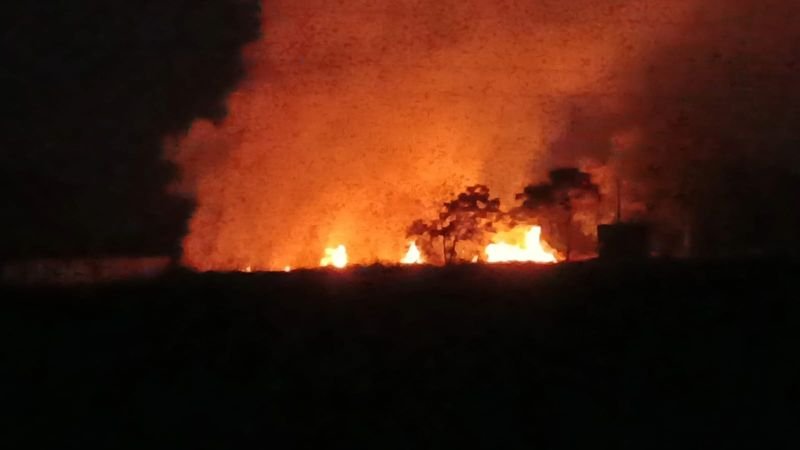

With farm fires in bordering regions of Pakistan witnessing a nearly threefold spike compared to Punjab over the past week, experts have warned that the impact of stubble burning could be more severe in Lahore, where air quality has already deteriorated.The Air Quality Index (AQI) in Lahore is hovering above 200, while Amritsar has recorded a relatively lower reading of around 153, indicating poorer air quality in the Pakistani city.According to Ravindra Khaiwal, Professor of Environmental Health at Department of Community Medicine and School of Public Health, PGIMER, Chandigarh — who also serves as Nodal Faculty Officer at Centre of Excellence on Climate Change and Air Pollution-Related Illness (Health Ministry) — a recent satellite analysis revealed a sharp disparity in fire counts between Indian Punjab and Pakistani Punjab.Sharing data on farm fires reported through satellite in Pakistan in the past seven days, Khaiwal said there has been a steady rise in farm fire incidents in the bordering areas of Pakistan, which is contributing to pollution in northern cities of India.He said the satellite has detected 3,328 incidents of farm fires in Pakistan in the past one week, as compared to 1,031 incidents reported in Punjab during the same period, which is three times the number of farm fires reported in a week.He said that besides local factors such as garbage burning and dust emissions due to construction activity, a spurt in farm fires in Pakistan has also led to a rise in pollution levels in Amritsar, Ludhiana, Jalandhar, Patiala and other districts of Punjab and Haryana.“Before travelling to India, the stubble burning smoke will first hurt the residents of Pakistan,” said Assistant Professor (Physics) at Punjabi University, Patiala, Dr Karamjit Singh Dhaliwal, who is also the principal investigator of ‘ISRO-GBP ARFI Research Project’.Explaining the phenomenon, Dhaliwal said, “During November, North India experiences a seasonal transition characterised by light westerly and northerly winds. Because surface winds remain weak and variable during night and early morning hours, pollutants tend to get trapped near the surface, contributing to seasonal smog and haze across the Indo-Gangetic plain.”Sukhbir Singh Dhaliwal, who pioneered paddy residue management in the state, said the recent western disturbance and the resultant rainfall have also delayed harvesting operations, potentially adding to the pressure on farmers to dispose of paddy residue before sowing the next crop.With the wheat sowing season set to begin on November 1, experts anticipate a further rise in farm fires, with incidents likely to peak around Diwali. The first fortnight of November is considered ideal for wheat sowing, putting pressure on farmers to clear their fields after harvesting paddy.