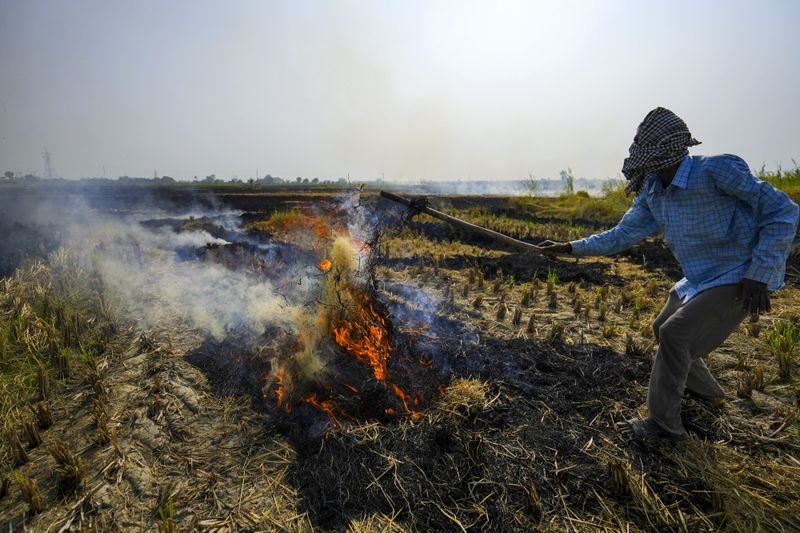

Contrasting scenes are unfolding across Punjab’s fields, where some farmers continue to burn paddy stubble while others are working overtime to manage crop residue and prevent environmental pollution.Fields along highways offer a striking picture of this divide. While heaps of paddy straw are being converted into bales and racks for proper management and utilisation, plumes of smoke can be seen rising from fields where farmers continue to burn the residue.Alongside trucks laden with paddy, combine harvesters and trolleys carrying racks and bales, compressed bundles of paddy straw, have become a common sight on highways across the state.According to Adarsh Pal Vig, former chairperson of the Punjab Pollution Control Board (PPCB), crop residue management is rapidly emerging as an alternative industry, with the number of people engaged in paddy straw collection, storage and utilisation increasing steadily. This shift has contributed significantly to the decline in farm fire incidents.”The numbers speak for themselves. Farm fire incidents have fallen from 87,162 in 2021 to 5,574 in 2025, clearly indicating that crop residue management is emerging as a remunerative industry,” Vig said.Sukhbir Singh Dhaliwal, who has been spearheading paddy residue management in the state for over 15 years, said farmers had started realising the potential of green energy. Balers and other crop residue management machines were working overtime across the state to facilitate ex-situ management of paddy straw, he added.He said erratic weather conditions in October had delayed harvesting by nearly 15 days and leading to farm fires. The November 1-15 period is considered ideal for sowing wheat seed, he said, adding that farmers had to harvest their crop, sell it in mandis, receive payments and manage paddy straw within this limited window.He said the pressure to clear fields for timely wheat sowing, coupled with delays in harvesting and payments, was driving some farmers to burn the residue.Paddy is cultivated over 32-35 lakh hectares, generating approximately 20 million tonnes of stubble annually.Dhaliwal explained that ex-situ management involved collecting paddy straw in the form of bales and transporting it to industries, power plants and other facilities for utilisation. The paper and packaging industry also uses paddy straw as a raw material for pulp, paper and biodegradable packaging.Harminder Singh Sidhu, a progressive farmer and director of the Gadri Baba Dulla Singh Giani Nihal Singh Foundation in Ludhiana, has taken proactive steps by establishing an equipments bank to lease farm machinery for harvesting and crop sowing over 50 villages surrounding Raikot. Had the weather remained favourable in October, the farm fires would have been negligible.A native of Sadhugarh village in Fatehgarh Sahib, 30-year-old progressive farmer Amrinder Singh has also ventured into the emerging stubble management economy. His firm, Farm2Fuel, has collected around 45,000 metric tonnes of paddy straw this year, nearly double the 28,000 metric tonnes collected last year.He said those involved in collecting and storing crop residue were earning returns of Rs 2,200 to Rs 2,500 per tonne, or even more, depending on demand and quality.Meanwhile, Punjab Agriculture and Farmers Welfare Minister Gurmeet Singh Khudian claimed that the government had invested Rs 1,325.35 crore in farm machinery over the past four years, providing 94,456 Crop Residue Management (CRM) machines to farmers. He attributed a 90 per cent decline in farm fires — from 49,922 in 2022 to 5,114 in 2025 — to these efforts.According to Commission for Air Quality Management (CAQM) data, Punjab utilised around 70.6 lakh metric tonnes of paddy straw through ex-situ methods in 2025. The target for 2026 has been fixed at 78 lakh tonnes.Industrial boilers accounted for the largest share of utilisation at 41 lakh tonnes, followed by biomass power plants (11.7 lakh tonnes), thermal power plants (8.7 lakh tonnes), CBG plants (5 lakh tonnes), brick kilns (2.2 lakh tonnes) and second-generation ethanol plants (2 lakh tonnes).Punjab currently has 11 operational biomass-based power plants with a combined generation capacity of 101.5 MW, consuming around 11.7 lakh metric tonnes of paddy straw annually. In addition, 78 PPCB-registered pellet plants are using paddy straw as fuel for thermal power plants.