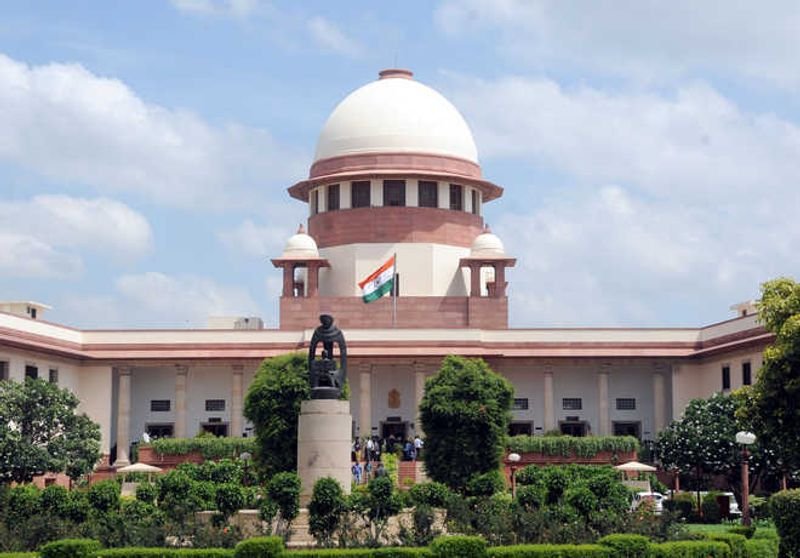

In an important ruling expanding the scope and ambit of civil liberties, the Supreme Court on Thursday ruled that the 24-hour constitutionally mandated deadline to produce an accused before a judicial magistrate runs from the time of his detention and not just from the time of his formal arrest by the police.“Any attempt to draw an artificial distinction between ‘arrest’ and ‘detention’ would dilute or negate the fundamental protection guaranteed by the Constitution under clause (2) of Article 22. Such an endeavour should be avoided. We must adopt that interpretation which enhances and furthers the constitutional objective,” a Bench of Justice Ujjal Bhuyan and Justice Atul S Chandurkar said.Holding that the words “arrested” and “detained” appearing in clause (2) of Article 22 were synonymous, the Bench said, “Thus, the prescription of 24-hour time period would commence the moment a person is detained by the arresting authority suspecting him to have committed an offence, when his liberty is effectively curtailed.”The verdict came on appeals filed by four persons challenging the Tripura High Court’s April 29 judgment denying them bail in a case under the NDPS Act. The accused were detained on September 29, 2025, at 2 pm as part of a search and seizure but were formally arrested the next day.Setting aside the high court’s order, the top court held that they should have been produced before the magistrate within 24 hours from 2 pm on September 29. Noting that they were kept under detention for about 18 hours without any judicial oversight in violation of Article 22(2), the Bench ordered that they shall be produced before the jurisdictional Special Court within seven days from today and, thereafter, they shall be released on bail on such terms and conditions as may be deemed appropriate.Writing the judgment for the Bench, Justice Bhuyan said, “Article 22(2) does not sanction exclusion of the time taken for enquiry and investigation before the arresting authority could effect arrest of the detainee. This is beyond the mandate of Article 22(2) of the Constitution. Article 22(2) does not sanction creation of any buffer zone where the liberty of an individual is curtailed for investigating purposes but not formally shown as arrested.”Justice Bhuyan said, “Creation or contemplation of such buffer zone is unconstitutional. There cannot be any suspension or keeping in abeyance of the constitutional safeguards provided under clause (2) of Article 22 save and except what is provided thereunder. Therefore, the declaration that the period of 24 hours for the purposes of Article 22(2) commences from the completion of such search and seizure and only from the time of arrest recorded by the arresting authority is not only unsustainable in law but also entirely unconstitutional.”The top court said, “The 24-hour timeline as mandated under clause (2) of Article 22 of the Constitution would commence from the date and time of detention of the person detained when his liberty stands curtailed and not from the time of his formal arrest.”In the event such detention continues beyond 24 hours before the person is produced before a magistrate, he shall be forthwith released from custody, the Bench said.“While computing the 24-hour deadline, no other time period is permitted to be excluded therefrom except the time necessary for the journey from the place of arrest to the court of the magistrate,” it said, adding the detaining authority should keep in mind not only the 24-hour deadline mandated by clause (2) of Article 22 of the Constitution but also ensure that such detention should not extend beyond a reasonable period within the 24-hour period considering the circumstances of the case in terms of Section 58 of the BNSS (Section 57, CrPC).”“At the time of production, the magistrate is duty-bound to record the actual date and time of detention of the person produced before him when his liberty stood curtailed and examine whether the 24-hour deadline has been complied with or not from the time of such detention. If there is breach of the 24-hour deadline, the person concerned shall be released forthwith from detention,” the Bench said.“The magistrate shall also examine at the time of production whether the detention of the person produced, though it is within the time frame of 24 hours, has exceeded the period which can be construed to be reasonable in the circumstances of the case. If he is satisfied that detention in custody has been for a longer period than what is reasonable, he may decline remand,” it said.The top court ordered that a copy of the judgment be circulated to all Director Generals of Police of states and union territories as also to the Registrar Generals of high courts and Directors of state judicial academies.