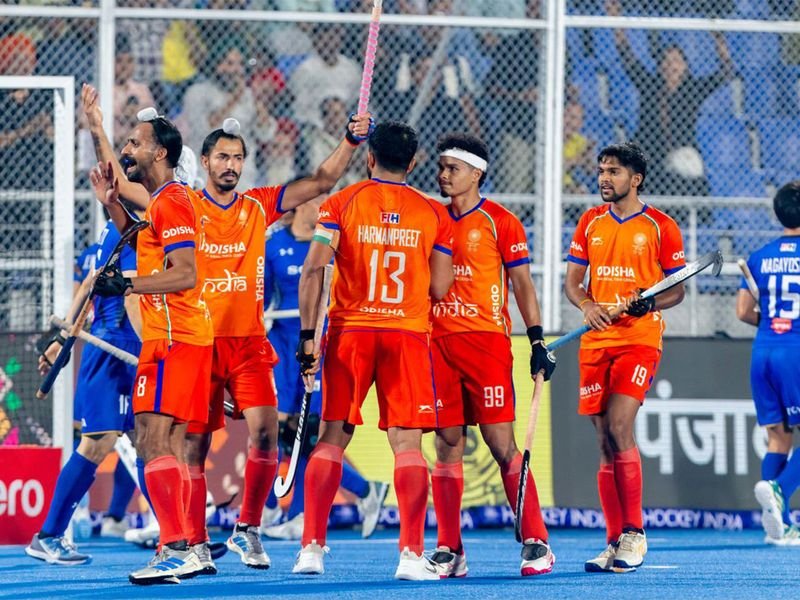

India’s complete domination over the other competing teams in the Asian Champions Trophy has raised questions over the logic behind selecting a full-strength team for the tournament.India defended their title with an all-win record, racking up one-sided victories to finish with a positive goal difference of 39.The Asian Champions Trophy is neither a top-tier event nor a qualifying tournament for the Olympics or the World Cup, and therefore has little relevance. It is mainly used by coaches to try new faces and expand the pool of players for the main team.Coming at the end of a busy season, which included the FIH Pro League, the World Cup and the Asian Games, the tournament was a perfect platform for coach Craig Fulton to blood youngsters, while giving much-needed rest to his otherwise invaluable core group of players.India arrived at the Asian Champions Trophy having already achieved their target for the year. By defending their Asian Games title, they earned early qualification for the 2028 Los Angeles Olympics. The Asiad was where Fulton wanted his team to peak and his senior players delivered.Almost all of the other teams came to India with new line-ups. But for India, as hosts, winning the title took precedence over developing new players, and Fulton decided to pick his best players, many of whom belong to Punjab. For players such as Harmanpreet Singh, Manpreet Singh, Hardik Singh, Mandeep Singh, Sukhjeet Singh, Jugraj Singh, Jarmanpreet Singh and Dilpreet Singh, there was the added motivation of playing an international tournament in their home state for the first time.The Asian Champions Trophy was the third tournament in three months for all of these players, who showed signs of physical and mental fatigue. “There has been a lot of hockey this last six months so trying to keep everyone mentally fresh and keen, and hungry to play,” Fulton had said during the pool stage of the tournament.It led to fitness issues, with Manpreet getting injured in the lead-up to the event. Mandeep and Abhishek also picked up injuries during the tournament, while Dilpreet was seen playing with a strapped thigh.Fulton has revealed that India will take a new-look team for the three-match series in New Zealand later this month. But the results in Jalandhar and Mohali make it clear that the transition could have been initiated at the Asian Champions Trophy. When Fulton was asked whether he would have named an experimental squad had the tournament been hosted outside India, the South African said, “No, because we had the New Zealand tour. It was always the plan to take a new team to New Zealand.”Fulton, though, admitted that Punjab hosting its first international hockey tournament in almost two decades gave extra importance to the Asian Champions Trophy.Team at crossroadsThe Indian team is at a crossroads as many players from the bronze winning teams of the last two Olympics have either retired or reached the final phase of their international careers.The national team setup, historically, has not been great at making smooth transitions. This being a golden generation, the transition will not be easy and requires more attention and planning.India have been struggling to fill the gaping hole left by the retirement of former captain and goalkeeper PR Sreejesh. The same is the case for former captain Manpreet, midfield maestro Hardik and current skipper and drag-flicker Harmanpreet, who will be difficult to replace. Manpreet, in particular, is irreplaceable because of his all-round skills and leadership abilities. Most of the Indian team’s core group players are likely to play at the next Olympics, but their future beyond the LA Games seems doubtful.The LA Olympics are less than two years away, but Fulton expressed confidence that it was enough time to develop new players. Despite his confidence, Fulton’s task is very difficult, and its start has already been delayed.Talwinder Singh, who played over 60 games for India and trained in the national camp from 2013 to 2018, said it takes at least 50 matches to find your feet at the international level. “The first few international matches are a blur. You don’t even realise what is happening,” Talwinder said.System lacks uniformityThis transitional phase is made tougher by the deficiencies in the Indian system, which lacks uniformity. Foreign coaches over the last decade have brought modern training and playing systems to the India team setup, but it is yet to be implemented at the national level, especially at the grassroots.Even for a junior India player, the transition to the senior camp is an unsettling experience. “It comes as a shock at first, the difference in level. Many are unable to complete that transition and are side-lined,” Talwinder said.There is also the case of players who manage to get over these initial hurdles but still do not get a long run. Rather than looking at the developmental aspect, India’s selection process has almost always been dictated by an unrealistic demand for results.Avtar Singh, a former coach at the famous Surjit Hockey Academy in Jalandhar, said not all players develop at the same rate. “Developing players and then managing them properly has not been the Indian team’s strong suit. They measure everyone with the same yardstick, and not all players get enough opportunities to mature,” he said.