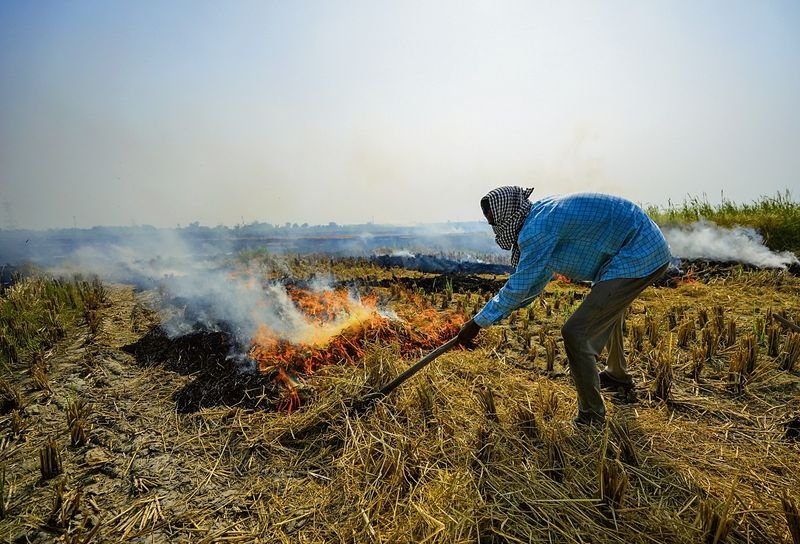

Punjab and Haryana have recorded a dramatic decline in stubble-burning incidents, with satellite data showing a 95 per cent reduction in Punjab and 98 per cent in Haryana between 2020 and 2026, highlighting the impact of farm mechanisation, scientific interventions and increased farmer participation in crop residue management.According to data monitored by the CREAMS Laboratory of the ICAR-Indian Agricultural Research Institute (IARI), Punjab recorded 2,196 farm-fire incidents between September 15 and November 3 this year, compared with 43,994 during the corresponding period in 2020.Haryana witnessed an even sharper decline, from 2,699 incidents in 2020 to just 52 this year, it said.The figures point to a significant shift in the management of paddy straw in the two states, which have traditionally been at the centre of the annual stubble-burning crisis and its contribution to air pollution in north India.“A major factor behind the improvement has been the Centre’s scheme for promotion of agricultural mechanisation for in-situ management of crop residue, launched in 2018. The initiative provided financial and institutional support for specialised farm machinery and custom hiring centres (CHCs), allowing small and marginal farmers to access equipment without making substantial investments,” Rajbir Singh, Deputy Director General (Agriculture Extension and Engineering,) ICAR, said.“By 2025-26, a cumulative 3,45,789 machines had been distributed across the country, supported by 43,276 CHCs. Punjab accounted for around 1.48 lakh machines and 25,917 centres, while Haryana established 6,775 CHCs,” he said.The data noted that the scale of in-situ management in Punjab has also increased considerably. Around 11.4 million tonnes of paddy straw were managed within fields during 2025-26, accounting for nearly three-fifths of the state’s estimated straw generation, it said.These practices generated cultivation-cost savings of more than Rs 600 crore and are estimated to have saved around 571 million cubic metres of groundwater through improved soil and moisture management.Meanwhile, nearly 7.85 million tonnes of paddy straw generated in Punjab during 2025 was utilised through various ex-situ pathways, including industrial boilers, biomass and thermal power plants, fodder, compressed biogas, brick kilns and bioethanol production.Singh said the growing use of crop residue as industrial feedstock is also creating opportunities for rural employment and a bioeconomy, although assured procurement, remunerative prices and efficient supply chains remain critical to sustaining these initiatives.The year-wise data by CREAMS Laboratory shows that the decline has not been uniform. Punjab recorded 20,578 farm-fire incidents in 2021 and 24,146 in 2022 before the number dropped to 12,813 in 2023, 4,132 in 2024 and 2,518 in 2025.In Haryana, incidents rose to 3,438 in 2021 but subsequently declined to 2,377 in 2022, 1,372 in 2023, 857 in 2024 and 145 in 2025.Compared with last year, farm-fire incidents fell by 12.8 per cent in Punjab and 64.1 per cent in Haryana in 2026, it said.“Uttar Pradesh also recorded a decline, with incidents falling from 1,534 in 2020 to 359 this year. Delhi reported only two incidents during the period. However, Madhya Pradesh witnessed a contrasting trend, with farm fires increasing by 24.2 per cent, from 570 in 2025 to 708 in 2026,” the data showed.M L Jat, Secretary, Department of Agricultural Research and Education (DARE), said the experience of crop residue management demonstrated that sustainable agricultural transformation was possible when scientific innovations, enabling policy frameworks and active farmer participation converged.“The next phase of the campaign will require greater focus on high-incidence villages, timely deployment of machinery, stronger biomass markets and village-level action plans. A proposed village-level Zero Burning Mission involving Krishi Vigyan Kendras, gram panchayats, farmer organisations and local entrepreneurs could further strengthen community participation,” he said.