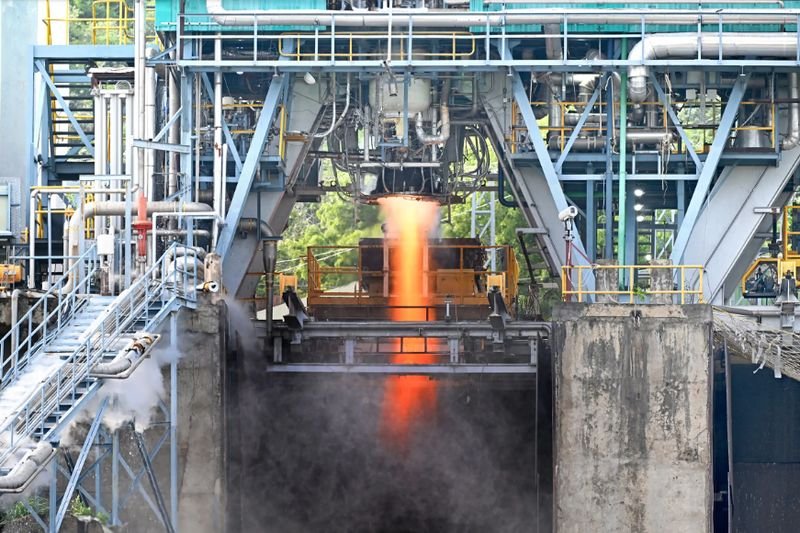

The Indian Space Research Organisation (ISRO) has successfully conducted the flight acceptance test of the cryogenic engine designated for its upcoming Geosynchronous Satellite Launch Vehicle (GSLV-F19) mission, which will launch the fourth navigation satellite for military and civilian applications.The ignition of both the main engine (ME) and the gas generator (GG) occurred at the Propulsion Complex in Tamil Nadu as expected. During steady-state operation, the engine performance was normal and consistent with nominal predictions, according to a statement issued by the ISRO on November 10.The test duration was 200 seconds and the performance of the engine was satisfactory and consistent with the pre-test predictions. The engine will be inducted in the Cryogenic stage for the GSLV – F19 mission that will launch the NVS-04 navigation satellite, which would be part of India’s Navigation with Indian Constellation system.Though the launch date for the GSLV F-19 mission has not yet been announced by ISRO, it is expected to take place in 2027. On October 30, ISRO had used a GSLV to place the NVS-03 satellite in the NavIC series into a geosynchronous orbit.The GSLV-F18 mission launched from the Satish Dhawan Space Centre in Tamil Nadu had placed the 2,250 kg NVS-03 satellite in a geosynchronous transfer orbit of 170 km x 37,023 km.Subsequently, IRSO carried out four orbit manoeuvres with a cumulative engine burn of 6,164 seconds, with the satellite being placed into its final intended geosynchronous orbit of 35,765 km x 36,196 above the Earth on November 4.The NavIC also known as the Indian Regional Navigation Satellite System, is India’s independent, indigenous satellite navigation system developed by ISRO that employs several advanced geostationary satellites.The system is designed to provide real-time positioning, navigation and timing services cross the entire Indian landmass and an extended region up to 1,500 km beyond its borders, thus reducing dependence on foreign global systems like the US-owned GPS.The 420-tonne GSLV is a three-stage indigenously developed launch vehicle, with the final upper stage being powered by a cryogenic engine. The vehicle took about 18 minutes from lift-off to inject the NVS-03 into the transfer orbit.ISRO’s cryogenic engines replaced the Russian-supplied power plants stage used in earlier GSLV flights, boosting self-reliance in advanced launch vehicle technology. It was developed after restrictions blocked a Russian cryogenic engine transfer to Indian in the 1990s, making India among the few countries to master this technology.A cryogenic upper stage is the final stage of a launch vehicle that uses specialised propellants to provide the high efficiency needed to place satellites into their intended orbits. Though a very complex system, it is more efficient and provides more thrust for every kilogram of propellant burnt as compared to solid and earth-storable liquid propellant rocket stages.ISRO’s indigenous cryogenic upper stage used on GSLV employs liquid hydrogen as fuel and liquid oxygen as oxidiser, both stored at extremely low temperatures ranging up to minus 250 degrees Celsius, which has thermal and structural challenges.