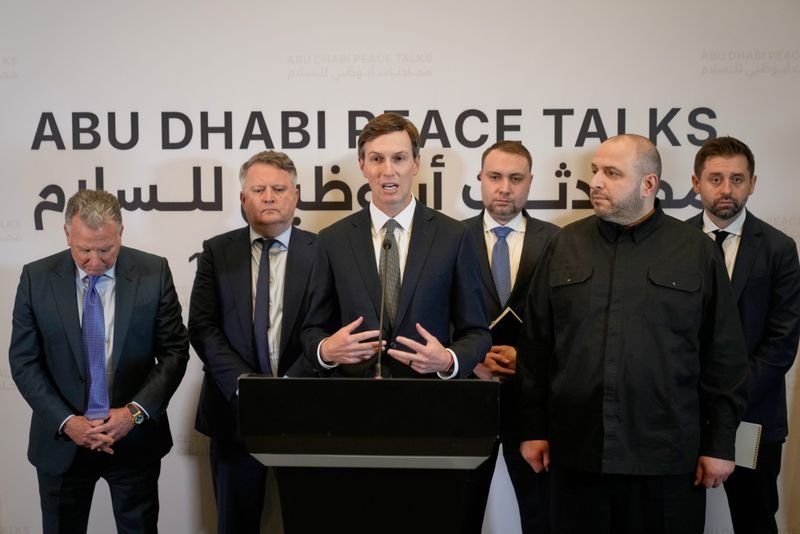

Two days of trilateral peace talks between the US, Russia and Ukraine at Abu Dhabi produced an agreement on a large-scale prisoner swap, but no breakthrough was reached on ending the war that has caused a rise in crude oil prices and snapped the supplies of foodgrain exports via the Black Sea route.Ukrainian President Volodymyr Zelenskyy said Tuesday’s session was “constructive and quite substantive”.US envoy Jared Kushner, son-in-law of US President Donald Trump, told a news conference in Abu Dhabi that the number of prisoners to be swapped would be finalised on Thursday.Kushner would travel to Moscow with US special envoy Steve Witkoff to brief Russian President Vladimir Putin. Kushner said he hoped to “make more progress on some of the issues that were discussed in Abu Dhabi”.“We see some openings and some opportunities from the talks,” he said.From Moscow, Kushner and Witkoff will fly to Dublin to meet Zelenskyy and “explore some of the ideas”.Russia’s chief negotiator, Vladimir Medinsky, said both sides had agreed to a major prisoner swap and had reached “mutual understanding” on some issues.Russia’s state-run TASS news agency reported that the exchange could take place within two to three weeks. If completed, it would be the latest in a long line of such swaps.In March this year, Ukraine and Russia had freed 200 prisoners of war following talks in Geneva in February. Last year, each side exchanged 146 prisoners after UAE mediation, and large-scale swaps followed three rounds of talks in Istanbul from May to July.Medinsky said the latest deal would need to surpass the 1,000-for-1,000 swap of May last year to count as the largest yet.Earlier, Kushner was quoted by news agencies as saying that “territorial questions would be the hardest to resolve, though progress had been made on a post-war security framework”.Medinsky said more talks would be held in the near future and that Moscow was not opposed to European Union participation. However, he said it was unclear what Russia and the EU would discuss, citing what he described as a lack of proposals from the European side.Ukraine emerged with a positive note with its chief negotiator, David Arakhamia, saying that Abu Dhabi talks had built a “good momentum” towards a solution before the end of the year. He said the next round should be multilateral rather than trilateral, with Europe represented.Zelenskyy, who like Putin did not attend the talks, said on Wednesday that European security could not be considered “without Europe”.The US is pushing for Europe to be part of the talks, with Kushner saying upcoming discussions with both presidents would address “whether we can get Europeans to the format and make this a multilateral format”.At Abu Dhabi, representatives of European governments, the European Union and NATO were present and were consulting with the Ukrainian delegation.Yesterday, Ministry of External Affairs spokesperson Randhir Jaiswal told the media that India had suggested three humanitarian-focused measures for the talks. These included ensuring the safety of commercial shipping in the Black Sea region, addressing the immediate concerns of both countries over energy and grain exports, and exploring non-aggression possibilities and pacts to prevent further escalation and protect critical infrastructure.