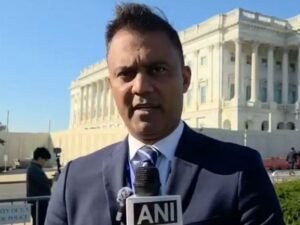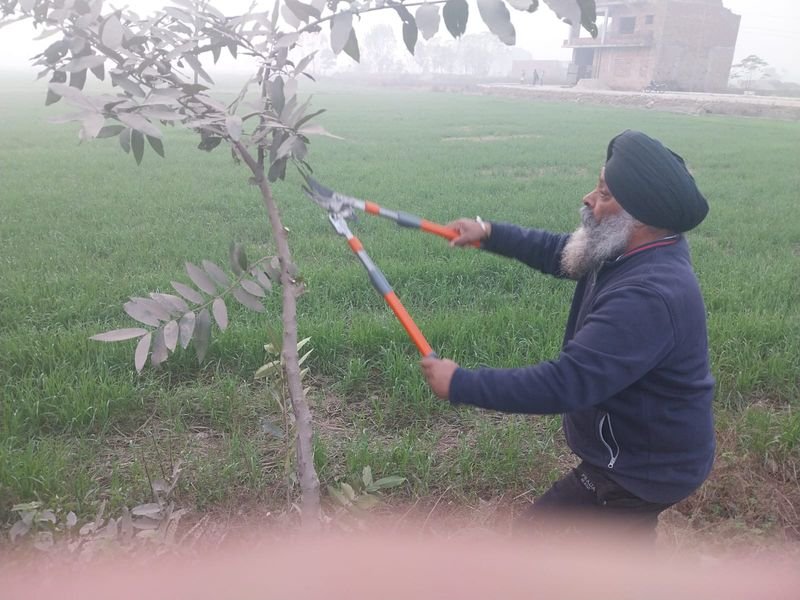

He has earned the sobriquet of the “tree man of Gurdaspur”. Everything Master Ranjit Singh Chinna does is marked by selflessness and an unwavering commitment to public service. His work has left an indelible impression on residents across the district, making him a widely respected and unforgettable figure.Guided by the belief that life’s most important question is, “What are you doing for others?”, Chinna has devoted himself to serving both people and the environment.For the past 18 years, the government schoolteacher has planted hundreds of trees, including fruit-bearing and medicinal species, along highways and roads across Gurdaspur district. He initially focused on national highways before extending his efforts to link roads connecting villages in this border region.Apart from promoting greenery, Chinna has taken upon himself another unusual but vital public service: the disposal and burial of animal and bird carcasses.He regards the task as an important responsibility linked to civic hygiene, public health and animal welfare. “Decomposing carcasses are major breeding grounds for harmful bacteria, viruses and other pathogens. Prompt disposal prevents the spread of zoonotic diseases among humans as well as wildlife. People often leave dead animals on busy roads, causing secondary accidents when drivers try to avoid them. Removing the carcasses makes roads safer for everyone,” he explains.Chinna believes that animals deserve dignity in death as much as humans do. “Disposing of them in garbage dumps or leaving them exposed strips them of that dignity,” he says. The Covid-19 pandemic further highlighted his commitment to society. At a time when fear and uncertainty gripped communities, Chinna emerged as a true “corona warrior”.He installed a loudspeaker on top of his car and publicly announced that he was ready to transport Covid-infected patients to hospitals whenever required. The tree man has also performed what he describes as another “humanitarian duty entrusted to him by the Almighty”. From 2005 to 2012, without missing a single day, he stood on the platform of Chhina railway station near his native village, serving drinking water to passengers travelling on the Amritsar-Pathankot rail route.His contributions have earned widespread recognition. Chinna has been conferred the prestigious Bhai Kanhaiya Award for excellence in social service. Several social and voluntary organisations have also honoured him with awards and commendations. Yet, for Chinna, such recognition is secondary.“Serving humanity is the biggest reward,” he says.On green missionMaster Ranjit Singh Chinna admits he cannot transform Gurdaspur’s environment single-handedly, but believes small, sustained efforts can make a difference. According to the India State of Forest Report (ISFR), the district has only 23.91 sq km of forest cover, including 5.55 sq km of moderately dense forest and 18.36 sq km of open forest, with no very dense forest cover. Chinna says the district’s green cover could grow significantly if NGOs and social organisations joined the effort. Until then, he continues his mission alone, planting and nurturing trees across the district.