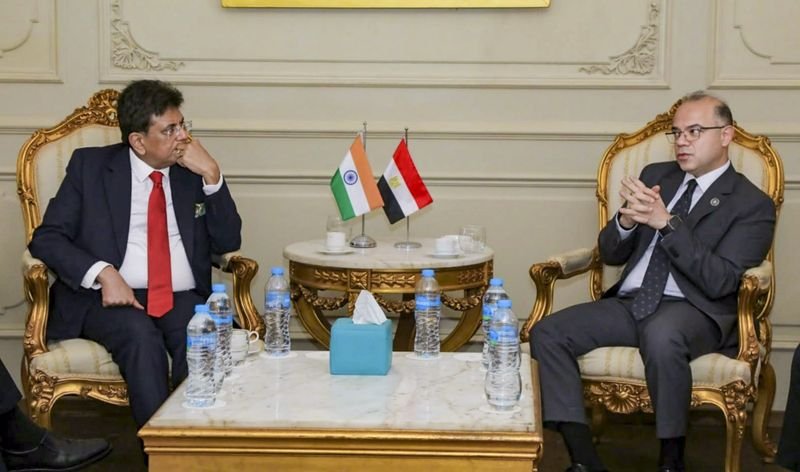

Union Minister of Commerce and Industry Piyush Goyal and Egypt’s Minister of Investment and Foreign Trade, Dr Mohamed Farid Saleh, on Monday reaffirmed their commitment to expanding bilateral trade, setting a target of USD 12 billion.The meeting, co-chaired by the two leaders, marked the seventh session of the India-Egypt Joint Trade Committee (JTC), held in Egypt’s New Administrative Capital.It was the first time that this important bilateral institutional mechanism was convened at the ministerial level, underscoring the priority both governments attach to strengthening the economic dimension of the India-Egypt Strategic Partnership.The two Ministers emphasised the need to diversify trade, promote value-added exports and address trade-related challenges. As a key outcome of the seventh JTC meeting, they agreed to establish a Joint Working Group to explore the Terms of Reference for a Preferential Trade Agreement or Free Trade Agreement to facilitate stronger bilateral trade, improve access to both markets and promote investment linkages between the two countries.The meeting was preceded by bilateral discussions between the two Ministers on expanding trade, facilitating investments and developing long-term industrial and commercial linkages. The JTC provided an opportunity to review existing trade ties, assess challenges faced by businesses and identify new areas for closer collaboration.The committee reviewed the growth in India-Egypt trade, which increased by 35 per cent to reach USD 6.5 billion in FY 2025-26 (April 2025-March 2026). Trade during April-September 2026 also grew by 65 per cent to reach USD 5.04 billion, compared with USD 3.08 billion during the corresponding period in 2025.The increase reflects the growing momentum in commercial exchanges and the potential for further diversification of the trade basket. Significant complementarities exist for enhanced trade in industrial goods, energy and fertilisers, chemicals, pharmaceuticals, engineering, textiles and agricultural products.The discussions primarily focused on expanding trade, developing supply chains and establishing predictable trade pathways. Both sides considered measures to address non-tariff barriers, facilitate customs processes, strengthen standards and conformity assessment, and improve market access.They also discussed practical issues affecting business operations, including product registrations and trade-related regulatory procedures.Discussions further focused on strengthening business exchanges and encouraging joint manufacturing and investment. Priority sectors included pharmaceuticals and medical devices, engineering and electrical equipment, fertilisers, textiles, renewable energy and emerging technologies.Opportunities for Indian investment in Egyptian industrial zones, as well as Egyptian investment in India’s expanding manufacturing and services sectors, also formed an important part of the agenda.Both sides expressed interest in strengthening the framework agreement between Invest India and Egypt’s General Authority for Investment and Free Zones, including a proposed digital platform for sharing investment information and facilitating business linkages.Egypt’s proximity to the Suez Canal and its connectivity with African, Arab and European markets make it a valuable partner for export-oriented manufacturing and regional supply chains. India, in turn, offers Egyptian investors and exporters a large and dynamic market, increasingly competitive infrastructure, and opportunities for technology and production partnerships.Goyal highlighted five areas of strong complementarity between India and Egypt: pharmaceuticals and healthcare, leveraging India’s strengths in affordable medicines, vaccines and medical technology; engineering and automobiles, covering machinery, auto components and industrial manufacturing; agriculture and food processing, including food security, fertilisers, irrigation and cold-chain infrastructure; digital and fintech, through UPI linkages, local currency trade and India’s Digital Public Infrastructure; and culture and museums, through proposed collaboration between the Grand Egyptian Museum and India’s upcoming Yuge Yugeen Bharat National Museum in conservation, curation and digitisation.