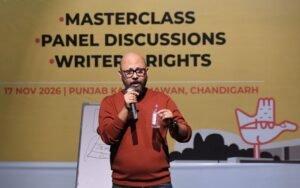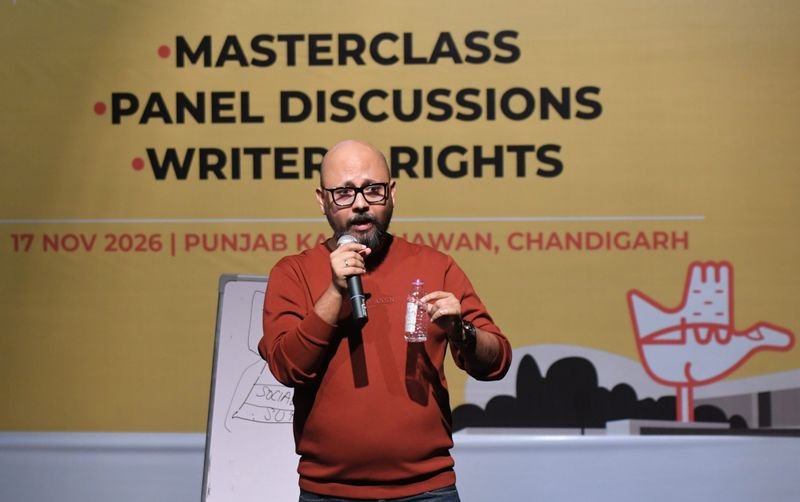

Writers who hand their thinking to artificial intelligence risk losing the very faculty that makes stories, screenwriter-director Satyanshu Singh said on Tuesday at SWA Connect, the Screenwriters Association’s Day-long event at Punjab Kala Bhawan.Satyanshu, who wrote the Netflix series Black Warrant and directed Chintu Ka Birthday, opened the programme with a three-hour masterclass on the fundamentals of screenwriting. He told the participants that leaning on AI tools to produce scripts weakens both the mind and the imagination. For a story that feels stale, he suggested shifting it to a new setting, which he said can make a familiar plot interesting again.He also drew a line between sympathy and empathy. “Making viewers feel the protagonist’s pain is what builds empathy, and that feeling is what ties the viewers to a character on screen,” he said.Care for the protagonistAway from the stage, on the sidelines of the programme, Satyanshu spoke to The Tribune about his own path. Raised in a small town in Bihar, he trained as a doctor before moving to Mumbai 18 years ago to write. His first rule for newcomers concerns the person at the centre of a script. “The moment viewers stop caring for your protagonist, that is the moment when everything stops to matter,” he said.Caring about a character also shapes how that character talks, he said. Good dialogue comes from knowing the person, not from polishing words. “Dialogue writing has less to do with the language, it has more to do with psychology,” Satyanshu said.For young writers, his advice was simple: “Write every day and read screenplays before any textbook,” he said.On Black Warrant Season 2, he offered only a short update: “We are working on it. Let’s see what happens.”Satyanshu ended with a reminder of why anyone takes up the craft in the first place. “We need to reconnect again and again with the little kid in you who fell in love with the movies. That will save you. That will make you,” he said.The other sessions:From page to screen: The panel discussed how films, television and OTT platforms each have their own grammar and format. Moderator Preeti Mamgain observed that television is a writer’s medium and film a director’s medium, before asking, what OTT’s identity was. Charudutt Acharya called OTT the medium of the future, saying it holds Gen Z’s attention.Stories and songs: In a conversation with Ginny Diwan, Jagdeep Sidhu compared the work cultures of the Punjabi film industry and Bollywood, describing the latter as more professional, with stronger production houses. Drawing on his experience, he advised newcomers to practise and write every day and encouraged them to explore SWA Pitch Fest and Sticky Frames to pitch their scripts to producers or directors.Know your rights: Charudutt Acharya and Preeti Mamgain were the panelists, with Vibha Singh as moderator. The session covered copyrights, contracts and the role of the SWA in protecting writers’ interests. It was the last session of the day, and the programme ended with closing remarks and a vote of thanks at 6 pm.