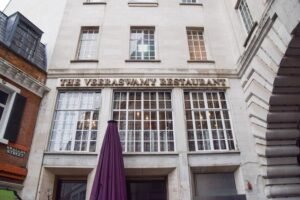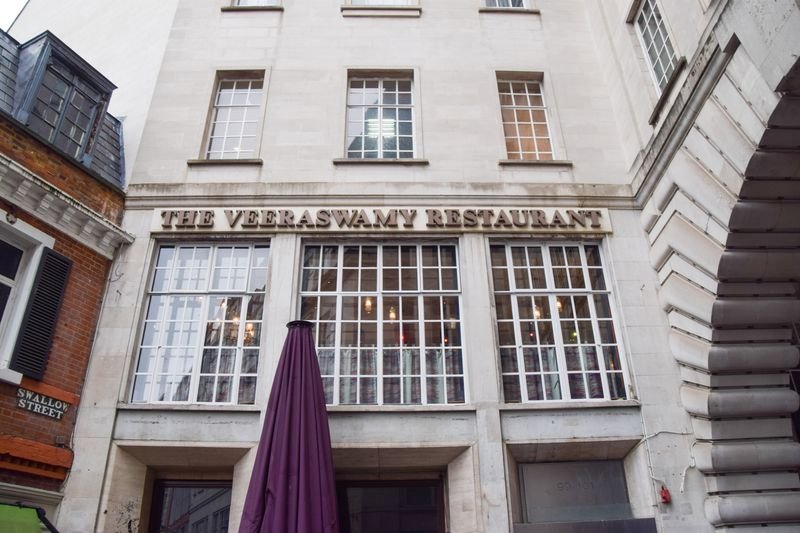

London has always had a complicated relationship with India. It once ruled the Subcontinent; now it queues outside its restaurants. And, judging by the prices, it is prepared to pay handsomely for the privilege.There was a time when an Indian restaurant in London was a relatively modest affair. You went in, ordered a chicken tikka masala or a vindaloo, washed it down with a pint of lager and emerged feeling that you had briefly visited the Subcontinent without the inconvenience of a passport.Those days are gone. London has become one of the world’s great destinations for Indian food. But just when the city should be celebrating this culinary conquest, its Indian restaurants seem to be having an identity crisis.Consider Veeraswamy. Established in 1926, it has occupied its distinguished perch on Regent Street for a century. It has entertained royalty, politicians, celebrities and generations of Londoners who wanted something rather more sophisticated than the neighbourhood curry house.Now it faces the prospect of closure as the Crown Estate seeks to redevelop parts of the building for offices. The landlord’s financial calculations appear to favour commercial space over a century of culinary heritage. Veeraswamy’s owners are fighting back with considerable public support.It is an unhappy prospect. London has never been particularly good at preserving its history when a property developer comes along with a calculator. The old India Club on the Strand was an early victim.The irony is that Indian food has never been more fashionable.At Gymkhana in Mayfair, diners can experience the sort of sophisticated Indian cooking that has earned the restaurant two Michelin stars. The atmosphere evokes the exclusive clubs of colonial India, although the prices are distinctly contemporary London. Some of the old Maharajas would have needed to check their bank balances before ordering.Then there is Trishna in Marylebone, with its sophisticated take on coastal Indian cooking, particularly seafood. It is a useful reminder that Indian cuisine is more than chicken tikka, lamb rogan josh and an increasingly alarming number of chillies.Many others favour Tayyabs in Whitechapel. Its Punjabi cooking, particularly the celebrated lamb chops, has attracted generations of devotees. Here, the atmosphere is lively, the food generous and the experience refreshingly democratic. Nobody appears to be worrying about whether the tablecloths are sufficiently luxurious.And then there is Dishoom, which has successfully recreated the atmosphere of Bombay’s old Irani cafés for a British public prepared to queue patiently for a bacon naan roll. It is hard to imagine a more successful exercise in culinary cultural transplantation. Londoners have taken to it with extraordinary enthusiasm.Yet the Indian restaurant has also become an unlikely theatre for Britain’s cultural arguments.Take Singh’s Dining in Hammersmith, formerly known as Rangrez. Its Sikh proprietor, Harman Singh Kapoor, has attracted attention for displaying a sign announcing that the restaurant is proudly non-halal. His refusal to serve halal meat has become part of a much wider controversy involving his social media comments about Muslims and Gaza.Last Friday, the restaurant found itself at the centre of a demonstration. A large crowd gathered outside, Palestinian flags were waved, slogans were chanted and Metropolitan Police officers formed a line to keep protesters away from the premises.Kapoor had been arrested at his west London home earlier that day on suspicion of possessing and distributing an extreme image, according to the police. He separately alleged that his family have suffered threats and intimidation. The protesters, meanwhile, have objected not merely to the restaurant’s food policy but also to the proprietor’s online remarks.The episode has attracted an unlikely celebrity intervention. John Cleese, of ‘Fawlty Towers’ fame, reportedly arranged for private security to protect the restaurant.There is something almost Monty Python-esque about the spectacle: an Indian restaurant, a Sikh proprietor, a religious controversy, a police cordon and a British comedy legend apparently picking up the security bill.How would comedians like Basil Fawlty have coped? Perhaps he would have refused to serve halal food too, although he might have had difficulty explaining the policy without offending every guest in the dining room.To be fair, a restaurant owner is entitled to decide what food to serve. Customers are equally entitled to take their business elsewhere. Peaceful protest is a democratic right. But intimidation and threats are quite another matter. A menu should not require a police protection operation.There is also something rather extraordinary about the transformation of the Indian restaurant in Britain. The early establishments catered to a relatively small clientele of colonial officials, returning travellers and curious Londoners.The great wave of South Asian immigration transformed the landscape. Punjabi, Gujarati, Bengali and Pakistani entrepreneurs brought their food, their enterprise and their hospitality to British high streets.They did not merely introduce Britain to curry. They helped change the way the country eats.Chicken tikka masala may have acquired an almost mythical status as Britain’s favourite curry, but the real achievement is much greater. Indian restaurants have moved from the high street to the Michelin Guide, from inexpensive family businesses to fashionable destinations attracting international attention.And yet, as Veeraswamy’s uncertain future demonstrates, success does not necessarily guarantee survival. Nor does a century of history always count for much when commercial property values enter the equation.Perhaps that is the real story of London’s Indian restaurants. They have conquered British appetites, but they remain vulnerable to the city’s shifting fashions, property ambitions and cultural quarrels.Hopefully, Veeraswamy will survive to celebrate its next anniversary. London would be a poorer city without it.And if anyone fancies a chicken tikka masala in the meantime, there is no shortage of choice. Just check whether the restaurant is halal, non-halal, Michelin-starred, historically significant or currently requiring a police cordon.In London, even ordering dinner has become an adventure.