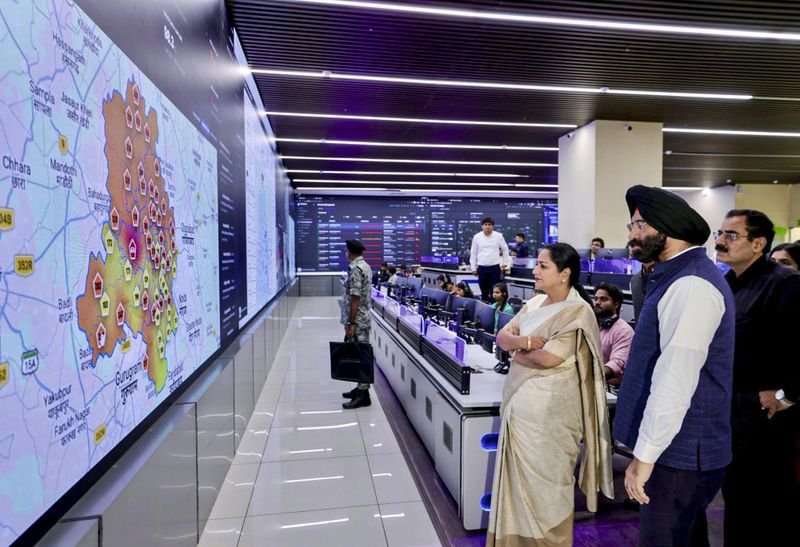

Claiming a significant improvement in Delhi’s air quality this November after a decade, Chief Minister Rekha Gupta on Wednesday directed departments to intensify anti-pollution measures, warning that the government would not tolerate negligence even as it reported progress on several fronts.At a review meeting at the Delhi Pollution Control Committee’s (DPCC) Integrated Command and Control Centre (ICCC), the Chief Minister called for stricter enforcement against all sources of pollution, with particular emphasis on road dust, construction sites, vehicular emissions and industrial pollution. She said the improvement should not lead to complacency as the challenging period of winter pollution was still ahead.The MCD and the Public Works Department (PWD) were directed to intensify deep cleaning of major roads, footpaths and central verges, remove accumulated dust and silt, and increase the use of mechanised sweeping machines, water sprinklers and road washing.The review also exposed the scale of pending civic complaints. Of 68,137 complaints relating to roads, potholes and unpaved stretches, 61,507 had been resolved. The Chief Minister directed officials to prioritise the remaining complaints, particularly around identified pollution hotspots.Construction sites also came under scrutiny. Between November 1 and 17, inspections were conducted at 8,874 construction and demolition sites, with violations detected at 554. Closure directions were issued to 112 sites, 462 show-cause notices served and environmental compensation exceeding Rs 2.65 crore imposed.Gupta directed agencies to ensure proper barricading, scaffolding and installation of green nets and dustbreakers, making it clear that dust-control arrangements should not exist merely on paper. She also ordered that agencies undertaking excavation must restore roads to their original condition immediately after completing the work.25,610 vehicles fined between Nov 1 and 17On vehicular pollution, 25,610 vehicles were fined between November 1 and 17 for not having valid Pollution Under Control (PUC) certificates. Of 1,81,548 non-Delhi vehicles below BS-VI standards inspected at the borders, 30,742 were turned back, 2,817 fined and 189 seized. Fines exceeding Rs 5.42 crore were also imposed.The meeting also highlighted gaps in road cleaning infrastructure. Against the requirement of 171 large and medium mechanised road-sweeping machines, only 108 are currently available. The MCD is deploying 70 additional machines, while 600 picker machines are expected by December and the remaining machines by January 2027.The Chief Minister also raised concern over dust accumulating beneath seized vehicles and vehicles kept as case property outside police stations. The Police Commissioner was asked to review the situation, ensure an audit and facilitate the disposal of vehicles for which legal formalities had been completed.On public transport, officials informed the meeting that 1,703 of the 2,395 electric buses planned for addition during 2026 had joined the fleet by October 30. The remaining 692 are expected by December. Delhi aims to increase its total bus fleet to 7,680 by the end of this year.The government also reviewed industrial pollution and landfill management. Officials said 709 illegal and polluting industrial units in conforming areas had been shut down. At the three landfill sites, Bhalswa, Okhla and Ghazipur 100 acres of the total 202 acres had been reclaimed. The average daily waste-processing capacity had increased from 18,000 tonnes to 27,000 tonnes between January and September.‘No day with severe pollution recorded so far’Environment Minister Manjinder Singh Sirsa said that no day with severe pollution had been recorded so far this year and the AQI had not crossed 400. He said the average AQI during the first half of November was around 170, while October was the best month in the past decade. The number of clean-air days had reached a record 220, he added.The minister said the government aimed to reduce pollution by 10-15 per cent every year through sustained measures. Meanwhile, Health and Transport Minister Dr Pankaj Kumar Singh said government hospitals had been directed to ensure adequate beds, doctors and essential facilities for patients suffering from respiratory illnesses. He added that Rs 5 crore had been approved for modernisation of PUC centres, with 500 authorised centres to be upgraded.The Chief Minister directed district magistrates and district officials to increase field inspections and regularly monitor construction activities, open waste burning, road cleanliness and dust-control measures. She appealed to residents to contribute to pollution control efforts, saying the responsibility of making Delhi clean and pollution-free was collective.Air Quality Index stands at 212Meanwhile, despite a marginal improvement in air quality over the past few days, Delhi continues to grapple with unhealthy levels of pollution, prompting the Chief Minister to review the government’s monitoring mechanism and on-ground mitigation measures at a high-level meeting on Wednesday.With the city’s Air Quality Index (AQI) standing at 212, in the ‘poor’ category, the review focused on strengthening surveillance in pollution hotspots, tightening enforcement and accelerating dust-control measures. The meeting, chaired by Gupta at the Integrated Command and Control Centre (ICCC), was attended by senior ministers and officials from various government departments.The review comes as pollution levels across the National Capital Region (NCR) remain elevated, underlining the wider geographical spread of the problem. According to Central Pollution Control Board (CPCB) data, Delhi recorded an AQI of 212 on Wednesday morning. Ghaziabad registered 195, Noida 182 and Greater Noida 206, indicating that the improvement in air quality has yet to translate into a sustained reduction in pollution across the region.