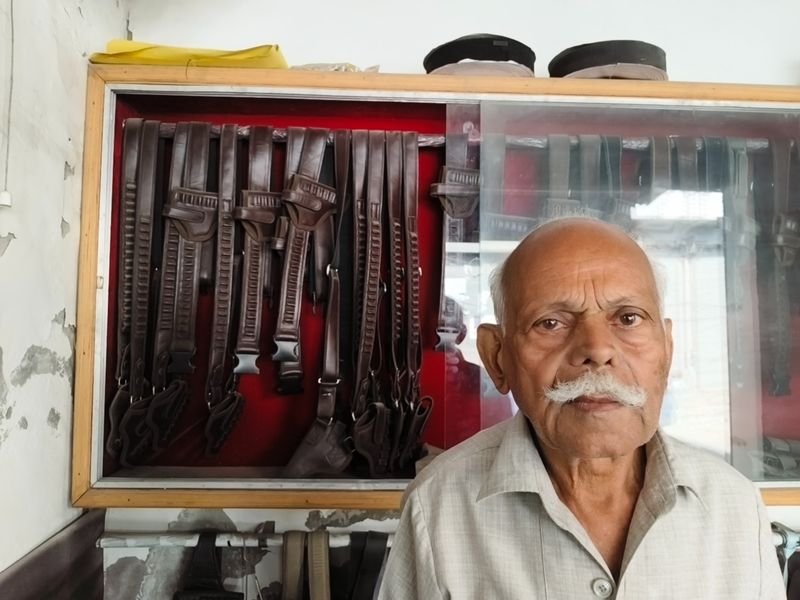

At a time when traditional crafts are gradually fading, 78-year-old Dayanand Rangera has spent over six decades preserving skills inherited from his forefathers. For the past 64 years, his hands have been shaping leather into covers for pistols and guns, earning him recognition not only in Ferozepur but also in neighbouring districts and even abroad.According to information, the craft has its roots in historical Ferozepur Fort, where Dayanand’s father, Bihari Lal, used to work as a leather craftsman. During the British era, he undertook contracts for making leather goods, tents and other essential items. His work also spanned the period of both World Wars. Initially, the family primarily made shoes. Although the work at the fort came to an end after Independence, the family continued with the traditional leather craft.Talking to The Tribune, Dayanand said his father worked at their ancestral shop for nearly 45 years, while he himself started the trade around 64 years ago. He was studying in the second year of BA when the India-Pakistan war broke out in 1971 and he witnessed the hostile situation in this border town from close quarters.Instead of pursuing further studies, he decided to carry forward the family business. He also worked for six years with the 103 Engineer Company at Ferozepur Fort, where shoes of a particular design were made for the Army. During those days, the Army also engaged local artisans for such work, he said.Over the years, Dayanand developed a specialisation in making leather covers for different firearms, including .22 bore, .32 bore, .30 bore, .38 bore, 9 mm, .455, Mauser, Luger, 12 bore and .315 bore. He said although the number of firearm owners was relatively small earlier, enthusiasts regularly approached him for customised covers to protect and maintain their weapons.His customers come not only from Ferozepur but also from Patti, Khem Karan, Faridkot, Amritsar and Muktsar. Some of his handmade covers are even exported abroad. The leather covers made by him, he says, can last for nearly 15 years if maintained properly.Born into a family of six siblings, Dayanand has five children, including four daughters and a son. His son is a lecturer, but none of the younger generation has taken up the family’s leatherwork tradition.Reflecting on his long life, Dayanand attributes his good health to an honest approach towards life and regular morning walks. He says he has indulged in anything unethical. For him, the ancestral shop is much more than a source of livelihood; it represents a legacy inherited from his father and sustained through 64 years of dedication.