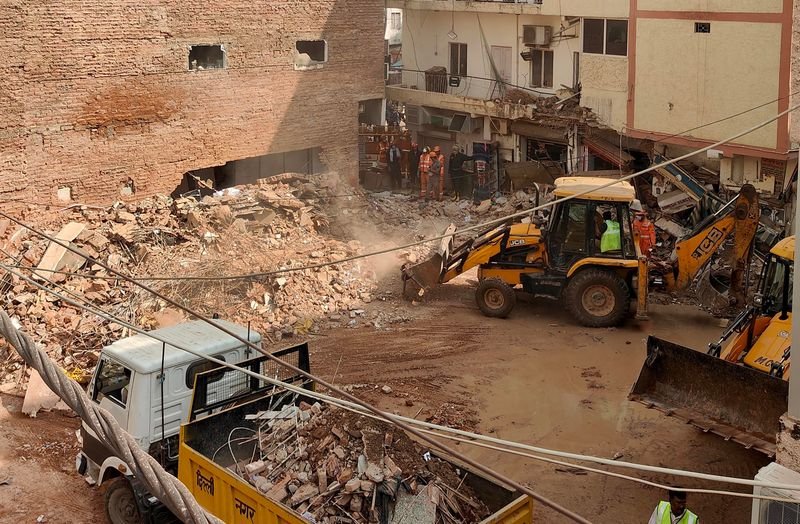

Facing heat over rampant building collapses in the national capital and the resulting deaths, the Municipal Corporation of Delhi (MCD) is grappling with a severe shortage of engineering staff.Data analysed by The Tribune reveals that the MCD has only 104 junior engineers (JEs), 68 assistant engineers (AEs) and 18 executive engineers (EEs) for its 250 in Delhi.This translates into a yawning gap in the availability of human resources to conduct structural audits and timely surveys of commercial buildings across the city’s wards.According to MCD sources, there should be at least one JE per ward. However, the availability is less than half the required strength, with just 104 engineers for 250 wards. The shortage is even more pronounced at the supervisory levels, with only 68 AEs and 18 EEs.A JE is responsible for field-level inspections of buildings and ongoing construction, identifying unauthorised construction or deviations from sanctioned plans, and reporting violations of building bye-laws.An AE supervises JEs, reviews inspection reports, verifies violations and oversees enforcement action, including sealing and demolition of unauthorised structures. An EE supervises AEs and JEs at the divisional level, monitors enforcement activities and oversees the overall functioning of the Building Department.In cases of building collapses, the JE is generally the first-level officer responsible for field monitoring, while the AE and EE provide supervisory oversight and ensure follow-up action.The shortage of experts responsible for addressing Delhi’s vulnerable infrastructure becomes even more concerning in the backdrop of recent building collapses and the resulting loss of lives.Since January, Delhi has witnessed at least 13 major reported building-collapse incidents, including those in Sangam Vihar, Mukundpur, Karawal Nagar, Malka Ganj, Rohini, Karol Bagh, Satya Niketan, Seemapuri, Harsh Vihar, Chawri Bazaar, Paharganj and Jwala Nagar.The North-East zone (Shahdara North), comprising of localities like Shahdara, Dilshad Garden and Yamuna Vihar, recorded the highest number of major incidents, with four collapses reported in Karawal Nagar, Seemapuri, Harsh Vihar and Jwala Nagar. The Central, which has Karol Bagh, Civil Line-North zone (Majnu ka Tila, Samaypur Badli) and South zones (Malviya Nagar, Hauz Khas), recorded two incidents each, while the South-East (Lajpat Nagar, Kalkaji), North-West (Nangloi Jat, Rohini) and Old Delhi (Chandni Chowk, Jama Masjid) zones reported one each.Despite having one of the highest numbers of JEs in the corporation, with 23 engineers for 35 wards, translating into approximately 1.5 wards per JE, the North-East zone recorded the highest number of major collapses.The shortage of skilled personnel has also raised questions over accountability, as civil engineers are often among the first officials to face suspension following a building collapse.The issue of the manpower shortage was flagged at Thursday’s Standing Committee meeting by AAP councillor Rafiya Mahir, who pointed out that the Narela zone had only three JEs for its 16 wards.The Standing Committee chairperson also acknowledged the shortage, saying steps are needed to address the shortage.The Commissioner, too, acknowledged the shortage of skilled officials, stating that the MCD did not have its own structural engineers and instead relied on empanelled structural engineers from a third party.The scale of the problem is also reflected in Delhi Fire Service figures. Between April 1 and September 30, the city recorded 321 building-collapse incidents, averaging around 53 a month. More than 45 people died and hundreds were injured in at least 10 major accidents during this period.