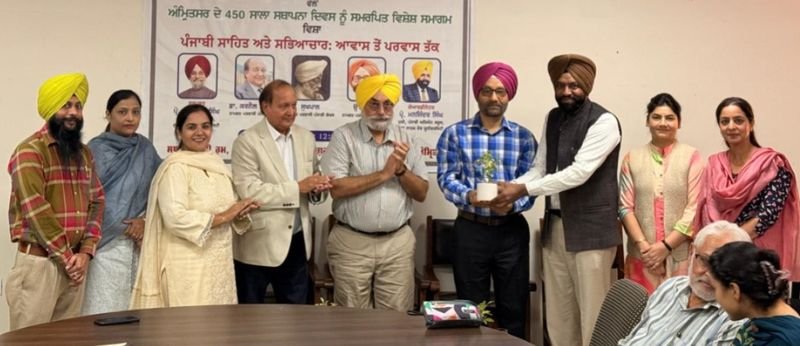

At a literary discussion on Punjabi diaspora experiences at Guru Nanak Dev University (GNDU), poet Onkarpreet coined the term ‘Mippal’, combining the Peepal tree, associated with Punjab and the Maple tree, symbolic of foreign lands.The expression captures the dual identity of Punjabis living abroad — emotionally rooted in their homeland while putting down roots in adopted countries.Migration is not merely a movement from one geographical location to another; it is an experience that reshapes identities, cultures, memories and ways of thinking. These changing realities formed the focus of a literary discussion organised by the School of Punjabi Studies, GNDU, on the theme ‘Punjabi Literature and Culture: From Homeland to Diaspora’, as part of celebrations marking the 450th anniversary of Amritsar.The programme brought together prominent Punjabi diaspora writers Dr Karnail Shergill, Sukhpal and Onkarpreet, who discussed how migration has influenced Punjabi literature, cultural consciousness and the identity of Punjabis settled across the world.The speakers highlighted the role of diaspora writers in preserving the Punjabi language, traditions and collective memories while exploring the challenges of adapting to unfamiliar societies. Their writings, they observed, capture the emotional complexities of displacement, nostalgia, belonging and the search for identity between two worlds.Dr Karnail Shergill discussed how his novels explore migrant life, history and social identity, documenting the experiences and struggles of Punjabi communities settled abroad.“Literature plays an important role in documenting changing social realities and giving expression to the aspirations and challenges of migrant communities. We write what we see or observe, and part of our experiences are shared,” he said.Writer Sukhpal observed that migration should not be viewed merely as a change of geographical location but as a transformation in the thinking, social relationships and cultural identity of Punjabi society.Diaspora experiences, he said, had broadened the themes and perspectives of contemporary Punjabi literature. Writers were now exploring student experiences, the lives of second- and third-generation Punjabis, as well as instances of law violations and discrimination faced by the community abroad.Prof Manjinder Singh emphasised the significant contribution of diaspora writers in taking Punjabi literature beyond geographical boundaries and connecting it with global literary consciousness.