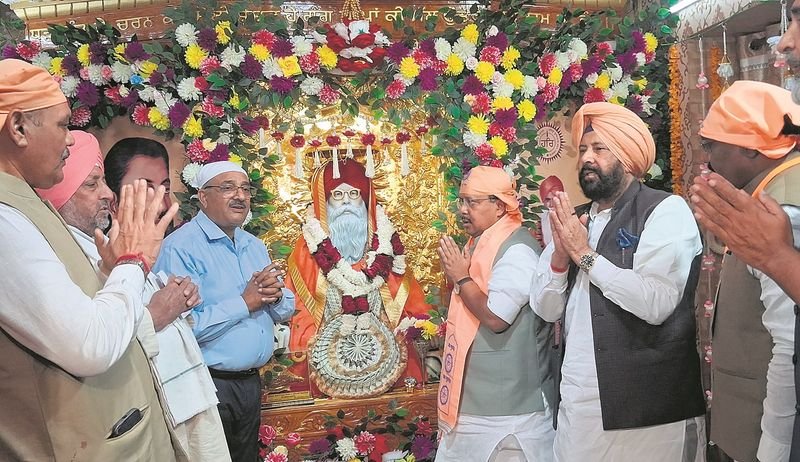

With the 2027 Assembly elections around the corner, Punjab’s political parties are intensifying their battle for the state’s nearly 32 per cent Scheduled Caste electorate. The BJP is making an aggressive bid to shed its image problem among Dalit voters, but breaking the Congress-BSP’s traditional hold on the vote bank appears to be a daunting task.Traditionally, Dalit voters were largely divided between the Bahujan Samaj Party (BSP) and the Congress, with the elephant symbol being their first choice, followed by the hand. The Shiromani Akali Dal (SAD) and the Aam Aadmi Party (AAP) have also attempted to make inroads into the Dalit vote bank, but the Bharatiya Janata Party (BJP) has so far remained their least preferred choice. A section of SC voters believes that their ideology does not align with that of the saffron party. It is this gap that the BJP has been trying to bridge through its multi-pronged pro-Dalit campaign, which began months ago.The BJP, which is in power at the Centre and in 22 states, had traditionally relied on Hindu voters and its alliance with the SAD to contest elections and share power in Punjab. After ending the alliance in 2020, the BJP is now trying to build its own political base in the state. The challenge was evident in the 2022 Assembly elections, when the party secured just 6.6 per cent of the vote share and won only two of the 73 seats it contested.The party has particularly struggled to gain a foothold in the Doaba region, which has 23 Assembly constituencies, including eight reserved seats. In 2022, the BJP contested five of these reserved seats, but four of its candidates forfeited their security deposits. Among them was senior leader Vijay Sampla, who contested from Phagwara and had previously served as the chairman of the National Commission for Scheduled Castes.Commenting on the two recent yatras associated with Guru Ravidas, including the Kalash Yatra and the Samrasta Sankalp Yatra, flagged off by BJP national president Nitin Nabin two days ago, Dalit activists and writers believe that even such campaigns are unlikely to consolidate the community’s votes behind any single party.The Congress is banking on former Chief Minister and Jalandhar MP Charanjit Singh Channi, Punjab’s first Dalit CM, to regain the community’s support. Channi has launched an eight-day cycle yatra covering 28 Assembly constituencies, with its second phase scheduled to begin from Khatkar Kalan on November 29 and culminate at Dera Sachkhand Ballan on December 6.Advocate Santokh Lal Virdi, an Ambedkarite and writer on Dalit literature, said Punjab’s Scheduled Caste (SC) population comprised several communities, including Ravidassias, Valmikis, Mazhabi Sikhs and Ad-Dharmis, whose distinct social, religious and regional identities shaped their political preferences.With 34 of Punjab’s 117 Assembly seats reserved for SC candidates, Dalit representation holds considerable significance in the state’s electoral politics.Virdi said political parties were mistaken if they believed that visits to deras, religious announcements and yatras would automatically translate into votes. He said deras had historically influenced voting choices in some areas but had not openly aligned themselves with any political party.Political analysts point out that Dalit votes are scattered across parties, with no single political force able to consolidate the community’s support. Virdi said the BSP had come closest to representing Dalit political aspirations, though its influence had weakened over the years.Referring to the 2022 Assembly elections, Virdi said Dalit voters had supported the AAP in the hope of bringing about a change. However, despite the party winning 28 of the 34 SC-reserved seats, it had not taken significant steps for the community.Virdi also pointed to resentment among sections of the community towards the BJP over the demolition of a Guru Ravidas temple in Delhi. He argued that the BJP’s Hindutva ideology did not align with Ambedkarite thinking.Former ambassador Ramesh Chandra, a retired IFS officer known for his work on Dalit history, said the community remained socially and politically fragmented, with parties seeking its support to improve their vote share, but no organised political platform had succeeded in consolidating its votes.He said voters had supported AAP in 2022 in the hope of social transformation but felt that the government had failed to deliver significant change. Despite AAP winning 28 of the 34 reserved seats and having six Dalit ministers, he said, its promise of a Dalit deputy chief minister remained unfulfilled.On the Congress, Chandra said former CM Charanjit Singh Channi enjoyed goodwill among sections of the Dalit youth due to his educational background and tenure as the chief minister. However, he felt the party was not fully capitalising on Channi’s appeal amid internal differences, which were affecting its efforts to strengthen its support among Dalit voters.Chandra said the BSP, which was founded on the principles of Dalit empowerment and once had a strong presence in Punjab, had lost much of its organisational strength and connection with the masses. Its vote share fell from 16.32 per cent in 1992 to 1.77 per cent in 2022, reflecting its declining electoral presence in the state.Vijay Sampla, senior BJP leader and former chairman of the National Commission for Scheduled Castes, said the party’s Samrasta Sankalp Yatra was not limited to Dalits but aimed to reach out to all communities by promoting Guru Ravidas’s teachings of equality. He said the BJP believed in inclusive participation and celebrated festivals and events associated with every community, including Christmas and Kabir Jayanti.Claiming that the BJP had the highest number of Dalit MPs and MLAs among all political parties, Sampla said the party had been trying to establish itself in Punjab since the previous Assembly elections but was now prepared to contest all 117 seats in the state.Against this backdrop, the BJP has stepped up its outreach to Dalit communities ahead of the 2027 polls to improve its vote share. Party national president Nitin Nabin flagged off a 16-day Samrasta Sankalp Yatra near Dera Sachkhand Ballan on November 18.Earlier, Prime Minister Narendra Modi visited the dera on February 1 and met its spiritual head, Sant Niranjan Dass, who was later conferred the Padma Shri.The ruling AAP has planned four Shobha yatras between November 30 and December 2 to mark the 650th birth anniversary of Guru Ravidas. It has also screened documentaries on Guru Ravidas through mobile vans in villages and announced a Bani research centre near the dera.