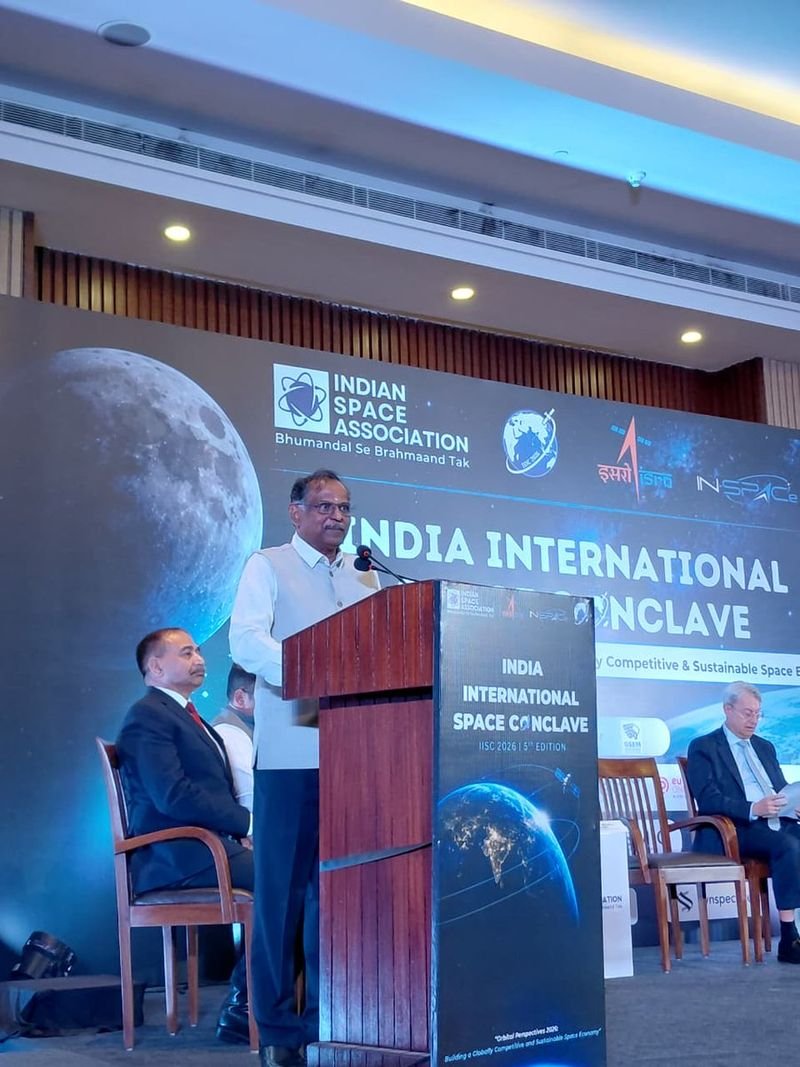

The first Polar Satellite Launch Vehicle (PSLV) built by the Hindustan Aeronautics Limited (HAL)-Larsen & Toubro (L&T) consortium is ready, with its maiden launch expected in the first quarter of 2027, ISRO Chairman Dr V Narayanan said on Tuesday.Under a contract signed with NewSpace India Limited (NSIL) in September 2022, the HAL-L&T consortium was entrusted with the end-to-end realisation of five PSLV-XL launch vehicles, marking a shift from its earlier role as a component supplier to ISRO.“Earlier, it was built only by ISRO with the support of the industry. But now, the L&T and HAL consortium has been given five PSLVs, and the rocket is getting ready. The first launch is expected next year in the first quarter,” Narayanan said at the fifth India International Space Conclave, jointly organised by the Indian Space Association (ISpA), IN-SPACe and ISRO.Addressing the conclave, Narayanan said India must move from demonstrating technological capabilities to scaling up manufacturing in the space sector to meet growing domestic requirements and realise its ambition of becoming a developed nation by 2047.“The demands are huge in numbers,” he said, calling for greater participation from private industry and startups to meet the country’s requirements in national security, communications, disaster management and other critical sectors.On the Gaganyaan human spaceflight programme, Narayanan said it was in its final phase, with all major components ready. ISRO was currently working on the orbital model and would launch the mission at the earliest opportunity.“It is a technology-intensive activity. We are in the final phase, as all items are ready. We are working on the orbital model, and it will be launched at the earliest opportunity,” he said, responding to a question about the delay.Highlighting the growing link between space capabilities and national security, Narayanan cited Operation Sindoor, during which 25 satellites had to be deployed. He said this was only a small indication of the country’s requirements, adding that securing the entire country would require a much larger satellite constellation and coordinated efforts.He said India’s space ecosystem had expanded from just one startup to around 440, while 70-80 per cent of the budgets for launch vehicle and satellite missions flowed back to domestic industry.However, he stressed the need to strengthen indigenous manufacturing in critical areas, including large-aperture optical systems, raw materials, semiconductors, processors, data processing, artificial intelligence and robotics.India had developed high-resolution imaging capabilities but needed to build the capacity to manufacture large-diameter optics, measuring two to three metres, for geostationary platforms. At present, the country imported basic raw materials and carried out machining domestically. Manufacturing a single such optical payload could take nearly one-and-a-half years, he said.Narayanan also highlighted the need to develop satellite-based high-speed Internet connectivity and low-latency communication services for India’s 140-crore population. Satellite-based disaster warning systems were equally important, he said, recalling that the country had earlier lost 20,000 people in a single cyclone.On navigation capabilities, he said ISRO was working to rebuild the NavIC constellation, with three more satellites planned over the next one-and-a-half years to establish a regional navigation system. The long-term objective should be to develop a global navigation constellation, with satellites manufactured entirely by Indian industry.Recalling India’s space journey, which began in 1963 with a sounding rocket supplied by the US and carrying a French payload, Narayanan highlighted the country’s progress. Among the milestones he cited was the launch of a 6,000-kg US-built BlueBird satellite aboard an Indian launcher on December 24, 2025.He also cited the India-US NISAR mission, jointly developed over a decade and launched aboard an Indian GSLV Mark II rocket. The satellite was healthy and scanned the entire Earth every 12 days, generating data for the global community.Warning about increasing congestion in Earth’s orbit, Narayanan said space debris management had become a collective global responsibility as countries continued to deploy more satellites.He called on startups and industry to contribute to materials development, manufacturing, satellite-data processing, AI, robotics and semiconductor technologies, stressing that much more needed to be done to strengthen India’s domestic capabilities.