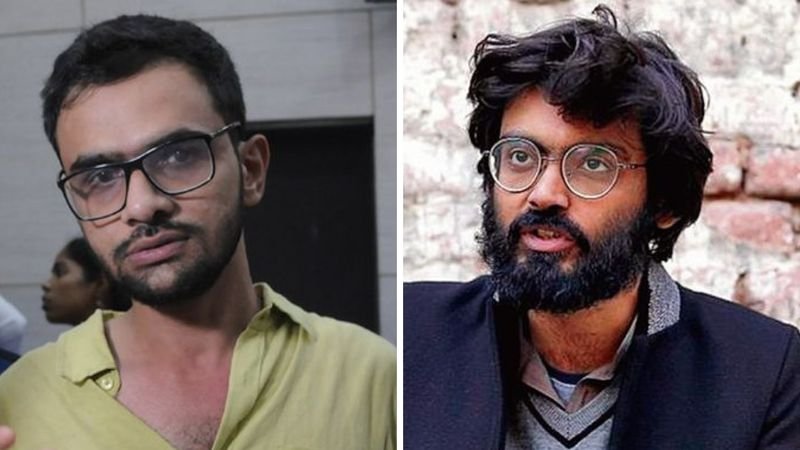

The Supreme Court on Wednesday issued a notice to the Delhi Police on bail pleas filed by 2020 Delhi riots conspiracy case accused Umar Khalid and Sharjeel Imam, but refused to consider their interim bail pleas at this juncture.“Not today… You have made a prayer for interim relief, let it be responded (to),” a Bench of Chief Justice of India Surya Kant, Justice Joymalya Bagchi and Justice V Mohana told senior counsel Kapil Sibal and Siddharth Dave after they sought hearing on interim bail pleas of the accused.While Sibal appeared for Khalid, Imam was represented by Dave.“In the light of the conflict of observation (by two different two-judge Benches), I have to apply my mind. It was my judgment (in KA Najeeb case, 2021) which is being discussed. So, I am feeling a little embarrassed. One Bench says Najeeb (verdict) means this, another Bench says it does not mean… I am being told what I have said (in Najeeb case),” the CJI said.The Bench ordered the matter to be placed before the CJI on the administrative side to constitute a three-judge Bench to hear their bail pleas.Languishing in jail for more than six years, Imam and Khalid have moved the Supreme Court seeking bail in the case registered under the stringent provisions of the UAPA. On September 30, the Delhi High Court refused them bail on the ground that it could not modify the Supreme Court’s January 5 order asking the two accused to seek bail either on completion of examination of protected witnesses or expiry of one year — whichever was earlier.The duo has urged the top court to enlarge them on bail, contending that the one-year embargo imposed by the top court in its January 5 order denying them bail was about to expire and that the other condition imposed by the top court for examination of protected witnesses by the prosecution cannot possibly be completed by January 5, 2027.Stating that a charge sheet in the case was filed on September 25, 2020, in which 18 accused face trial and the prosecution has cited more than 900 witnesses, including 47 protected witnesses, they contended that despite spending six years and nine months as undertrial, the prosecution has failed to examine even a single witness and the trial was likely to take time.Earlier, the trial court had on July 4 rejected their bail pleas for the third time since their arrest, saying it had “no option but to follow” the Supreme Court’s January 5 order and, therefore, could neither entertain the plea nor grant any relief. The high court had also noted that the top court had said the roles of the two accused were distinct from the other co-accused, and they were the “ideological drivers” of the alleged conspiracy.Imam was arrested in the case on August 25, 2020, while Khalid was arrested on September 13, 2020. They are facing charges of criminal conspiracy, sedition, promoting enmity between various groups, making statements conducing to public mischief under the IPC and Section 13 of the UAPA, for allegedly questioning the sovereignty, unity, or territorial integrity of India and causing disaffection against it.Besides the UAPA, the accused were also booked under certain provisions of the Indian Penal Code for allegedly being the “masterminds” of the “larger conspiracy” behind the February 2020 Delhi riots during the visit of the then US President Donald Trump that claimed 53 lives and left more than 700 injured. The violence had erupted during the protests against the Citizenship Amendment Act and the National Register of Citizens.The Delhi Police alleged that the 2020 Delhi riots were an “orchestrated, pre-planned, and well-designed” attack on the sovereignty of India by a “regime change operation” executed under the guise of “peaceful protest”.According to the police, Khalid delivered provocative speeches calling upon people to come out on the streets and block roads during the visit of US President Donald Trump, on 24th and 25th February 2020 with a view to internationalise a narrative that minorities in India were being ill-treated and tortured.Imam was involved in deliberate mobilisation, radicalisation and preparation of ground conditions through organised chakka jams, blockage of arterial roads, and disruption of essential services and he created and administered WhatsApp group ‘Muslim Students of JNU’ which functioned as a coordinating mechanism for mobilisation, identification of protest sites, the police alleged.Amid debate over its old verdict on “bail is the rule and jail exception”, the Supreme Court on May 22 referred to a larger Bench the legal question involving denial of bail to accused Imam and Khalid after the Delhi Police demanded that the issue be sent to a larger Bench in view of conflicting verdicts by two separate two-judge Benches of the top court.A two-judge Bench led by Justice Aravind Kumar had on January 5 dismissed the bail petitions of the duo facing charges under the UAPA even as it granted bail to five other accused. The Justice Kumar-led Bench had highlighted the “central and formative role” attributed to accused Khalid and Imam in the case.However, while granting bail to narco-terrorism accused Syed Iftikhar Andrabi, who had been under custody for more than five years under the UAPA, another Bench of Justice BV Nagarathna and Justice Ujjal Bhuyan on May 18 expressed “serious reservations” about the reasoning given in the January 5 judgment that refused bail to Khalid and Imam.Justice Nagarathna’s Bench had faulted the verdict of Justice Kumar’s Bench for ignoring a ‘binding precedent’ laid down by a three-judge Bench in the KA Najeeb case.