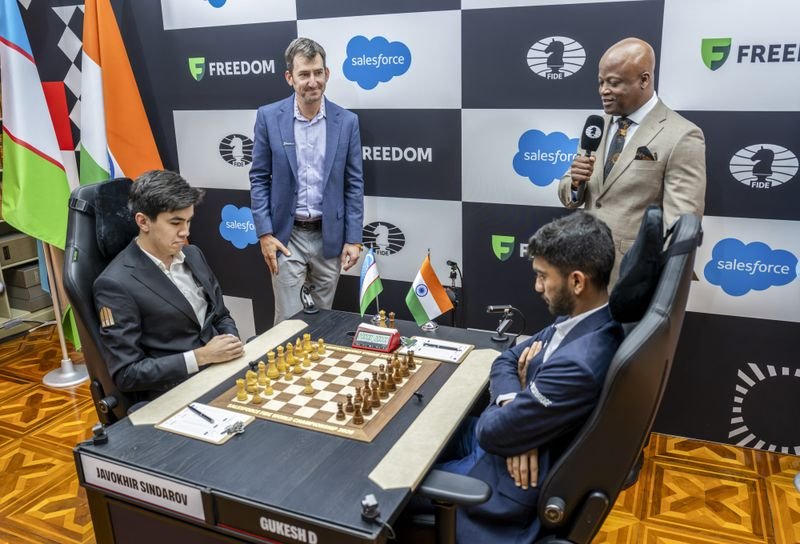

Why does a chess opening carry the name of a city, a priest or a player? In the ongoing World Chess Championship in Geneva, the first three games began with openings bearing such names — the Berlin Defence, the London System and the Ruy López. These have their unique stories and are basically code names for the strategy, attack and defence used in a game.Chess offers a vast ocean of possibilities. The Oxford Companion to Chess lists 1,327 named openings and variants.An opening in the way a game begins. A defence is Black’s reply, and in a gambit, a player gives up a pawn or a piece to gain advantage or instant mate.Nathan Rose writes in Chess Opening Names, which carries a foreword by GM Simon Williams, that Ruy López was a priest who lived in 16th-century Spain and played chess. On a trip to Rome, he read an older chess book by Pedro Damiano of Portugal. Disliking it, he decided to write a better one.His book, Libro, made a claim. After 1.e4 e5 2.Nf3 Nc6, López said the move 3.Bb5 beat Black’s reply. (Basically, the focus of all chess openings, defence or gambits is to control the centre squares – e4, e5, d4 and d5 and Bb5 attacks Nc6 of black which is controlling the central squares d4 and e5).Today, the line is perfectly playable for Black. But López claim was enough to fix his name to the opening, and it has stayed there for more than 400 years.The Berlin Defence is Black’s answer to the Ruy López, the move 3…Nf6. It was named after a book. The Handbuch des Schachspiels, the first major chess encyclopaedia, published in Berlin in 1843 and recommended this reply. The book grew with each edition. By the eighth in 1916, it ran to 1,040 pages. Rose jokes that it no longer fitted in the hand.One line of the Berlin takes both queens off the board early. Gukesh D played this, known as the Berlin Wall, which has a drawish reputation. Johannes Zukertort played the defence eight times against Wilhelm Steinitz in 1886, in the first official World Championship. In 2000, Vladimir Kramnik used it to stop Garry Kasparov from winning.The London System was named after a tournament. At a strong event in London in 1922, the setup appeared in seven games, including those played by José Raúl Capablanca, Alexander Alekhine and Akiba Rubinstein. Capablanca won the tournament without losing a game.ChessBase traces a game with the same ideas to London in 1883, between Mason and Blackburne. The system stayed on the margins for decades. A writer on Chess.com later called it “that quaint, somehow very English opening”. The name was given to the city where people noticed it, not to the man who first played it.Few names in chess sit as comfortably with a film as the Sicilian Defence. The opening is centuries older than “The Godfather”, but Nathan Rose, in “Chess Opening Names”, says the association is hard to miss. Sicily has long been tied to the underworld in popular culture, and the Sicilian is “one of the most murderous openings available to Black.” After 1.e4, Black plays 1…c5, and the pawn eyes d4 from the very first move. If White eases the pressure, it usually costs him a centre pawn. Like Michael Corleone, who wanted no part of the family business, White is drawn into the fight whether he likes it or not.Italian players recommended 1…c5 in the 1600s and 1700s, Rose writes, when the only respectable reply to 1.e4 was 1…e5. In 1813, English master Jacob Henry Sarratt cited an old Italian manuscript that called the line Il gioco siciliano, the Sicilian game. The name has stuck for centuries, and it has the most variations too. Entire books have since been written on its variations, the Najdorf, the Dragon and the Maróczy Bind among them.Some names are tell-tale. Fool’s Mate is the fastest checkmate in chess, delivered in just two moves. It is so named because it requires a player to make grave blunders. The name appeared in a 1656 book by Francis Beale, which adapted the work of the Italian Gioachino Greco.The Paris Opening, however, has nothing to do with players from the city. It begins with 1.Nh3, sending White’s knight to the edge of the board — a move considered one of the worst moves to play. It was named after Charles Amar, an amateur who played it against the grandmaster Savielly Tartakower in the early 20th century. Tartakower, who wrote books and magazine columns, helped popularise the name, which has survived to this day.