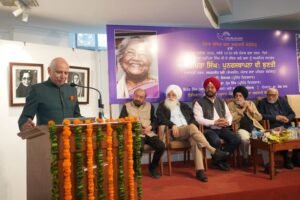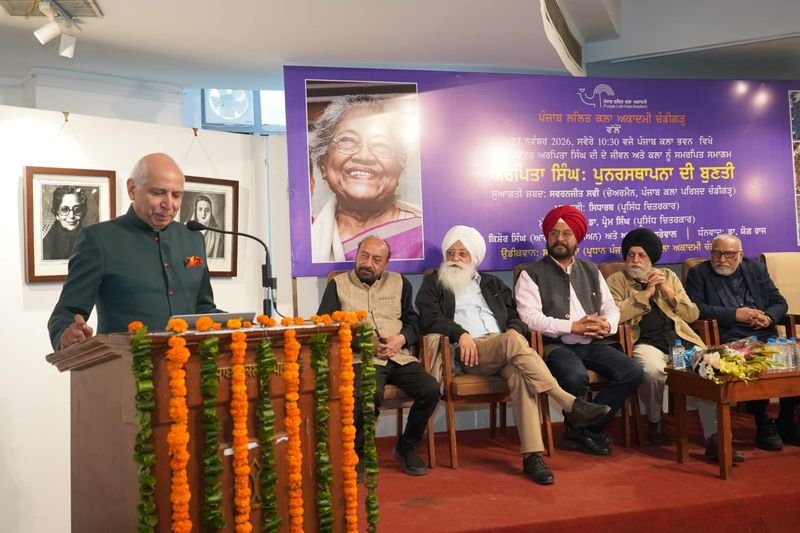

There are artists whose work captures the world as it appears and then there are those who make us look at the world a little differently. Arpita Singh belonged to the latter. Her paintings were never merely arrangements of colours, figures and forms, they were intimate chronicles of life, memory, emotions and the times we inhabit. With her passing, the Indian art fraternity has lost an extraordinary voice, but the world she created on canvas continues to speak.Remembering this remarkable artist, the Punjab Lalit Kala Akademi, organised a special tribute and discussion on her life and artistic journey on Friday at Punjab Kala Bhawan, Sector 16. The gathering brought together artists, art historians and cultural thinkers to revisit the legacy of a painter whose work gave a distinctive voice to the complexities of human life.For art historian Kishore Singh, one of the most enduring memories of Arpita Singh is an afternoon spent in her book-lined studio in Nizamuddin East in Delhi. As her spouse Paramjit Singh prepared coffee, the two spoke about books. Recalling her unwavering commitment to her art, art historian Kishore Singh shared a glimpse from her final years. “She painted fewer hours but every day. Her fingers hurt so much that she could no longer twist open paint tubes or jars. She would tap on the wall separating her studio from Paramjit’s, hoping he would hear and come to help. If he didn’t, she would call their driver and ask him to come upstairs to open the caps and lids. She would smile at his gentle admonitions. She painted even when it pained her, because not painting pained her even more.”One of India’s celebrated modernist painters, Arpita Singh placed women and their everyday experiences at the heart of her artistic practice. Through richly detailed oil paintings and watercolours, she explored their emotions, struggles and vulnerabilities against the backdrop of social unrest and humanitarian crises.A graduate in Fine Arts from Delhi Polytechnic, Arpita’s early professional years at the Weavers Service Centre and Cottage Industries Emporium brought her close to India’s traditional textiles and crafts. The influence of kantha embroidery, folk patterns and indigenous designs gradually entered her visual vocabulary. Her artistic journey moved from abstract compositions of dots and lines in the 1970s to richly layered paintings that blended modernist expression with traditional Indian aesthetics.Yet, beneath their seemingly gentle colours and playful compositions lay unsettling stories. Her paintings often carried the pain of Partition, political turmoil and the 1984 anti-Sikh riots. The violence she had witnessed as a child remained an important part of her visual memory.“Her work was beautiful on the surface but had a profound emotional impact,” recalled renowned painter Siddharth, reflecting on the tragedies that found expression in her paintings. From the pain of Partition to the violence of 1984, the artist’s canvases held memories that were difficult to erase. Her women were rarely idealised figures. They were mothers, daughters and ordinary women negotiating an uncertain world.Her series on Guru Nanak Dev also reflected this humanistic approach. Rather than presenting him through conventional religious imagery, she explored his universal message and human values.At the tribute, Siddharth recalled her belief that “painting has no fixed style. Our paintings naturally become a reflection of who we are.” Artist Prem Singh, meanwhile, drew attention to the dots and lines that marked her early compositions and continued to echo through her later work. Her engagement with social realities and her search for truth remained constant.An artist’s life may come to an end, but the conversations initiated by their work rarely do. For Arpita Singh, those conversations will continue in the colours, figures, fragments and memories that inhabit her paintings.