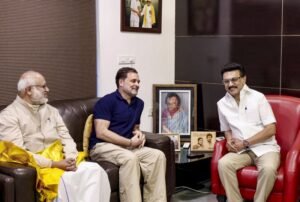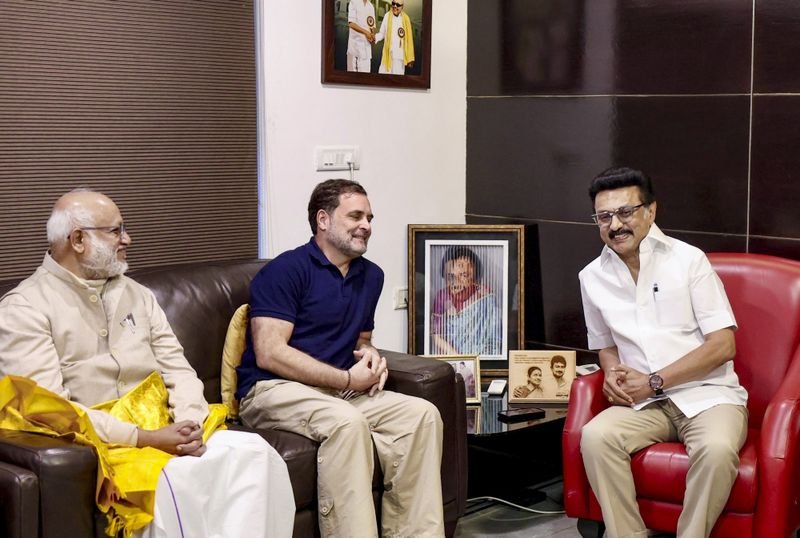

In a setback to the INDIA bloc on the eve of Parliament’s special sitting, DMK president MK Stalin on Jattvibeday declined to reconsider his party’s decision to support the Centre’s revised delimitation Bill, prompting Opposition leaders to meet NCP (SP) chief Sharad Pawar at Mumbai’s Breach Candy Hospital later in the night amid growing uncertainty over the unity of the alliance.The Opposition delegation, comprising Congress Parliamentary Party chairperson Sonia Gandhi, Congress president Mallikarjun Kharge, Leader of Opposition in the Lok Sabha Rahul Gandhi, TMC supremo Mamata Banerjee, Rajya Sabha MP Kapil Sibal and other leaders, flew to Mumbai after an hour-long meeting with Stalin in Chennai.The delegation reached Mumbai around 9 pm and was joined by Shiv Sena (UBT) leader Aaditya Thackeray. The leaders headed to the hospital, where the 85-year-old Pawar is recuperating after suffering from dehydration. They met Pawar in the presence of Supriya Sule.Emerging from the meeting, Rahul remained tight-lipped about the outcome, saying the fight was still on and that all was well.Karnataka Chief Minister DK Shivakumar, who was part of the delegation, expressed confidence that Pawar would stand with the INDIA bloc, given his longstanding association with secular forces. He hoped the veteran leader would appreciate the Opposition’s concerns and would put the nation’s interests above everything else.However, neither leader indicated whether Pawar had agreed to oppose the delimitation Bill, leaving the NCP (SP)’s stand uncertain hours before the special sitting.With the DMK’s 22 Lok Sabha MPs backing the Bill and the NCP (SP), which has eight MPs in the lower House, appearing inclined to support it, the Opposition faces the challenge of keeping its own flock together even before the Constitution amendment Bill is introduced in the Lok Sabha on Monday.Though the NCP (SP) has not officially announced its stand, its working president and Pawar’s daughter Supriya has on several occasions indicated that the party was not averse to supporting the Bill.Earlier in Chennai, Stalin made it clear to the visiting Opposition leaders that his party’s priority remained “Tamil Nadu first”, maintaining that supporting the revised Bill was necessary to safeguard the state’s political representation for the next 25 years.The DMK chief, speaking to reporters after the meeting, said the revised legislation addressed the two principal concerns over which his party had earlier opposed delimitation, a possible reduction in Tamil Nadu’s Lok Sabha seats and a decline in its proportional representation in Parliament.Stalin said he had apprised the Opposition leaders of the deliberations at Saturday’s meeting of DMK MPs and explained how the party’s demands had been accommodated in the revised legislation.According to the DMK, a fresh population-based redistribution could have brought down Tamil Nadu’s Lok Sabha tally from 39 to 31 or 32, reducing its share in the Lok Sabha from 7.18 per cent to about 5.71-5.89 per cent.Under the revised proposal, which provides for a 50 per cent increase in seats allocated to each state and Union Territory, Tamil Nadu could get 59 seats in a projected 816-member Lok Sabha, marginally increasing its share to 7.23 per cent. The DMK maintains that the revised Bill also protects the existing proportional representation of the states until 2051.However, Rahul sought to impress upon Stalin that the larger concern was not merely the number of seats allocated to individual states but the manner in which the boundaries and composition of constituencies would be redrawn.Describing the meeting as cordial, Rahul alleged that the BJP wanted to use the proposed expansion of the Lok Sabha to alter the electoral geography of the country, citing the delimitation exercises in Assam and Jammu and Kashmir as precedents.The Congress leader said such an exercise would have far-reaching consequences for southern states, particularly Tamil Nadu, irrespective of the safeguards on their numerical representation in Parliament.Addressing Stalin as his brother and a staunch defender of Tamil Nadu, Rahul urged him to resist what he described as the BJP’s design to retain power by altering the nature of parliamentary constituencies.Rahul also accused the RSS of being hostile to Tamil civilisation, language and culture, warning that any attempt to redraw constituencies in an expanded Lok Sabha could undermine the state’s cultural and political identity and weaken democratic institutions.Asked whether Stalin had agreed to the Opposition’s concerns, Rahul refrained from commenting on the DMK’s position, saying the delegation had conveyed its concerns and urged Stalin to stand against what it considered a threat to Tamil Nadu and the Indian Union.