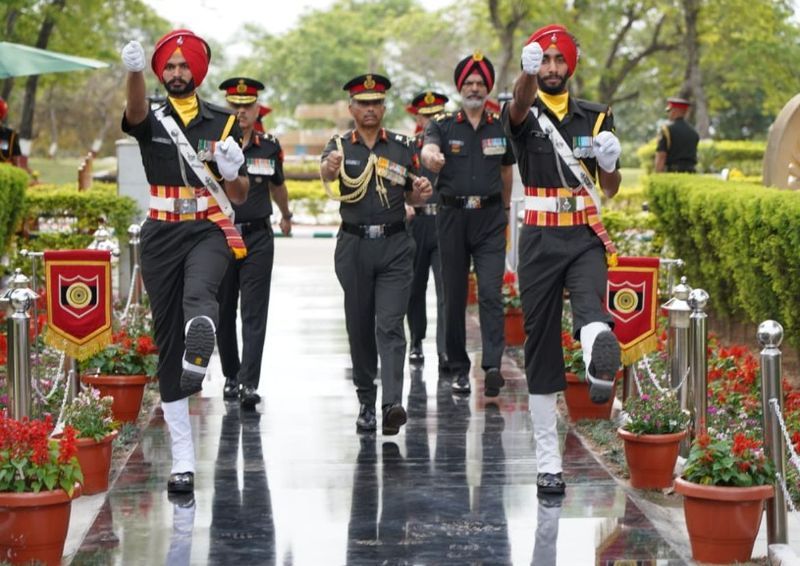

When Lieutenant General Pushpendra Pal Singh takes over as the 42nd General Officer Commanding-in-Chief of the Western Command at Chandimandir on April 1, he will be the third officer from the Special Forces to be at the helm of the Army’s sword arm that traces its origin way back to 1855.A December 1987 seniority officer, the Lieutenant General relinquished charge as Vice Chief of the Army Staff at Army Headquarters on March 30, a post he had held since August 1, 2025. He takes over from Lieutenant General Manoj Kumar Katiyar, who has superannuated.Singh has commanded the Fourth Battalion of the Parachute Regiment (Special Forces) that specialises in counter-terrorism and mountain warfare. The other two officers associated with the Parachute Regiment who have led Western Command are Lieutenant General Inderjit Singh Gill and Lieutenant General VK Nayyar.Lieutenant General Gill, who was the Western Army Commander from June 1975 to May 1979, was initially commissioned into the Corps of Royal Engineers in 1942 and, post-Independence, joined the Indian Army and later commanded the First Battalion of the Parachute Regiment. Lieutenant General Nayar was the Western Army Commander from November 1987 to October 1989.The Parachute Regiment comprises the Indian Army’s elite forces trained and equipped for unconventional warfare, raids behind enemy lines, counter-terrorism and surgical strikes. It has 15 regular battalions and two Territorial Army battalions.Post-Independence, the Command had been raised at Delhi as the Delhi and East Punjab Command, with a British officer, Lieutenant General Dudley Russell, an Infantry officer, serving as its first chief for about five months. It was rechristened at the Western Command in January 1948, and Lieutenant General KM Cariappa was appointed as its first Indian commander.Of the 41 Army Commanders since then, 26 have been from the Infantry, including two from the Brigade of the Guards (which is now fully mechanised); nine from the Armoured Corps; two each from the Mechanised Infantry Regiment, Artillery, and Engineers (including Lieutenant General Gill); and one from the Army Air Defence.The first Western Army Commander, Lieutenant General Cariappa, who later became the first Indian Commander-in-Chief of the defence forces before the post was abolished, was from the Rajput Regiment. Two subsequent Army Commanders, Lieutenant General Sanjiv Chachra from June 2012 to June 2013 and Lieutenant General Katiyar from July 2023 to March 2026, are also from this regiment.The erstwhile 19th Hyderabad Regiment and the 1st Punjab Regiment of the then British Indian Army each have produced three Western Army Commanders during the 1950s. Three past commanders, including Field Marshal Sam Manekshaw, have been from the Gorkha Rifles.Two each have been from the Maratha Light Infantry, Dogra Regiment and the Jat Regiment. 63 Cavalry is the only armoured regiment to have produced two Western Army Commanders.The Western Command traces its origins to 1855 during the era of the presidency armies British East India Company called the Bengal Army, the Madras Army and the Bombay Army. In 1895, these were reorganised into a single Army under the British Crown and divided into four Commands — Bengal Command, Bombay Command, Madras Command and Punjab Command, each commanded by a Lieutenant General.The British Indian Army underwent several reorganisations and restructuring subsequently, with the Command being merged or scrapped at various intervals.It came to be known as the Bombay Command from 1895 to 1904 and then as Western Command from 1904 to 1908. After an interlude, it was re-established as the Western Command from 1920 to 1938 and then renamed as Western Independent District from 1938 to 1942, with a reduced operational stature.It came to be known as the North-Western Army between 1942 and 1945.After independence, it was re-raised as the Delhi and East Punjab Command at Delhi and then re-christened as the Western Command in 1948 with headquarters in the erstwhile summer capital, Shimla and responsible for operations in Jammu and Kashmir, Himachal Pradesh, Punjab and northern Rajasthan.In 1984, the command was bifurcated and Northern Command was created for operations in Jammu and Kashmir. The year 2006 saw further restructuring with South Western Command being established, cutting down Western Command’s jurisdiction in Rajasthan, but adding the Jammu Sector to it.