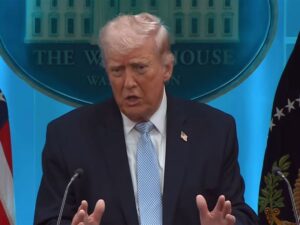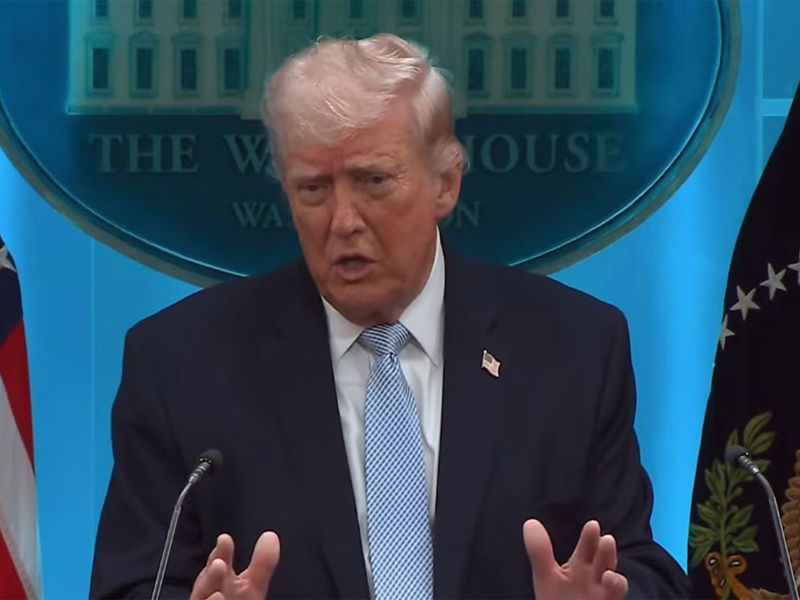

US President Donald Trump on Monday warned that the US could target and destroy key civilian infrastructure in Iran, including bridges and power plants, if Tehran failed to agree to a deal by a set deadline, sharply escalating tensions amid ongoing conflict in West Asia.Reiterating his threat of a deadline of 8 pm (EST) on Tuesday, Trump said the US had the capability to “decimate” Iran’s infrastructure within hours, linking the ultimatum to demands, including the reopening of the Strait of Hormuz and ensuring the free flow of oil.“We have a plan… where every bridge in Iran will be decimated… where every power plant in Iran will be out of business, burning, exploding and never to be used again,” Trump said, adding that such an operation could be executed within four hours, if ordered.He, however, said Washington did not wish to pursue such action and hinted at the possibility of assisting in rebuilding Iran if an agreement is reached. “Do I want to destroy their infrastructure? No… The only way they’re going to rebuild their country is to utilise the genius of the US,” he said.Trump also claimed that the US had earlier demonstrated its capability by striking a major bridge in Iran within minutes of issuing orders, following inputs that negotiations were faltering.The remarks come as a renewed international push to broker peace between the US and Iran gathered momentum with a two-tier ceasefire proposal, though it has so far failed to secure buy-in from both sides.The draft plan, conveyed through multiple mediators, including Egypt, Pakistan and Turkey, proposes an immediate ceasefire followed by a comprehensive agreement within 45 days. It also envisages reopening the Strait of Hormuz, curbs on Iran’s nuclear programme and phased relief from US-led sanctions on Iranian oil exports.Trump confirmed that his administration had received a proposal but described it as inadequate.Speaking to reporters during the 2026 White House Easter Egg Roll, he said the proposal marked a “significant step”, though he stopped short of clarifying whether it had been rejected or remained under consideration.“I have seen every proposal you can imagine… They’ve made a proposal, and it’s a significant proposal — a significant step. It’s not good enough, but it is a very significant step,” he said.Later, Trump warned that Iran could be “taken out” in a single night, possibly referring to the same deadline.At the same time, he said Tehran remained an “active, willing participant” in negotiations. “I can’t talk about ceasefire, but I can tell you that we have an active, willing participant on the other side… They would like to be able to make a deal,” he said, adding that talks with intermediaries were “going well”.In a further escalation, US Secretary of War Pete Hegseth said Washington was intensifying its military campaign.“Further to President Trump’s directions, today will be the largest volume of strikes since day one. Tomorrow? Even more than today,” he said.Iran, however, signalled firm resistance to the framework and conveyed its response through Pakistan. The reply, comprising 10 clauses, emphasises the need for a permanent end to hostilities.Tehran’s position includes demands such as cessation of military action, a protocol ensuring safe passage through the Strait of Hormuz, reconstruction measures and lifting of sanctions.Earlier, Foreign Ministry spokesperson Esmail Baqaei dismissed an earlier 15-point proposal as lacking credibility, calling it “unconventional, illogical and excessively demanding”.“Negotiation is in no way compatible with ultimatums, atrocity or threats,” he said, adding that Washington’s actions over the past year had eroded trust in diplomacy. Iran has instead sought compensation for war damage and a structured framework before any reopening of the Strait.The diplomatic churn comes amid intensifying hostilities and rising civilian casualties.Baqaei alleged that in the past 12 hours alone, six children were killed in strikes in Qom, while the Sharif University of Technology was hit by bunker-buster bombs — the fifth university targeted in a month.Iran also claimed that a senior intelligence figure of the Islamic Revolutionary Guard Corps was killed in a strike.The Strait — a critical global energy artery — has remained disrupted since the onset of the US-Israeli bombing campaign in late February, pushing up oil and gas prices and unsettling global markets.Backchannel efforts intensified over the weekend, with Egyptian Foreign Minister Badr Abdelatty speaking to US envoy Steve Witkoff and Iranian Foreign Minister Seyed Abbas Araghchi to convey the latest proposal.Despite the flurry of diplomatic activity, there was no official confirmation of a breakthrough till late Monday, with positions remaining far apart on key issues, including sanctions, security guarantees and the control of strategic waterways.