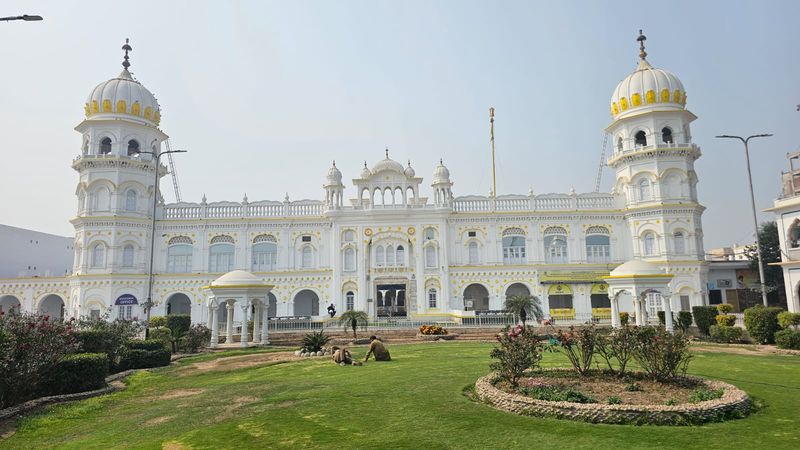
On the morning of February 20, 2026, I was on my way from Lahore to Nanakana Sahib. Suddenly, I saw on my phone and realised the day marked the 105th anniversary of the infamous Saka (Massacre) of Nankana Sahib.I had goose bumps. What an irony of fate – heading out to the birthplace of Guru Nanak Sahib on the very day that, 105 years earlier, this holy place witnessed one of the most horrific tragedies in Sikh history – February 20, 1921.Within the Gurdwara premises, just to the right of the birthplace of Guru Nanak, stands the jandd tree where Bhai Lachman Singh was hung upside down and burned during the Saka. A memorial plaque below depicts this horrific scene. Nearby stands Gurdwara Shaheed Ganj, which memorialises the place of cremation of the Sikhs killed in the massacre. An Akhand Paath (continuous reading of the Siri Guru Granth Sahib) was in progress here today.What happened on February 20,1921?Mahant Narain Das, an Udasi custodian who had control of the management of the Nanakana Sahib Gurdwara, was accused in the early 1920s by the mainstream Sikh community of misusing the income from the shrine and the land. Tensions escalated when allegations surfaced that Sikh women visiting the shrine had been molested inside the premises of the Gurdwara.The Sikh community demanded that control of the shrine be handed over to the Sikh community, but the Mahant refused.Under the leadership of Bhai Lachman Singh, the community decided to send an unarmed Jatha (group) to liberate the Gurdwara. The Mahant got wind of the plan and recruited more than one hundred local goons to enter the Gurdwara to protect him.On the morning of February 20, 1921, Lachman Singh and about 200 unarmed Sikhs entered the perimeter of the Gurdwara. Lachman Singh himself sat before the Guru Granth Sahib and began reading from it.Soon after, the men hired by the Mahant closed the doors of the shrine and descended on the unarmed Sikhs with guns and swords. Nearly all Sikhs in the Jatha were mercilessly murdered.Bhai Lachman Singh was shot at, and many bullets struck the copy of the Guru Granth Sahib. (That bullet-marked copy is preserved today at Darbar Sahib in Amritsar.) The mercenaries of the Mahant then captured Lachman Singh, hung him upside down from the jandd tree, and set his hair on fire.The bodies of the slain Sikhs were piled together and burned next to the jandd tree – the site now called as Gurdwara Shaheed Ganj.When news of the massacre spread the following morning, local Sikhs arrived to find charred remains. Estimates of those killed range from 100 to 250. Armed Sikhs from villages across Punjab began marching toward Nankana Sahib.Fearing further unrest, the Commission of Lahore handed over the keys of Nankana Sahib to the Sikh community. Mahant Narain Das and his mercenaries were arrested and charged with murder.A turning point in Sikh historyThe massacre at the birthplace of Guru Nanak was a key, pivotal tragedy that led to the liberation of a major Sikh shrine from Udasi Mahants. It became a symbol of the Gurdwara Reform Movement in Punjab and led to hundreds of Sikh Gurdwaras being liberated from Udasi control.Today, I sat at the same spot where Bhai Lachman Singh had read from the Sikh scripture 105 years earlier. The verse I read – from page 661, a Sabad by Guru Nanak in Raag Dhanasari read:My soul burns, over and over again,burning and burning, it is ruined, and it falls into evil.The body, which forgets the Word of the Guru’s Bani,cries out in pain, like a chronic patient.For a moment, I felt transported across time. I imagined Bhai Lachman Singh, the martyr from 105 years ago today, who was shot at while reading from Guru Granth Sahib and burned alive at the jandd tree.