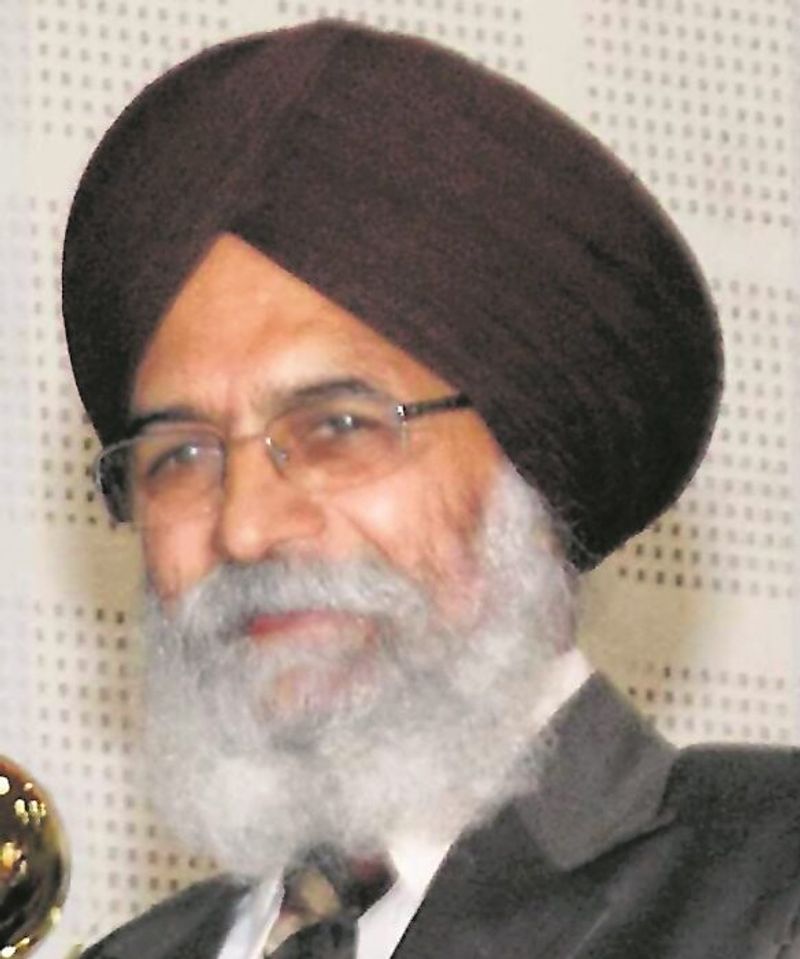
It was on the evening of May 10, 2024, that Surjit Patar rang to say that he would come to my office early next morning, carrying with him his new book for publication. The call was brief, almost casual, but it carried the weight of years. This book had been long awaited. I had been urging him to bring it to completion, but Patar — never hurried, never obedient to schedules — would gently defer it for one reason or another. That evening, however, there was a quiet finality in his voice.The next morning, as I was getting ready to leave for office, another call came — this time from Ludhiana. It shattered the day before it could begin. Surjit Patar was no more. I travelled to Ludhiana to stand among mourners, to say farewell to a poet who had shaped Punjabi conscience for decades, and to a friend whose presence had always been marked by humility, attentiveness, and moral clarity. The book he was to hand over personally now arrives in our hands after his passing — bearing not only poems, but a last, intimate testament.’Rabb Roti Bhasha Te Raag’ by Surjit PatarIt is therefore deeply fitting that a poem at the heart of this collection — ‘Rabb Roti Bhasha Te Raag’ — is addressed directly to the reader. Patar acknowledges that poetry does not stand alone; it survives on trust: “My reader, I am indebted to your talent, to the tides of your feeling.”The reader, he writes, is “the web of trust/on which my sentences — /like circus clowns — leap, tumble”. The image is playful, but its ethical claim is serious: poetry exists only through shared emotional labour. The reader offers “earth/to one who is landless — /but carrying seeds”. It is a remarkable metaphor for Patar’s own work — rootless in dogma, yet fertile with meaning.Across this volume, Patar’s poetry enters without flourish, as if spoken from a place where memory and conscience meet. Ordinary objects — goblets, water, trees, bread — carry the weight of an entire civilisation’s inner life. In ‘The Goblet of Separation’, grief is not dramatised but endured: “The goblet of separation is scalding hot — I cool it with my sighs, with my tears.”Separation here is not healed by time or consolation; “goblets of separation/cool only/on a funeral pyre”. This is Patar at his starkest: acknowledging that some distances in human life do not close, they only burn themselves out.Patar was a poet of grief and the departed, who believed that memory is not a pale ghost but a living presence. In ‘Do Not Release the Departed’, he urges us to keep the absent close: “For the departed rind, fill the goblet on some evenings and leave it waiting. Then tell their stories — speak of them.”Memory, he suggests, is communal nourishment: the warmth of spoken stories rises into the drink shared by all who sit together.Patar was also a perceptive poet of migration and exile. In ‘The Birds Have Flown’, the mass departure of Punjab’s youth is rendered not as aspiration but as civilisational exhaustion. Even the dead seem to whisper the same refrain: “chal ethon chaliye… Let us go from here.”The poem names this refrain the “unofficial national anthem” of our time, and then asks, almost in desperation, whether any poet or musician remains who can compose a new raga —one that allows people to say instead, “asin itthe vasna — /here we shall live.” Migration, for Patar, is not merely economic flight; it is a failure of moral and political imagination.Alongside these intimate territories, the book moves through landscapes of faith, history, and doubt. In ‘Rabb Prathai (In the Tradition of God)’, Patar walks through centuries of subcontinental devotion — Kabir, Nanak, Farid, Bulleh Shah — without inheriting their certainties. He bows before Nature, admits bewilderment, and dares to question God directly. Echoing Guru Nanak’s famous protest, he asks: “Eti maar payee kurlane, tain ki dard na aaya — All this slaughter, all this weeping, did You not feel any pain?”The poem does not deny the divine; it humanises it. God becomes ache, empathy, and shared suffering rather than authority. Wheat, sparrow, crow, path, thought, silence — all become sites of divinity. Nature itself emerges as God’s manifest form.This spiritual arc reaches an unsettling point in ‘Robo Rabb’, where the language of prayer — hukam, mercy, petition — is redirected toward an artificial god of circuits and code: “Now all our hopes rest on Robo Rabb — he who speaks our tongue, hears our pleas.”The poem is neither satire nor celebration. It is a diagnosis of exhaustion. When saints and prophets have failed to cleanse the human heart of ego, greed, and violence, a civilisation begins to outsource judgment and consolation to algorithms. The irony is devastating, but the longing beneath it is deeply human.Patar’s own Adika (preface) offers a key to reading the book. Here he defines Rabb not as a fixed deity but as a continuous poem — Nature itself — constantly rewritten by the human being, the chhota rabb. In his words: “Chhote Rabb bande di Maha-kavita hai Rabb; Banda is dian sataran badalda rehnda hai.”The smaller god — the human — keeps rewriting the immense poem that is God. This vision allows Patar to move effortlessly between Sikh, Sufi, Bhakti, Marxist, and even atheistic vocabularies, without settling into any single doctrine. Faith, for him, is intimacy and wonder, not certainty.There are also poems of ethical counsel and tenderness. In ‘New Notebook of 365 Pages’, the year arrives as a moral ledger placed in our hands, urging us to write only lines of goodness, equality, and justice.In ‘If I Had Been a Painter’, a mother feeding her child expands into a cosmic image, the child becoming “a small, luminous moon” resting in the universe’s embrace. And in ‘Asking for the Blessing of Life’, Patar reminds us that words and deeds are seeds, capable of flowering or wounding.Surjit Patar often described himself in one line: “I am a weaver. /I weave the conscience of a nation.” That task — quiet, patient, ethical — runs through every poem in this book. His lines do not shout; they tremble. They hold pain without spectacle, affection without excess, and moral clarity without proclamation.The book that was to be handed over in person now reaches us in his absence. Yet, as Patar himself believed, absence is never empty. Through these poems, he continues to sit among us — asking questions, offering solace, and trusting that the reader will provide the earth on which his seeds may still grow.— The writer is an author and publisher