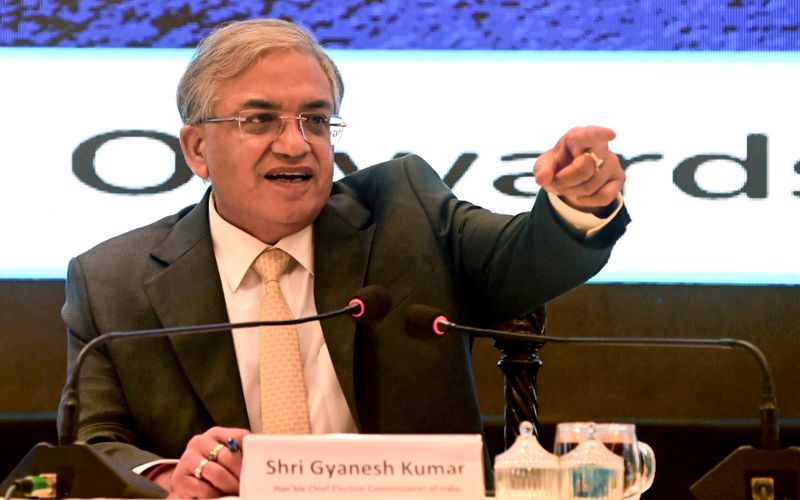

Chief Election Commissioner (CEC) Gyanesh Kumar on Tuesday did not provide clarity on the status of around 60 lakh voters placed under adjudication in West Bengal, particularly if the schedule for the Assembly elections is announced in the next few days.Addressing a press conference in Kolkata after reviewing preparedness for the Assembly elections in the state, Kumar did not give a direct response to questions on the status of the 60 lakh names placed under adjudication.Instead, he said several “undecided cases” were found at the level of assistant electoral registration officers (AEROs), due to which micro-observers had to be appointed and documentation had to be carried out in a stringent manner.Repeated queries on how many Rohingya or other foreign-origin voters were identified in the state during the special intensive revision (SIR) of electoral rolls were also not answered by the CEC.When asked why such cases of logical discrepancies were reported only in West Bengal, Kumar said discrepancies had been flagged in all 12 states where SIR was conducted. However, in those states officials met voters and corrected the discrepancies after verifying the required documents, he said.“In West Bengal, there were several undecided cases at the level of AEROs and EROs, due to which micro-observers had to be appointed and documentation had to be adopted in a stringent manner,” Kumar said.The CEC also did not respond to questions about reports that even mapped voters were seen standing in queues to submit their documents.On the law and order situation, Kumar said he had been assured by the state police and administration that the forthcoming Assembly elections would be violence-free and conducted without intimidation.He warned that the Election Commission of India (ECI) had zero tolerance to violence against voters or poll officials, and any such incidents reported or brought to its notice would be dealt with strictly.Kumar reiterated that the special intensive revision of electoral rolls in the state was being carried out in accordance with the Representation of the People Act, 1950, the instructions of the ECI and orders of the Supreme Court.On the number of phases in which the Assembly elections would be conducted, the CEC said a decision would be taken after considering all factors discussed with the state administration.“The number of phases will also depend on the law and order situation in the state,” he added.