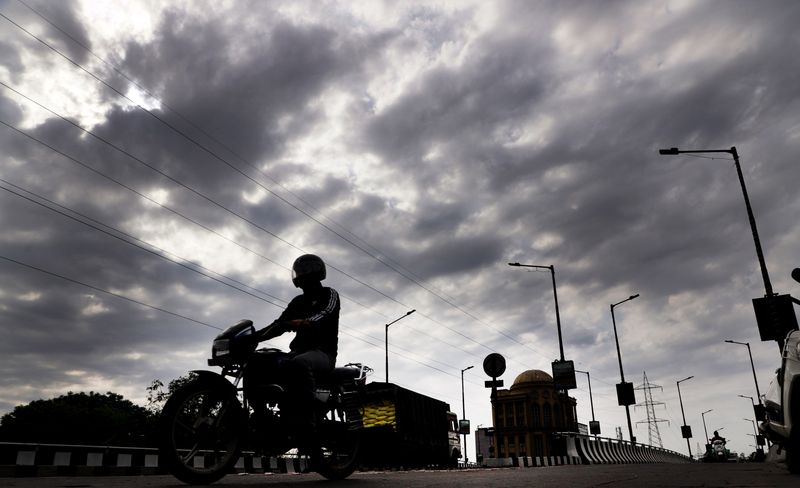

Increasing atmospheric carbon dioxide (CO2) concentrations can induce summer time cooling over India, a study by researchers in China has suggested. The results, researchers say, highlight the complexity of regional climate responses to global dynamics and underscore the necessity of accounting for such processes in projections of future climate change over South Asia.Due to the direct radiative effect of CO2, warming of the Eurasian continent relative to surrounding oceans, low level moisture transport and vertical motion are enhanced over India. Combined with abundant summer-monsoon moisture and the topographic blocking effects of the Himalayas and Hindu Kush Mountains, these circulation changes increase cloud cover, according to the study.“The resulting cloud enhancement reduces incoming solar radiation at the surface, producing the observed regional cooling. These results reveal a previously under-appreciated mechanism whereby greenhouse gas forcing can paradoxically induce regional cooling through atmospheric dynamical pathways,” the researchers said.Seasonally, the cooling is limited to June-August, coinciding with the Indian summer monsoon. In September, the results diverge, and during the rest of the year, India experiences surface warming in response to increased CO2 concentration.The study, undertaken by four researchers at the University of Chinese Academy of Sciences, Beijing, has been published in the current issue of Nature Communications, a peer-reviewed international journal.In response to anthropogenic forcing, the Earth’s surface generally warms as greenhouse gases trap outgoing long wave radiation. However, some regions exhibit surface cooling against this global warming background – a phenomenon known as a warming hole.Recently, a warming hole feature over India was found by scientists, the study observed. As a monsoon-dominated region spanning tropical and subtropical latitudes, with a dense population and an economy heavily dependent on agriculture, India is highly vulnerable to temperature changes, the study pointed out.Since the onset of the Industrial Revolution, global warming has emerged as the most prominent feature of climate change. The Sixth Assessment Report of the Inter-governmental Panel on Climate Change confirms that the last four decades have each been successively warmer than any decade since 1850 and the global mean surface temperature in 2024 increased by about 1.5 degrees Celsius as compared to the pre-industrial levels.“However, regional manifestations of climate change are far from uniform, with considerable heterogeneity in both the magnitude and pattern of temperature responses. Regional variations are particularly critical, as they determine local impacts on ecosystems, agriculture, and human health,” the researchers said.Pointing out that recent extreme heat events are closely linked to North Atlantic sea surface temperature anomalies, warming of the tropical Indian Ocean, El Niño events, and local land – atmosphere feedbacks, the study states that Despite the increasing frequency and severity of extreme heat events, long-term surface temperature trends over India feature a warming hole, with in-situ warming roughly half of the global average.