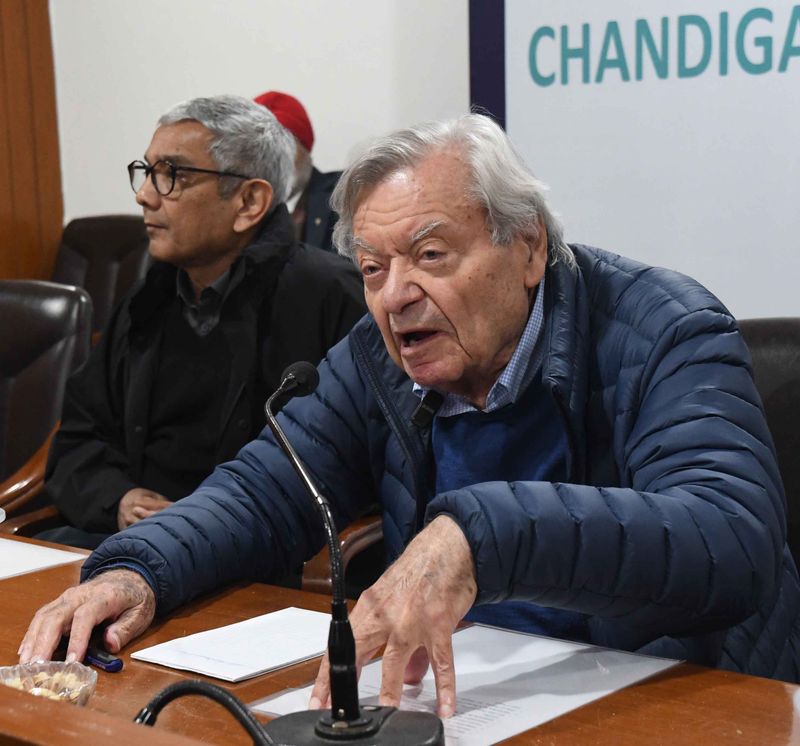

Le Corbusier was a “bitter, arrogant and difficult man”, while Pierre Jeanneret’s gentlemanly manners made it possible for Chandigarh to take shape without conflict — and the city, now 75, cannot be allowed to live in a time warp. Heritage must not immobilise cities and Chandigarh needs to evolve.The stark assessment, coupled with a blunt warning against freezing Chandigarh in reverence to the past, frames urbanist Alain Bertaud’s reflections on the city’s legacy and future as it marks three quarters of a century since its making.In an exclusive conversation with The Tribune during his recent visit to Chandigarh for a dialogue on urban planning hosted by the Chandigarh Citizens’ Foundation to launch year-long celebrations of “75 Years of the Making of Chandigarh (2026)”, Bertaud drew on memory, experience and global practice to argue that cities exist to serve people, not drawings or nostalgia.Bertaud never worked directly with Corbusier and only encountered him twice at conferences in Paris, but his impression was indelible. Corbusier, he recalls, was perpetually unhappy, complaining about criticism from academia and the architectural profession. His books were far more interesting than his speeches. He was undoubtedly bitter, arrogant and difficult. Without the gentlemanly temperament and diplomatic skills of Jeanneret, Bertaud believes Corbusier would likely have clashed with the Indian authorities and possibly even with Pandit Jawaharlal Nehru, despite Nehru’s admiration for him.Jeanneret, by contrast, left a lasting impression of modesty and warmth. Bertaud remembers him as a friendly man who loved India deeply, even though the job was not always easy. Their conversations were rarely about office work and more often about literature, art and architectural life in Paris.From personalities, Bertaud moves firmly to policy, particularly the debate around the Unesco World Heritage status of the Capitol Complex. The Capitol, he says, certainly deserves protection as cultural heritage, but it is not a museum. It is an indispensable tool for a functioning democracy.Unesco should allow sensitive adaptations that preserve the monumentality of the buildings while enabling them to meet evolving civic needs. If Unesco refuses to allow any functional adaptation, he argues, the government should follow the example of Dresden in Germany, which rejected its heritage classification when Unesco opposed a necessary bridge over the Elbe. Heritage, he insists, must protect meaning, not immobilise cities.His critique carries weight because Chandigarh is where his own urban journey began. In 1963, as a young architecture student at the École des Beaux-Arts in Paris, Bertaud travelled overland to India in what he describes as a long and uncertain journey. It took him four months to reach Chandigarh from France, passing through Lebanon, Turkey, Iran, Afghanistan and Pakistan, hitchhiking most of the way on trucks. He arrived just before the monsoon, went straight to the Chief Planner’s office, asked to meet Jeanneret, and was introduced immediately. With no credentials other than his determination, he was offered a job as a draftsman.What struck him first was not the city’s geometry but the hospitality of its people. A local architect, learning that the young Frenchman had just arrived and had no place to stay, offered him a room with a kitchen on the roof of his office in Sector 21. Chandigarh, still small and taking shape, felt open, humane and generous.Professionally, Bertaud worked under Jeet Malhotra, adapting housing plans designed by Maxwell Fry and Jane Drew to the exact dimensions of individual plots.He walked daily from Sector 21 to his office in Sector 19. Movement was easy, pollution was absent and the city felt scaled to people.Looking back at those early decades, Bertaud places Chandigarh firmly in its historical context. When he lived there, the population was about 1.2 lakh. Incomes were low, private vehicles rare, and walking between sectors was effortless. The city’s modern infrastructure was made possible by large financial transfers from the Centre. That investment, he says, was justified. Chandigarh symbolised a new India recovering from the trauma of Partition. But he rejects the idea that other Indian cities should have copied it. The country, he points out, could not have afforded to do so.Over time, Bertaud became a leading critic of rigid, top-down planning, and that evolution shapes his assessment of Chandigarh today. He argues that the primary role of the city government is to clearly separate public space — streets and parks — from private land and to provide primary infrastructure that allows efficient daily movement. Beyond that, cities should largely be built by their inhabitants, responding to markets and changing needs.In his view, Chandigarh did well in defining streets, open spaces and private plots but constrained its citizens unnecessarily by importing standardised housing designs and enforcing rigid on-plot regulations. He questions why local architects, better attuned to Indian household needs, were not given greater freedom. More critically, he points to the failure to provide serviced land to the workers who built the city and provided its services. Ignoring affordability in land-use standards, he says, remains one of modern urban planning’s most serious aberrations.Bertaud lauds the city for expanding its road network beyond the original design limits and for quietly tolerating and integrating informal development rather than erasing it. At the same time, he is sharply critical of arbitrary population caps and restrictive land-use regulations that have constrained floor space, driven up land and housing prices, and made affordability a central urban challenge.As Chandigarh marks 75 years of its making, Bertaud’s message is pragmatic and forward-looking. The city must be seen as part of a larger, interdependent metropolitan region extending into Punjab and Haryana. Quality-of-life indicators such as commuting time, housing costs, pollution levels and income distribution must be monitored continuously. Chandigarh, he says, is a living entity. Its welfare must be measured, managed and protected — not frozen in time.