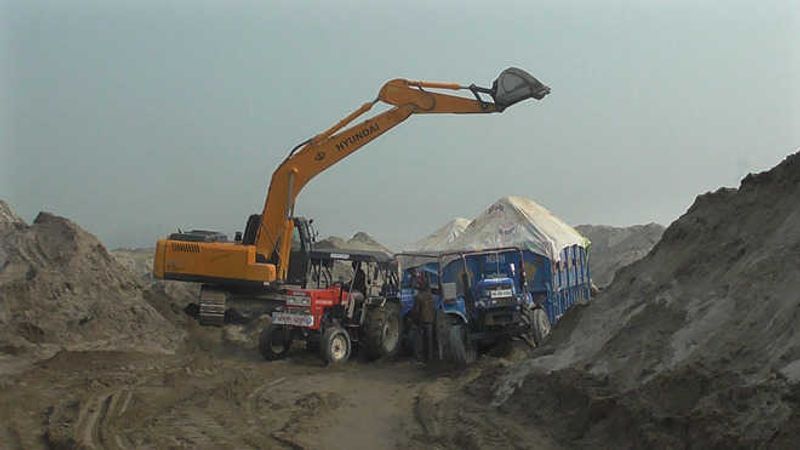

illegal mining has emerged as a focal point of environmental concern in Punjab following a series of strong orders by the National Green Tribunal (NGT), which has exposed how river desilting and hill mining slipped into large-scale commercial exploitation, bypassing mandatory environmental safeguards. In its February 17 order, the NGT stayed desilting work in rivers and seasonal rivulets across Punjab, including key sites in Ropar district, after observing that the exercise was being undertaken not merely for flood management but for commercial gain. The case arose from a petition challenging an auction notice issued by the Punjab Water Resources Department for desilting works, under which the excavated silt and sand were to be sold in the open market.For the Shivalik foothills and along the Sutlej and Beas, the implications of illegal mining are serious. Environmentalists have long warned that aggressive extraction of river material in this region destabilises riverbanks, increases erosion, and threatens agricultural land. The NGT noted that once desilting crosses into commercial extraction of minor minerals, it squarely attracts the requirement of prior environmental clearance under the Environment Impact Assessment (EIA) Notification, 2006.The NGT allowed the tender process to continue but restrained any actual desilting without its permission, effectively freezing physical activity on the ground. This interim protection is particularly relevant for Ropar, Hoshiarpur, Gurdaspur and Pathankot where repeated complaints have surfaced about the misuse of desilting as a cover for sand mining. These concerns mirror the findings of the Tribunal in the “Vanishing Hills” case, which also has strong Ropar linkages. Taking suo motu cognizance of a media report published in The Tribune, the NGT imposed environmental compensation of over Rs 180 crore on 13 stone crushers operating illegally in the Shivalik belt spanning across Khera Kalmor area of Ropar and Garshankar in Hoshiarpur. Several of these units are located in the sub-mountainous areas feeding directly into Ropar’s river systems.The Tribunal recorded that entire hillocks in the Bet and adjoining areas were flattened some by as much as 200 feet despite the Shivaliks being a notified eco-sensitive zone and Punjab’s most critical groundwater recharge area. For Ropar, Hoshiarpur, Gurdaspur and Pathankot districts, which frequently face flooding during the monsoon, the destruction of these natural buffers has direct consequences. The hills slow down runoff and their removal accelerates water flow into the plains, heightening flood risks along the Sutlej and its tributaries.In sharp words, the NGT criticised regulatory authorities for failing to identify violators in initial reports. Only after sustained judicial scrutiny were 13 stone crushing units named and ordered shut, with the Punjab Pollution Control Board (PPCB) directed to recover compensation, pursue criminal cases and verify raw material sources of other crushers in the Ropar belt.What connects the desilting stay and the crusher closures is the Tribunal’s emphasis on intent and impact. In both cases, activities presented as development-oriented flood control on one hand and industrial activity on the other were found to have morphed into profit-driven extraction with severe ecological fallout. For the people affected, these orders validate long-standing grievances that illegal mining in the Shivaliks and riverbeds has continued unchecked for years, despite court bans and policy safeguards. The NGT has now made it clear that administrative labels will not shield environmentally destructive practices from legal scrutiny.The coming months will be crucial. The Tribunal has sought compliance reports by May 2026, including details of penalty recovery and enforcement on the ground. If implemented sincerely, the orders could mark a turning point for Punjab restoring balance between development needs and ecological limits.The state government earns royalty of Rs 300 to Rs 350 from the mining in the state. However, experts estimated that the material being excavated was worth thousands of crores. AAP during the 2022 Assembly election had claimed that they would earn about Rs 20,000 crore from mining in the state.Now that four years have passed, earnings from mining has not increased but the illegal mining continues at same pace.