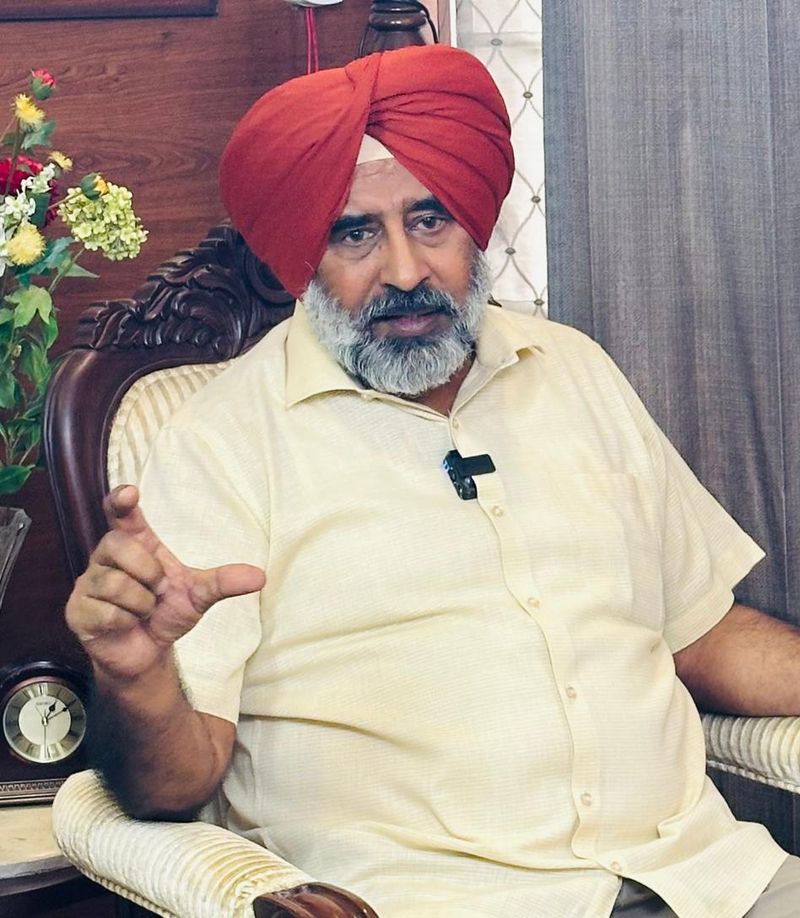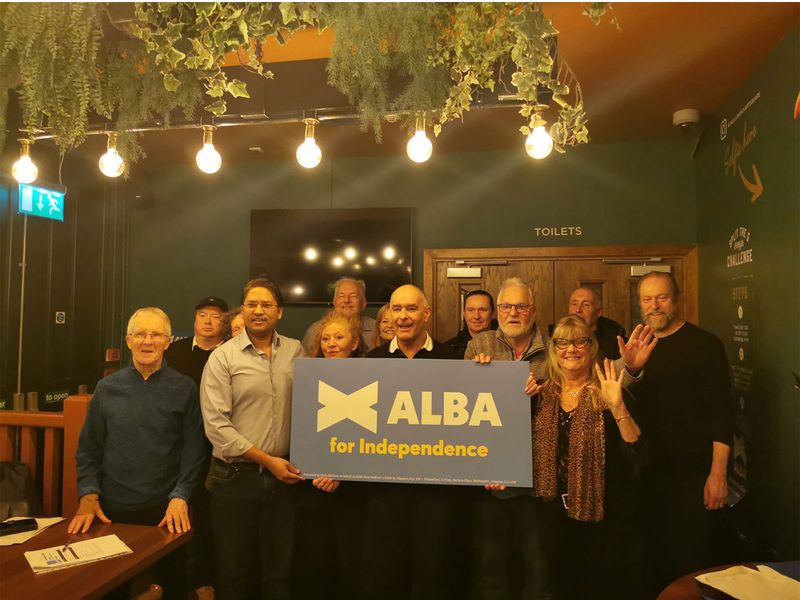

New Delhi [India] March 11 (ANI): Despite the dissolution of the Alba Party, the push for Scottish independence remains a central theme for some candidates. Dhruva Kumar, who is contesting the Glasgow Region, has pledged to continue his campaign under the newly formed Alliance to Liberate Scotland banner.In an interview with ANI, Alba Party spokesperson and parliamentary candidate for Glasgow South, Dhruva Kumar, said that the debate around Scottish independence has shifted from a theoretical aspiration to a practical necessity in a post-Brexit world.Depute Convenor Kumar emphasised that the wider independence movement remains his priority. He argued that Scotland, an energy-rich nation, should have democratic control over its resources.He said, “I remain fully committed to the eternal cause of Scottish independence and am therefore contesting the Holyrood election in the Glasgow Region under the broader Alliance to Liberate Scotland umbrella. For me, Scotland as a country comes first; this is about far more than party labels. Scotland is one of the wealthiest countries and an energy-rich nation where ordinary families are trapped in a cost-of-living and energy-bills crisis. Independence, democratic control of our resources and a fair economic settlement for working people are the priorities I am taking to the voters in Glasgow.”As the 2026 Scottish Parliament election approaches on May 7, the political landscape is undergoing a significant transformation. The Alba Party, established in 2021 by the late former First Minister Alex Salmond, has officially announced it will wind up operations and will not field candidates in the upcoming election.The decision comes amid mounting financial pressures and an ongoing investigation by Police Scotland into the party’s finances, which has been active since May 2025.Kumar added that he would contest the Glasgow region seat in the Holyrood (Scottish Parliament) election under the Alliance to Liberate Scotland banner.The party has faced mounting challenges in recent months, including a sharp fall in membership and financial difficulties. Kenny MacAskill, who succeeded Salmond as leader after he died in 2024, said the decision to wind up the party was taken by its national executive committee.MacAskill added that the Electoral Commission had advised that, given Alba’s financial position, it should either voluntarily de-register or face statutory de-registration.The party has also been under scrutiny as Police Scotland investigates alleged irregularities in its finances since May.On May 7, 2026, voters in Scotland will elect 129 Members of the Scottish Parliament (MSPs) in the Scottish parliamentary election.Furthermore, Alba Party MP Kumar argued Brexit has transformed the independence debate into a practical economic imperative, offering a clear alternative: rejoin Europe while protecting UK trade. He advocates for a Scottish-first industrial strategy, leveraging North Sea resources and Scotland’s location in Northwest Europe.Kumar said, “Post Brexit, the most important change is that the economic status quo no longer exists, Scotland was taken out of the EU against its democratic will, and that has fundamentally reshaped the case for independence. An independent Scotland now has a realistic choice between staying tied to a Brexit Britain with weaker growth and lower investment, or building a different model that reconnects us to Europe while protecting our trade with the rest of the UK.”Kumar highlights Scotland’s strengths in energy, food, drink, and renewables, which have been hindered by Westminster’s hard Brexit. He advocates for a Scottish-first industrial strategy, leveraging North Sea resources and Scotland’s location in Northwest Europe.Kumar said, “You see the divergence is in GDP charts, and also in lived experience, Scotland’s export strengths in energy, food, drink, universities and renewables, innovations, manufacturing, Oil& Gas have been held back by a Westminster-driven hard Brexit we did not vote for. At the same time, Holyrood is constantly told to manage decline with a shrinking block grant, instead of being allowed to grow the economy with the full toolbox of a normal independent country.”He proposed a Scottish-first approach, harnessing energy, food, drink, and renewables to drive growth.”So the argument for independence has become less theoretical and more practical. It is no longer ‘would independence be nice one day?’ but ‘what is the credible route back to prosperity and democratic control in a post Brexit world?’ For me, that route is a Scottish first industrial strategy, backed by independence, that harnesses our resources in the North Sea, our great Scottish people and our location in North West Europe,” Kumar added.Notably, when Scotland held a referendum in 2014, voters rejected the prospect of independence by 55 per cent to 45 per cent – but the political landscape then changed, mostly because of Brexit.Brexit refers to the United Kingdom’s withdrawal from the European Union, which officially took effect in 2020. Brexit is a combination of ‘Britain’ and ‘exit.’A majority of people in Scotland voted to remain in the European Union in the 2016 Brexit referendum, and the Scottish National Party (SNP) successfully used Brexit as a wedge issue, arguing that Scots were dragged out of the EU against their will.Alba Party’s Kumar acknowledges that the rising cost of living in Scotland’s Central Belt is exacerbating anti-immigration sentiments, as struggling families look for scapegoats amidst economic pressure. He emphasised that it’s not inherent prejudice, but rather the result of failed economic policies and underinvestment in communities.Kumar said, “When people cannot heat their homes, when mortgages and rents are spiralling, anger always looks for an easy target, and too often that target is migrants. In parts of the Central Belt, you can sense attitudes tightening, not because people are inherently prejudiced, but because they are under real pressure while Westminster has spent years pushing a narrative that blames migrants instead of owning up to failed economic policies and underinvestment in communities.”He stresses that Scotland remains welcoming and committed to integrating migrants, citing his own success story as proof of the country’s openness.”At the same time, Scotland as a nation remains deeply welcoming and committed to integrating those who come here to contribute, and my own success story is living proof of just how open, generous and opportunity-giving Scotland truly is. Immigrants did not design the energy market, they did not sign off on austerity, they did not profit from privatisation, but they are part of the workforce keeping our NHS, care homes, logistics and universities alive,” Kumar added.Kumar highlights ALBA’s distinct approach, advocating for targeted economic measures, a social energy tariff, publicly-led housebuilding, and using oil and gas revenues for industrial transition.ALBA’s stance differs from SNP’s cautious approach, with Kumar emphasising the need for radical measures to address Scotland’s economic challenges and ensure migrants contribute to the country’s growth.Kumar stated, “What makes ALBA different from the SNP is that we are willing to say two things at once, very clearly. First, Scotland needs migration, especially from communities like mine, to support a growing population, fill vital jobs and enrich our society. Second, we need targeted, radical economic measures that go beyond the SNP’s cautious incrementalism: a social energy tariff so low income households pay less per unit than the rich, an expanded programme of publicly-led housebuilding instead of relying on speculative developers, and using Scotland’s remaining oil and gas to fund a real industrial transition, not just warm words. Independence is the goal, but people in Glasgow also need to feel a material difference in their bills and their rent in the here and now.”Dhruva Kumar acknowledges the potential for Donald Trump’s Scottish heritage to be leveraged by nationalists, but emphasizes caution, particularly among Scots of colour. However, he distances the independence movement from Trump’s environmental record and tone on minorities.Instead, he advocates focusing on Scotland’s lived reality, a greener, richer, fairer Scotland that’s multi-ethnic, outward-looking, and climate-responsible.”As Scots of colour, we are always very cautious about turning anyone’s ethnic or religious background into a crude political weapon. At the same time, it is a simple fact that Scotland’s success story, including the story of people of all heritages, is not identical to England’s. That cultural divergence is real and growing, and it does feed the argument that decisions about Scotland should be made in Scotland. Donald Trump’s Scottish roots are often invoked symbolically, but for most people here, his environmental record, his climate denial and his tone on minorities are not welcomed, no more relevant than his mother’s birthplace. I do not believe we should build a modern independence movement on the nostalgia of any one family narrative. We should build it on the lived reality of a greener, richer, fairer Scotland that looks like the Glasgow streets I walk every day, multi ethnic, outward-looking and serious about climate responsibility,” Kumar added.Regarding Scotland’s North Sea energy resources, Kumar outlines a pragmatic approach to balancing economic and environmental concerns. Kumar argues that Scotland will use oil and gas for decades; the question is whether it’s produced under tough climate conditions or imported from regimes with weaker standards. A Scotland-first approach retains jobs, skills, and tax revenue, channelling funds into renewables, housing, and transition initiatives.”ALBA’s position is straightforward: the North Sea is still a national asset, and shutting it down prematurely while we are still importing higher carbon fuels is economic and environmental nonsense. We back new licences only where they are tied to strict net zero obligations and serious investment in carbon capture and storage, using the unique geology of the North Sea to store emissions and accelerate the transition.””That does create tension with some strands of ‘just stop oil’ rhetoric, but I think the honest position is this: Scotland will still use oil and gas for decades; the question is whether we produce it under some of the toughest climate conditions in the world, or offload our conscience by importing it from regimes with weaker standards. A Scotland-first approach keeps the jobs, the skills and the tax base here, and channels a defined share of that revenue into a national transition fund for renewables, public housing, transport and retrofitting.”Independent estimates suggest responsible North Sea management, combined with offshore wind, can boost Holyrood’s budgets, smoothing independence’s early years.”On revenue, independent estimates show that responsibly managing remaining North Sea production, combined with a serious push on offshore wind and other renewables, can provide a substantial but time-limited boost to Holyrood’s budgets, enough to smooth the early years of independence if we ring-fence it and do not repeat the UK mistake of treating it as a political slush fund. The precise figure depends on future prices and licence conditions, but the principle is clear: use the last decades of hydrocarbons to capitalise the first decades of a green Scottish state,” Kumar said, emphasising a time-limited, ring-fenced approach.Speaking as West Asia tensions escalate, Kumar condemns the US-Israel assassination of Iran’s Supreme Leader Khamenei and nuclear facility strikes, citing concerns about international law and collective security. ALBA advocates for a foreign policy based on the UN Charter, dialogue, and nuclear disarmament.Kumar said, “A scepticism towards the foreign policy consensus that took Britain into Iraq in 2003, and that scepticism has only deepened as we have watched the consequences in the wider region. Targeted assassinations and unilateral strikes on nuclear facilities, whether by the US, Israel or anyone else, take us further away from international law and collective security, and closer to a world where the strongest state sets the rules.”He added, “The killing of Iran’s Supreme Leader and the strikes on nuclear sites raise grave questions about legality, proportionality, care for humanity and long-term stability. It is entirely possible to condemn the human rights record of the Iranian regime, to stand firmly against terrorism and antisemitism, and still say that this pattern of extra-territorial violence is wrong and dangerous. In that sense, yes, there are uncomfortable echoes of 2003: intelligence claims we cannot properly scrutinise, limited parliamentary oversight, and a rush to military action without a credible diplomatic endgame.”He linked Scotland’s self-determination push to energy security, immigration pressures and foreign policy independence. Kumar supports Holyrood resolutions condemning breaches of international law, calling for de-escalation, and reaffirming Scotland’s opposition to nuclear weapons.”In an independent Scotland, I would want us to break decisively from automatic alignment with Washington or London. That does not mean being “anti-American” or indifferent to security threats; it means building a foreign policy based on the UN Charter, on dialogue, on nuclear disarmament and on consistent support for international law from Gaza to Kyiv to Tehran. At Holyrood level, even under devolution, I would support resolutions that condemn any actions that breach international law, whoever commits them. We call for an immediate de-escalation, return to diplomacy and reinstatement of nuclear inspections. We reaffirm Scotland’s opposition to hosting nuclear weapons on the Clyde and our desire for a humanitarian, law-based international order,” the Alba candidate stated.Scots will head to the polls on Thursday, May 7, to elect 129 MSPs (Members of the Scottish Parliament). The count and declaration of results will take place on Friday, May 8, according to the Scottish daily express.73 MSPs are directly elected by their constituencies, while the remaining 56 represent one of eight multi-member regions. (ANI)(This content is sourced from a syndicated feed and is published as received. The Tribune assumes no responsibility or liability for its accuracy, completeness, or content.)