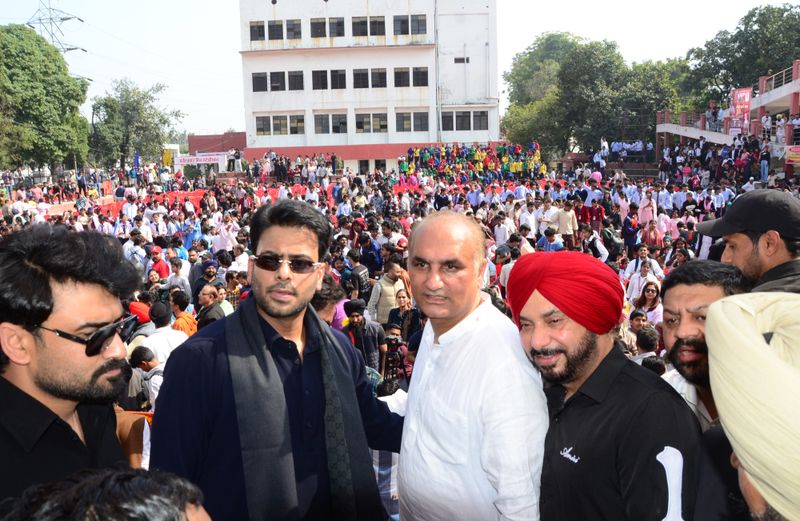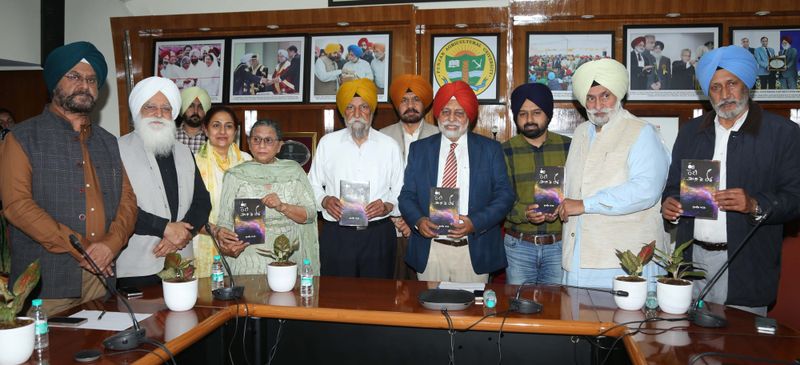

The literary and academic fraternity of Punjab recently gathered in solemn remembrance at Punjab Agricultural University, Ludhiana, for the posthumous release of the poetic work of eminent Punjabi poet and Padma Shri awardee Dr Surjit Patar.The book, ‘Rabb Roti Bhasha Te Raag’, was unveiled at an event held in a university committee room, drawing scholars, students, writers and admirers, who came to celebrate a voice that carved modern Punjabi literary consciousness.The university, where Dr Patar served for decades as a Professor of Punjabi before retiring in 2004, remained central to his intellectual journey.His association with the campus modelled generations of students, who encountered in him not only a teacher but a cultural guide who carried Punjab’s literary inheritance into contemporary discourse.The event, thus, unfolded not as a formal launch, but as a return of the poet to an institution that had long been one of his intellectual homes.Offering a reflective perspective, economist and former Chancellor of Central University of Punjab, Dr Sardara Singh Johl, highlighted the rare synthesis Dr Patar achieved between scholarship and sensitivity to the soil of Punjab.He spoke about the poet’s ability to interpret social realities through lyrical expression and recalled how his writings documented changing rural landscapes, ethical dilemmas and collective memory with remarkable restraint and depth.The academic legacy of Dr Patar found resonance in the address delivered by PAU Vice-Chancellor Satbir Singh Gosal, who underlined the enduring bond between the poet and the university.He said Dr Patar’s presence enriched the humanities within an institution primarily known for agricultural sciences, demonstrating that cultural literacy and scientific inquiry must grow together.His contribution, he opined, strengthened the intellectual fabric of the university and reinforced Punjabi language studies at a crucial time.A deeply personal note was struck by Bhupinder Kaur, Dr Patar’s wife.She spoke about the emotional journey behind bringing the manuscript to publication. She recited a few lines from the book, allowing listeners to experience the familiar cadence and contemplative depth that defined his poetry. Dr Patar’s son, Manraj Patar, said the collection represented the distilled essence of Dr Patar’s lifetime of observation and reflection, weaving together three essential dimensions of human existence: spirituality represented by Rabb (God), the struggle for sustenance symbolised by roti (food), and the aesthetic and emotional resonance of raag (melody).The programme was organised under the guidance of Dr Nirmal Jaura, PAU’s Director of Students’ Welfare, who reflected on Dr Patar’s lifelong engagement with students and young writers.He said Dr Patar believed literature must remain accessible and dialogic, encouraging questioning minds rather than prescribing conclusions.The event, he added, was conceived as an extension of that very ethos, by placing the poet’s final work directly before the academic community he cherished.As highlighted during the discussion, the collection stands apart not only as a literary work but as a final remembrance. Each poem carries the recognisable fragrance of Dr Patar’s language, inviting readers to pause, introspect and reconsider the relationship between faith, livelihood and artistic expression.The verses confront moral dilemmas, cultural transitions and the anxieties of a changing Punjab with remarkable simplicity, demonstrating the poet’s ability to articulate complex truths through restrained imagery. Eminent Punjabi litterateurs — including Gurbhajan Singh Gill, Amarjeet S Grewal and Swaranjit Savi — enriched the exchange with reflective insights on the relevance of Dr Patar’s thought in contemporary times, while Vishal Bector, Associate Director (Institution Relations), conducted the session with clarity and cohesion.Born in Pattar Kalan in 1945, Dr Surjit Patar spent more than six decades shaping Punjabi poetry with a voice that was introspective and socially alert.The release of the collection echoes that, while the poet is no longer physically present, his reflections on spirituality, sustenance and song continue to speak to a society still searching for balance among them.