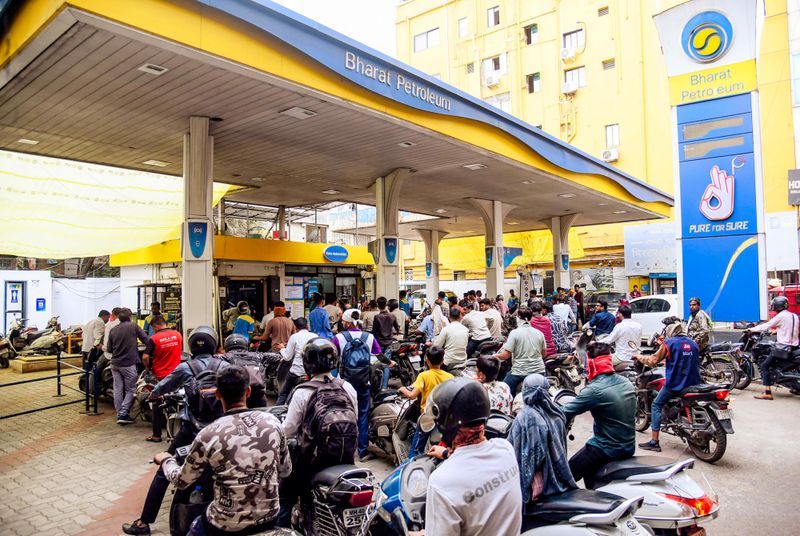

As global crude oil prices peaked on Friday, the government moved to shield domestic consumers from adverse effects of the surge by slashing excise duty on petrol and diesel by Rs 10 each and slapping windfall tax on the export of fuels. The prices of petrol and diesel remain unchanged in the domestic market.Dismissing lockdown rumours, Finance Minister Nirmala Sitharaman said in Parliament today, “There is a lockdown in Pakistan, not in India. Also, there is no scope of a lockdown in India.”As a cumulative impact of the twin moves by the Finance Ministry, which issued a related notification on excise duty cuts and export tax on fuels, prices of petrol and diesel remain unchanged in the domestic market and there is no price rise despite global crude oil prices soaring from $70 a barrel to $122 a barrel — a near 50 per cent increase in a month.Special additional excise duty on petrol was today reduced from Rs 13 to Rs 3 a litre and on diesel from Rs 10 to nil, with Petroleum Minister Hardeep Puri announcing the government decision to absorb the shock of the global crude oil cost surge.”Instead of passing the burden to the people, the government has chosen to absorb a loss of Rs 24 per litre on petrol and Rs 30 a litre on diesel on the count of global crude cost escalation,” Puri said as the West Asia conflict and disruptions in the Strait of Hormuz played havoc with global oil markets.Overall, the government will lose Rs 700 crore in revenue over a fortnight due to excise cuts on fuel. From the windfall tax on the export of fuel, the government will get Rs 1,500 crore over the same period.FM Sitharaman said duties had been imposed on exports of diesel at ₹21.5 per litre and on aviation turbine fuel (ATF) at ₹29.5 per litre to ensure adequate availability of these products for domestic consumption.The notification by the Department of Revenue withdrew tax rebate and duty exemption benefits on exports of petrol, high-speed diesel and ATF, amending the Central Excise Rules, 2017, with immediate effect.Notably, the government has carved out a specific exemption for public sector oil companies exporting these three fuels to Nepal, Bhutan, Bangladesh and Sri Lanka. State-owned oil companies supplying fuel to these four neighbouring countries will continue to operate under the earlier tax regime and will not be hit by the withdrawal of benefits.Meanwhile, excise cuts and export tax were levied immediately without any transition window to ensure fuel prices do not rise.Sitharaman, later, told the Rajya Sabha that Brent crude had not dropped below $100 since March 13.”Consequently, petrol and diesel prices for consumers have gone up all over the world — by 30 to 50 per cent in Southeast Asian nations, 30 per cent in North America, 20 per cent in Europe, 50 per cent in African countries….But we are carefully managing because the PM’s one single guidance is there should be no burden on the citizen,” she said.Explaining the twin moves, the FM said the government had issued a notification cutting petrol excise duty from Rs 13 to 3 per litre and removing the duty on diesel entirely.”There is no waiting period or phased rollout. Petrol and diesel retail prices in India remain unchanged. We are making sure people do not suffer and are taking a hit on our taxation revenues. Simultaneously, export tax has been levied. Any refinery in India exporting to foreign countries will now have to pay this export tax to the government. They can make money on exports but, must in this time of crisis, first make fuel available for India,” she said.The FM also assured Parliament that the government would find a way to ensure a fiscal deficit target of 4.3 per cent in 2026-27 despite excise cuts today.”We shall be on our toes,” she said, informing the House that in Pakistan petrol was selling for Pakistani Rs 321 a litre.”Smart lockdowns have been imposed in Sindh to conserve fuel; schools have been shut for two weeks,” the FM said, adding that all universities in Bangladesh had been shifted online to save energy and Dhaka was witnessing five-hour rotational power cuts.”There are rumours about lockdowns in India. There is no scope of lockdown in India,” she said, adding that India is maintaining a level of stability and appealing to people to stay united.Meanwhile, the government on Friday issued a fresh order allocating 20 per cent extra commercial LPG to states for delivery to labour-intensive industries, including steel, automobile and dyes.With this, the Centre through oil marketing companies, will allocate a total of 70 per cent of monthly commercial LPG requirements to states.The order was communicated to chief secretaries by Petroleum Secretary Neeraj Mittal.The letter said allocations would be conditional to additional LPG being given to industries with priority to steel, automobile, textile, dye, chemicals and plastics, all labour-intensive sectors.