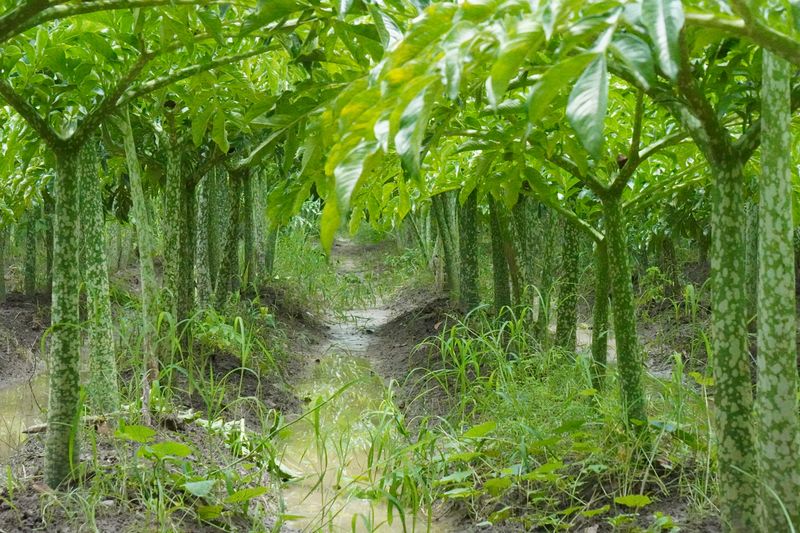
Agroforestry, a sustainable land management system that integrates trees with crops or livestock on the same land unit, serves as a crucial nature-based solution to climate change, yet the practice has few takers in the country.Despite its potential for climate resilience and rural income, less than five per cent 5 of agricultural credit supports agroforestry. Limited awareness among farmers about the National Agroforestry Policy-2014, particularly regarding harvesting rights and regulatory clearances, continues to restrict wider adoption and income generation.Speaking during the Treescapes-2026 Congress organised by the CIFOR-ICRAF (Center for International Forestry Research (CIFOR) and the International Centre for Research in Agroforestry (ICRAF)) in the Capital recently, ML Jat, Director General (DG) of the Indian Council of Agricultural Research (ICAR), underlined India’s efforts in doubling its agroforestry area from 28 million hectares to 50 million hectares by 2050 to enhance climate resilience, increase farmer income and meet rising timber demands.“Agroforestry has helped reduce deforestation and avoid tens of millions of tonnes of greenhouse gas emissions annually, while supporting rural livelihoods. We saw how this practice reaped benefits in western Rajasthan with an increased forest cover. At present, six states have formulated their agroforestry policies. We are confident of scaling it up further,” he said.Talking to The Tribune, Nepal Agriculture Minister Madan Prasad Pariyar said agroforestry was picking up pace in the Himalayan nation as well.“Nepal enacted its agroforestry policy in 2019. Earlier, farmers used to face many hurdles in selling their harvest. But under this new policy, 28 species grown in farms are exempted from the forest law. The move has now facilitated plantation of trees, increased farmer incomes, and optimal usage of uplands not suitable for crop cultivation,” he said, adding that the cultivation of fruit trees has also gone up under the policy.“Agroforestry provides inter-cropping opportunities, crop diversification as well as adds new income opportunities for farmers. It is high time governments across the world wake up to this idea, especially if they wish to promote climate-resilient agriculture,” he added.Ravi Prabhu, Director of Innovation, Investment and Impact, CIFOR-ICRAF, said agroforestry was a “very 21st century view” of using landscapes rather than a single-use perspective. He said today there were tools to map trees and one can even approach banks to get loans.“In poorer areas, agroforestry can contribute to the nutritional needs of the mother and child. States like Andhra Pradesh and Telangana have moved to the stage where they are creating assets in the sector. Farmers are planning their landscape now with a mix of horticultural crops, timber, oils and biomaterials.“In Madhya Pradesh, for instance, different types of credit are offered to farmers involved in agroforestry. There is also a thrust on high-value crops as small and marginal farmers cannot get out of poverty, if they only grow cereals,” he added.Prabhu, however, said the government needed to come up with sturdy measures to popularise the practice. “Knowledge, awareness and governance are the three keys missing in the country when it comes to scaling up agroforestry. We need to build a robust digital ecosystem where farmers can get the information regarding the soil property, nearest nursery, best quality seeds or fertilizers, in their smartphones in their local languages,” he added.