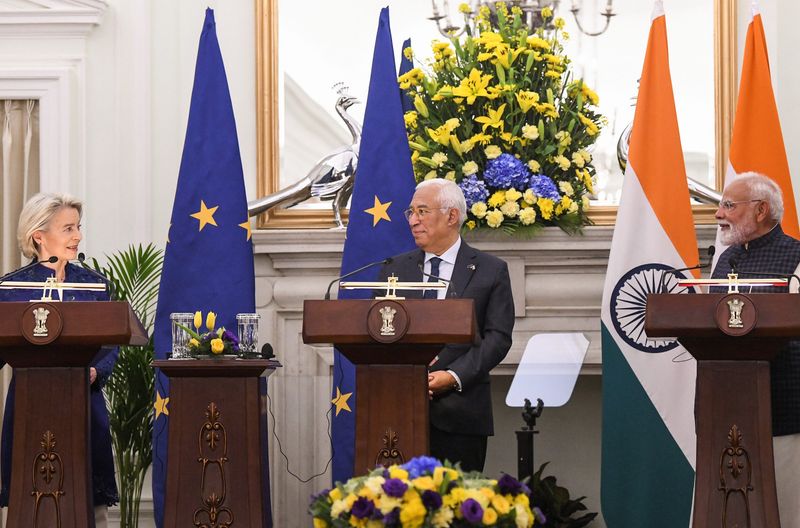

AS wars, sanctions and strategic rivalries redraw global trade routes, India and the European Union have moved to lock in a long-delayed Free Trade Agreement (FTA) that goes well beyond commerce.The deal reflects a shared geopolitical calculation: to reduce economic vulnerabilities, secure supply chains and deepen cooperation between two major democratic economies at a time of global uncertainty.For India, the agreement opens the door wider to one of the world’s richest consumer markets. For the EU, it strengthens economic engagement with a fast-growing economy while reducing excessive dependence on China. Together, the FTA signals a strategic convergence shaped as much by geopolitics as by trade.What the FTA coversThe India-EU FTA is a comprehensive pact covering trade in goods and services, investment, regulatory cooperation, and sustainability-related commitments. It will govern trade between India and the 27-member European Union, creating one of the largest integrated trade frameworks globally.The EU is already India’s largest trading partner, with bilateral trade in goods and services exceeding $180 billion. The agreement aims to make this trade smoother and more predictable by cutting import duties, easing regulatory barriers and setting clearer rules for businesses on both sides.The deal comes at a moment when geopolitics increasingly drives trade policy. The Russia-Ukraine war, sharpening US-China rivalry and repeated supply-chain disruptions have forced economies to reassess strategic dependencies.Europe is pursuing a “de-risking” strategy to reduce reliance on China, particularly in manufacturing, technology, and clean-energy supply chains. India, meanwhile, is positioning itself as a trusted production and services hub under initiatives such as “Make in India” and “China-plus-one”. In this context, the FTA acts as a strategic hedge for both sides.How India stands to gainThe most significant gains lie in improved access to the European Union market for labour-intensive and export-driven sectors.According to official estimates, the EU has committed to immediate duty-free access on over 70 per cent of tariff lines, covering more than 90 per cent of India’s current export value to the bloc. An additional 20 per cent of products will see tariffs phased out over time, taking the overall coverage close to 97 per cent of tariff lines and nearly the entire trade value.Indian exports such as textiles and garments, leather goods, footwear, engineering products, auto components, pharmaceuticals and marine products are expected to benefit from sharp tariff cuts and, in many cases, complete removal of EU import duties, either immediately or over a transition period.Services are another major area of interest. India has secured commercially meaningful commitments across around 144 services sub-sectors, including IT and IT-enabled services, professional services and education-related services.The agreement also improves predictability for Indian professionals and service suppliers by setting clear rules for temporary entry and stay, including business visitors, contractual service suppliers and intra-corporate transferees.What EU gets in returnThe agreement unlocks deeper access to the Indian market, which remains relatively protected in several sectors.India has offered immediate duty-free access on just under half of its tariff lines, covering about 30 per cent of EU export value, with a further nearly 40 per cent of tariff lines to be liberalised gradually over 5, 7 or 10 years. This phased approach allows the Indian industry time to adjust while signalling a clear commitment to market opening.European exporters are particularly keen on automobiles and auto components, wines and spirits, high-end machinery, medical devices and chemicals. The pact also provides greater regulatory certainty and investment protection for European companies planning long-term operations in India.Sustainability, sensitive sectorsBeyond tariffs, the FTA addresses non-tariff barriers through regulatory cooperation. Differences in standards and certification often act as hidden trade barriers, especially for Indian MSMEs. The agreement includes provisions to improve transparency, streamline procedures and promote cooperation on technical standards and food safety norms. Where feasible, mutual recognition of conformity assessments could reduce compliance costs and delays for Indian exporters entering the EU market.Sustainability was among the most sensitive negotiation points. The EU pushed for commitments on labour and environmental standards, while India cautioned against “green protectionism”. The issue is closely linked to the EU’s Carbon Border Adjustment Mechanism (CBAM), which could raise costs for carbon-intensive exports. While the FTA does not override CBAM, it creates a framework for dialogue and cooperation.Sensitive sectors have been protected on both sides. India has drawn firm red lines around agriculture and dairy, while automobiles will see gradual tariff reductions with long transition periods.The EU, for its part, has excluded several agricultural products such as meat, dairy, rice and sugar from tariff concessions.Strategic implicationsThe FTA elevates India-EU relations to a higher plane. It complements India’s trade engagements with the UK, EFTA, and Gulf partners, and strengthens Europe’s economic footprint in the Indo-Pacific.The agreement will now undergo legal review and ratification in India and across EU member states, followed by phased implementation.Its success will ultimately depend on domestic reforms and effective execution. If delivered well, the India-EU FTA could emerge as one of India’s most consequential trade agreements — economically significant and geopolitically timely.