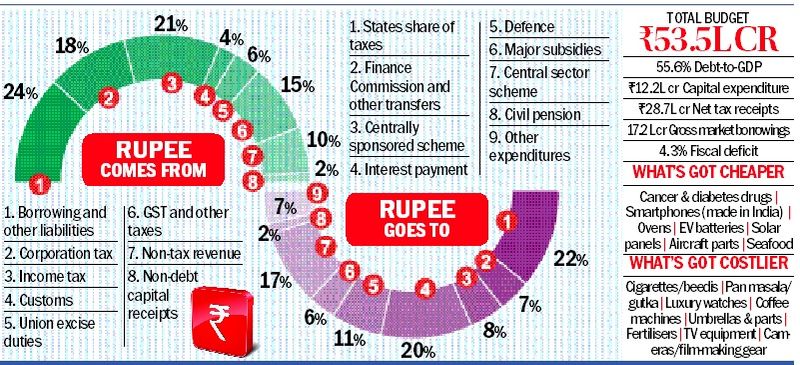

Amid global economic headwinds and uncertainties, Finance Minister Nirmala Sitharaman stayed the course of reforms in the Union Budget 2026-27, making allocations to boost growth, domestic manufacturing capacities and Indian export potential.Betting big on public spending in trends that have held over the past few years of the NDA government, Sitharaman raised the capital expenditure allocation to Rs 12.2 lakh crore in today’s budget, up from Rs 11.2 lakh crore last year.Among other big-ticket announcements were Rs 40,000 crore for electronics manufacturing, up from the 2025-26 outlay of Rs 22,919 crore, and Rs 10,000-crore Biopharma mission to develop India as a hub of domestic manufacturing of biologics and biosimilars.Though some poll-bound states found a mention in Sitharaman’s speech, she steered clear of populist announcements, walking the path of fiscal consolidation.The Rs 53.5 lakh crore Union Budget set the target of reducing the debt-to-GDP ratio from the current 56.1 per cent to 55.6 per cent next year and the fiscal deficit from 4.4 per cent to 4.3 per cent. Borrowings of Rs 17.2 lakh crore from the bond markets are planned.As soon as the Budget was unveiled, markets were rattled over a raise in the securities transaction tax on equity derivatives. Major indices fell around 2 per cent in the special Budget-day trading session before recovering somewhat.Amid frequent applause from Prime Minister Narendra Modi and other Cabinet colleagues, Sitharaman said it was a budget for a “self-reliant, confident India”, adding that “this is the first Budget prepared in Kartavya Bhavan”. The Finance Ministry had moved to India’s own new government office complex last year after vacating the colonial-era secretariat buildings British architect Herbert Baker designed in the early 1900s to meet the governance needs of the British Raj.“Our government’s ‘sankalp’ is to focus on the poor, underprivileged and the disadvantaged. To deliver on this sankalp, and given that this is the first Budget prepared in Kartavya Bhawan, we are inspired by three kartavyas,” the FM said, listing three duties — accelerate and sustain economic growth; fulfil aspirations of people; and ensure access of basic services to all.The FM listed the following requirements to keep the three promises — sustain the momentum of structural reforms; ensure a resilient financial sector to mobilise savings; allocate capital efficiently and manage risks; and rely on cutting-edge technologies, including AI applications, as force multipliers for better Delhigovernance.The Budget announced a massive push along six pillars, including manufacturing (biopharma mission, electronics, rare earth corridors, chemical parks and textile), revival of legacy industrial clusters and infra expansion powered by a mega capex push.The FM acknowledged that India continued to face an external environment in which trade and multilateralism were imperilled and access to resources and supply chains disrupted.“India will continue to take confident steps towards Viksit Bharat, balancing ambition with inclusion. As a growing economy with expanding trade and capital needs, India must also remain deeply integrated with global markets, exporting more and attracting stable long-term investment,” she said, explaining the Budget rationale.Besides a 20-year tax holiday for overseas firms providing global data centre services from India, along with a 15 per cent safe harbour on costs for data centre services provided by related entities of foreign cloud firms, the Budget made many other big announcements.These included exemption of basic customs duty on 17 cancer drugs and import duty exemptions for seven rare diseases.In a first, the FM made a mention of the need to develop a strong care economy and ecosystem.“A strong care ecosystem, covering geriatric and allied care services, will be built. In the coming year, 1.5 lakh caregivers will be trained,” she said, assuring of care services for India’s elderly.Among sectors, defence bagged a big push with Rs 7.85 lakh crore allocation, an increase of around 15 per cent over 2025-26. With Pakistan, China and Bangladesh posing a three-front security threat, the allocation is the first since Operation Sindoor.Tourism, health, agriculture and orange economy also figured prominently in the FM’s speech, with plans to unleash India’s domestic growth and export potential.Manufacturing remained at the core of the FM’s announcements with a proposal to launch India Semiconductor Mission 2.0 to produce equipment and materials, design full-stack Indian IP, and fortify supply chains with focus on industry-led research and training centres to develop technology and skilled workforce.The FM also announced a dedicated Rs 10,000-crore SME Growth Fund to create future champions, incentivising enterprises based on select criteria. Also, the Self-Reliant India Fund will get an additional Rs 2,000 crore to continue supporting micro enterprises and maintain their access to risk capital.For energy and highways, Sitharaman announced an outlay of Rs 20,000 crore over the next five years for carbon capture utilisation and storage technologies.She said the government would develop seven high-speed rail corridors between cities as “growth connectors” to promote environmentally sustainable passenger systems.The existing institutions for allied health professionals (AHPs) will be upgraded and new AHP institutions will be established in private and government sectors. Also, 1,00,000 AHPs will be added over the next five years. Moreover, five regional medical hubs are set to be established to promote India as a hub for medical tourism services.