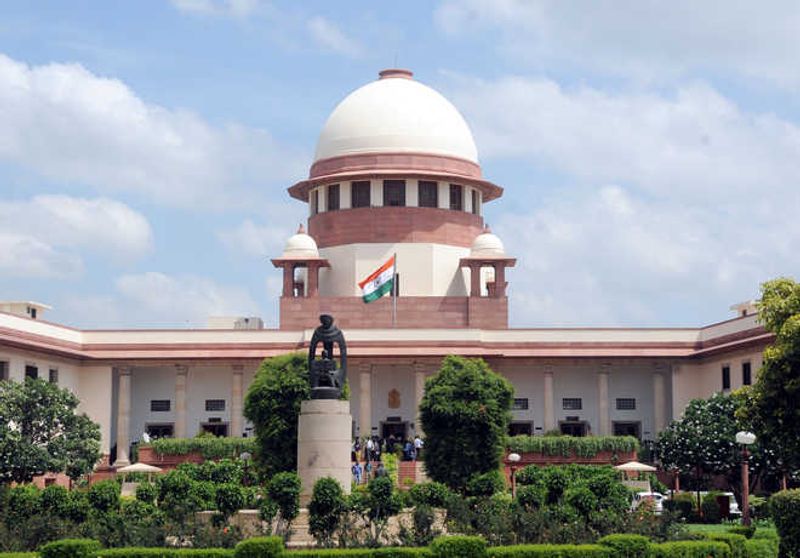

Asserting that religious faith was beyond the purview of judicial review, the Centre on Tuesday backed the age-old restriction on entry of women aged between 10-50 years into the famous Lord Ayyappa Temple at Sabarimala hilltop in Kerala.Opening arguments on behalf of the Centre before a nine-judge Constitution Bench led by Chief Justice of India Surya Kant, Solicitor General Tushar Mehta said if there was something unscientific in a religious practice, it was for the legislature to take remedial measures.Mehta cautioned the top court against exercising its jurisdiction to interpret any religion, saying there “is an inherent risk” involved in it. He also questioned the doctrine of “constitutional morality”, saying it was a vague political doctrine not defined in the Constitution.Urging the Bench to overturn the 2018 judgment and declare it a wrong law, the Solicitor General said, “It’s my case that it’s wrongly decided and deserves to be declared a wrong law.” He said, “We have to respect every (religious) denomination’s practice. If I go to a mazar or a gurdwara and if I have to cover my head, I can’t say my dignity, right or choice is taken away.”Noting that Lord Ayyappa temples all over the world were open to women, Mehta said Sabarimala Temple was a sui generis case (of its own kind). “The attributes of the deity (Lord Ayyappa) — a ‘Naishtika Brahmachari’ (an unfailing celibate) — cannot be judicially examined,” he contended.The Bench, which also included Justice BV Nagarathna, Justice MM Sundresh, Justice Ahsanuddin Amanullah, Justice Aravind Kumar, Justice Augustine George Masih, Justice Prasanna B Varale, Justice R Mahadevan and Justice Joymalya Bagchi, commenced hearing on petitions seeking review of the Supreme Court’s 2018 verdict that set aside the traditional restriction on the entry of women into the Sabarimala Temple.The top court is also examining discriminatory practices in other religions to lay down constitutional principles for determination of such issues.Justice Nagarathna questioned the application of Article 17 to women in the 2018 verdict, saying a woman could not be treated as untouchable for three days in a month and then she ceased to be considered untouchable on the fourth day.Her comments came after Mehta criticised the observation in the 2018 Sabarimala judgment that said the exclusion of women in the age group of 10-50 years from the temple was a form of “untouchability” and a violation of Article 17 of the Constitution that prohibited untouchability.“One opinion in Sabarimala says Article 17 applies to women… You are treating them as untouchables… I have very strong objections to it. India is not that patriarchal or gender stereotyped in the way that the West understands,” Mehta said.Justice Nagarathna, the lone woman on the Bench, suggested that the women members of the Constituent Assembly should be called “Founding Mothers”. As the hearing remained inconclusive, the arguments will resume on Wednesday.By a 4:1 verdict, a five-judge Constitution Bench led by the then CJI Dipak Misra had on September 28, 2018 allowed entry women, irrespective of their age, into the Lord Ayyappa’s temple at Sabarimala, overturning the age-old tradition that restricted the entry of women in the age group of 10-50 years.Justice Indu Malhotra, the lone woman judge on the Bench had delivered a dissenting verdict and supported the practice.While delivered its verdict on petitions seeking review of the 2018 verdict, the Supreme Court on November 14, 2019 enlarged the scope of case and referred to a seven-judge Bench seven issues of discriminatory practices in various religions. All these issues are now being examined by the nine-judge Constitution Bench.